
Disability tax credit eligibility: the tests the CRA applies
Short answer
Disability tax credit eligibility requires an impairment that has lasted or will last at least 12 continuous months and that markedly restricts a basic activity of daily living, needs life-sustaining therapy, or causes significant restrictions whose combined effect is equal to a marked one. A qualified medical practitioner must certify this on Form T2201.
- 01Minimum duration
- 12 continuous months, actual or expected
- 02Marked restriction standard
- Unable, or takes 3 times longer than a person of the same age
- 03How often the restriction must apply
- All or almost all of the time, generally at least 90%
- 04Life-sustaining therapy test
- At least 2 times a week and an average of 14 hours a week
- 05Areas the CRA assesses
- 8 daily activities plus life-sustaining therapy
What are the disability tax credit eligibility criteria?
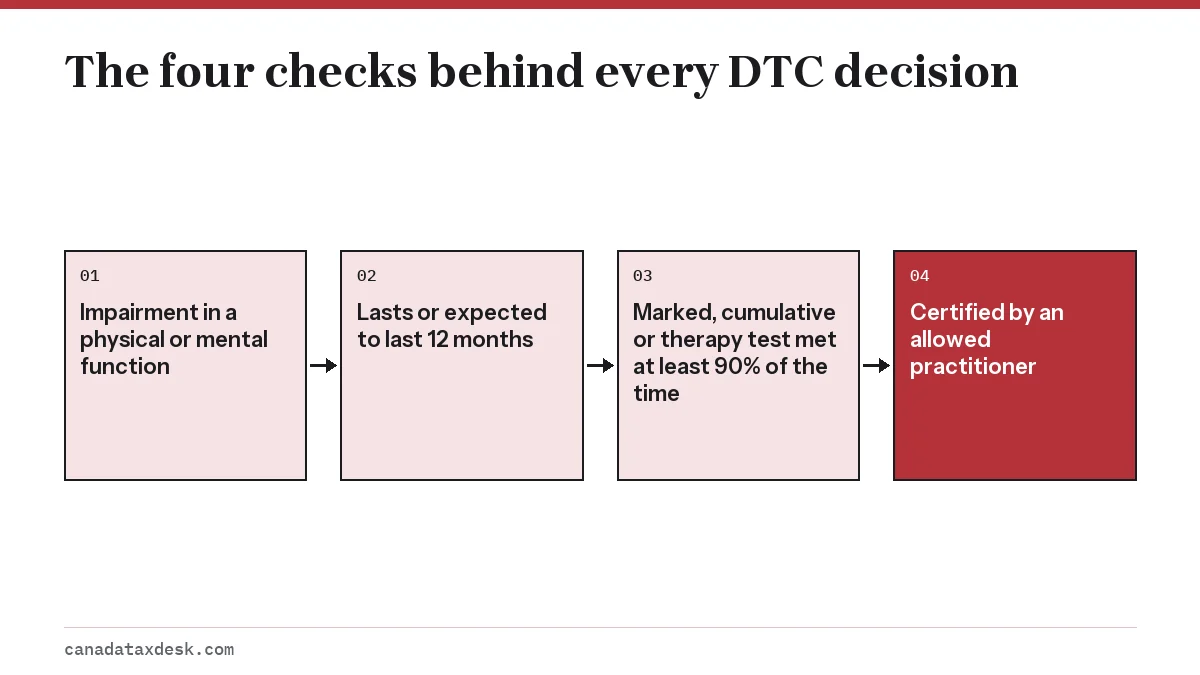
The CRA's disability tax credit eligibility test has three parts that must all be met: the impairment is severe, it is prolonged, and a medical practitioner who is allowed to assess that kind of impairment certifies both facts on Form T2201. Meeting two of the three is not enough.
Prolonged means the impairment has lasted, or is expected to last, for a continuous period of at least 12 months (CRA, Guide RC4064). Severe has a specific meaning: the effect on a basic activity must reach the marked or significant level described below.
Eligibility is a separate decision from the credit itself. Once you are approved, the amounts and how to claim them are covered on the disability tax credit overview.
Is there a disability tax credit eligibility list of conditions?
No. The CRA does not publish a list of qualifying diagnoses, and no condition qualifies by name alone. Guide RC4064 says eligibility is based on the effects of the impairment rather than solely on the medical condition.
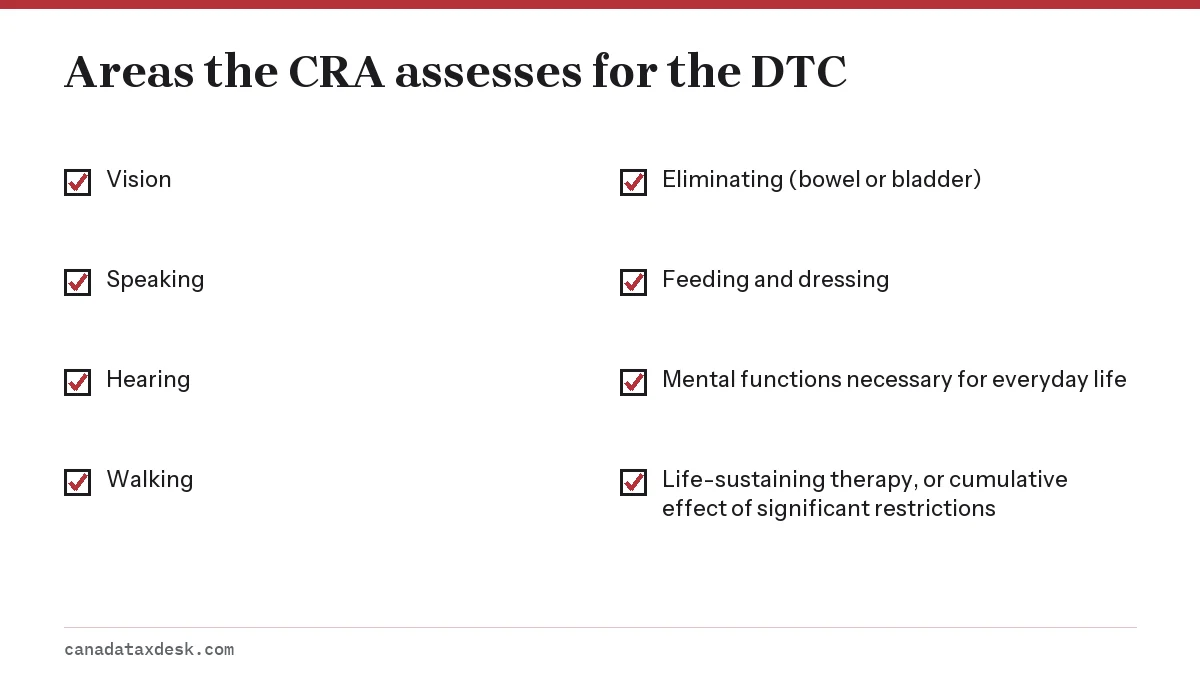
What the CRA does publish is a list of areas it assesses. These are the categories practitioners answer in Part B of the T2201:
Two people with the same diagnosis can get different decisions. One person with multiple sclerosis may walk short distances slowly on most days and not meet the walking test, while another may need three times longer to dress every morning and qualify under dressing.
What does markedly restricted mean for the DTC?
A person is markedly restricted when, even with appropriate therapy, medication and devices, they cannot do a basic activity of daily living, or it takes them 3 times longer than a person of similar age without the impairment. The restriction must be present all or almost all of the time, which the CRA treats as generally at least 90% of the time.
The 3 times benchmark is about the time the activity itself takes, not the time someone chooses to spend. If an average adult dresses in 5 minutes and you need 15 minutes or more almost every day because of joint pain and stiffness, that is the kind of fact the practitioner records.
Examples by category
| Category | What is assessed | Example of a marked restriction |
|---|---|---|
| Walking | Walking a short distance, such as 100 metres (about one city block) | Needs 3 times longer, with rests, or cannot walk the distance at all |
| Dressing | Finding, putting on and taking off clothing | Cannot manage buttons or footwear without taking 3 times longer |
| Feeding | Preparing food and feeding oneself | Cannot prepare a simple meal because of limited hand function |
| Eliminating | Bowel or bladder functions | Cannot personally manage these functions, or needs 3 times longer to do so |
| Hearing | Understanding speech in a quiet setting, with devices | Relies on lip reading or sign language even with hearing aids |
| Speaking | Being understood in a quiet setting | Cannot be understood by a familiar person, even with devices |
| Vision | Seeing, even with corrective lenses | Acuity of 20/200 or worse, or a field of vision of 20 degrees or less |
| Mental functions | Memory, attention, concentration, judgment, problem-solving, goal-setting, regulation of behaviour and emotions, and similar | Needs supervision or prompting to manage basic daily tasks |
The examples above are summaries for orientation. The exact wording of each test is in Part B of the current T2201 form, and the practitioner must answer those questions, not these summaries.
Who can certify each type of impairment?
Only certain practitioners can sign Part B, and each can only certify the areas within their field. A medical doctor or nurse practitioner can certify any category. Other professionals are limited, as the CRA sets out in RC4064 for 2025.
| Category | Who can certify |
|---|---|
| Vision | Medical doctor, nurse practitioner, optometrist |
| Speaking | Medical doctor, nurse practitioner, speech-language pathologist |
| Hearing | Medical doctor, nurse practitioner, audiologist |
| Walking | Medical doctor, nurse practitioner, occupational therapist, physiotherapist |
| Eliminating | Medical doctor, nurse practitioner |
| Feeding, dressing | Medical doctor, nurse practitioner, occupational therapist |
| Mental functions | Medical doctor, nurse practitioner, psychologist |
| Cumulative effect | Medical doctor, nurse practitioner, occupational therapist |
| Life-sustaining therapy | Medical doctor, nurse practitioner |
Choosing the right person matters. A physiotherapist who knows your mobility well can certify walking, but cannot certify a mental functions restriction in the same form.
What is the cumulative effect of significant restrictions?
Cumulative effect is the route for adults and children who are not markedly restricted in any single activity but are significantly restricted in two or more. The CRA asks whether the restrictions, taken together, are equal to being markedly restricted in one activity, and whether they exist together all or almost all of the time.
For example, a person with a lung condition and arthritis might walk slowly and also take much longer to dress, with neither restriction reaching 3 times longer on its own. If the combined effect is equivalent to one marked restriction, and it is present at least 90% of the time, the practitioner can certify under cumulative effect. Life-sustaining therapy cannot be counted as one of the restrictions in a cumulative effect claim.
How does life-sustaining therapy qualify?
Life-sustaining therapy qualifies when it supports a vital function, is needed at least 2 times a week, and takes an average of at least 14 hours a week. The CRA counts only time dedicated to the therapy, meaning time taken away from normal everyday activities. Travel time to receive the therapy, going to medical appointments and recuperation after therapy (unless medically required) do not count.
The CRA gives kidney dialysis, chest physiotherapy and insulin therapy as examples. People diagnosed with type 1 diabetes are deemed to meet the frequency and 14-hour criteria, so a doctor or nurse practitioner can certify them without logging the hours (CRA, RC4064).
Can I qualify if my condition comes and goes?
Sometimes. The CRA requires the restriction to be present all or almost all of the time, generally at least 90%. A condition with long symptom-free periods, such as flares a few times a year, will usually not meet that standard even if each flare is disabling.
Where symptoms are constant but vary in intensity, the question becomes whether the restriction is still marked on the better days. Practitioners should describe a typical week, how many days are affected, and what you cannot do on those days. Episodic mental health conditions raise the same issue; see DTC for mental health conditions.
Disability tax credit eligibility for adults: a self-check before you apply
The CRA decides, not you, but answering these questions honestly helps you decide whether to book the appointment and which practitioner to ask.
- Has the impairment lasted 12 months, or does your practitioner expect it to?
- Which of the nine areas is affected the most, day to day?
- Is the effect present at least 9 days out of 10, even with medication, therapy or devices?
- Does the activity take you 3 times as long as other people your age, or can you not do it?
- If no single area is that severe, are two or more areas significantly limited at the same time?
- Is the practitioner who knows you best allowed to certify that area?
If the answers point to yes, the next step is the disability tax credit application. Adults with income and people claiming for a relative apply the same way; the only difference is who claims the credit afterwards.
Why does the CRA refuse DTC eligibility?
Refusals usually trace back to what Part B says rather than to the condition. Common patterns include a practitioner describing the diagnosis without describing the restriction, answers showing the effect is present less than 90% of the time, a certifier who is not allowed to assess that category, and missing dates for when the restriction started.
The CRA may write to the practitioner for more information, and the practitioner has 60 business days to respond. If you are still refused, you can ask for a review with new medical evidence or file an objection within 90 days of the notice of determination.
Common questions
Does a diagnosis automatically qualify for the disability tax credit?
No. The CRA assesses the effect of the impairment on daily activities, not the diagnosis. The one partial exception is type 1 diabetes, which the CRA deems to meet the life-sustaining therapy time test.
Is there an age limit for disability tax credit eligibility?
No. The CRA's eligibility tests do not set a minimum or maximum age, so children, working-age adults and seniors are assessed on the same criteria. Each restriction is compared with people of similar age who do not have the impairment, so a senior is measured against other seniors. A person under 18 at the end of the year can also get a supplement added to the disability amount.
Can I qualify for the DTC if I work full time?
Yes. Employment is not a test. A person who works can still be markedly restricted in walking, vision, hearing or another area and be approved.
Does wearing glasses or hearing aids affect DTC eligibility?
Yes. The CRA assesses vision with corrective lenses and hearing with devices. If you function normally once corrected, you do not meet the test for that area.
Can a chiropractor or naturopath sign the T2201?
No. The CRA's list of practitioners is medical doctors, nurse practitioners, optometrists, audiologists, occupational therapists, physiotherapists, psychologists and speech-language pathologists, each limited to their own areas.
Do temporary injuries qualify for the DTC?
Only if the impairment has lasted or is expected to last at least 12 continuous months. A fracture or surgery recovery expected to resolve within a year does not qualify.
Sources
- Guide RC4064, Disability-Related Information 2025 canada.ca
- Eligibility for the disability tax credit canada.ca
- Form T2201, Disability Tax Credit Certificate canada.ca
- CRA's review: Disability tax credit canada.ca
We check figures against these official pages. Rules change; confirm anything that affects a deadline or payment with the agency before you act.
Tell us what happened
Describe your situation and our editors will use it to improve this guide. If you leave your email, we may reply with a pointer to the right page or official contact. We never share your details.