
Disability tax credit eligibility for mental health conditions
Short answer
Disability tax credit eligibility for mental health conditions depends on the category called mental functions necessary for everyday life: a medical doctor, nurse practitioner or psychologist must certify on Form T2201 that these functions are markedly restricted all or substantially all of the time (the CRA reads this as 90% or more) for at least 12 months. The diagnosis alone does not decide the claim.
- 01CRA category
- Mental functions necessary for everyday life
- 02Who can certify
- Medical doctor, nurse practitioner or psychologist
- 03How often the restriction must apply
- All or substantially all of the time (90% or more)
- 04Minimum duration
- At least 12 continuous months, actual or expected
- 05Deadline to object to a denial
- 90 days from the notice of determination
Can mental health conditions qualify for the DTC?
Yes. The disability tax credit (DTC) has a category for mental functions necessary for everyday life, and conditions such as major depression, anxiety disorders, bipolar disorder, schizophrenia, PTSD and eating disorders may qualify through it. Disability tax credit eligibility for mental health conditions rests on how severely and how constantly the condition limits a person, not on which diagnosis appears on the form (CRA, Guide RC4064).
Two people with the same diagnosis can get opposite decisions. One whose symptoms are controlled most weeks by treatment will usually be refused; one who, even with treatment, cannot manage basic personal affairs without daily help may be approved. The broader rules for every category are on our DTC eligibility page.
What are mental functions necessary for everyday life?
The CRA defines them as the thinking and self-regulation abilities a person needs to look after themselves and live independently. Its list on Form T2201, Disability Tax Credit Certificate, and in Guide RC4064 covers ten functions.
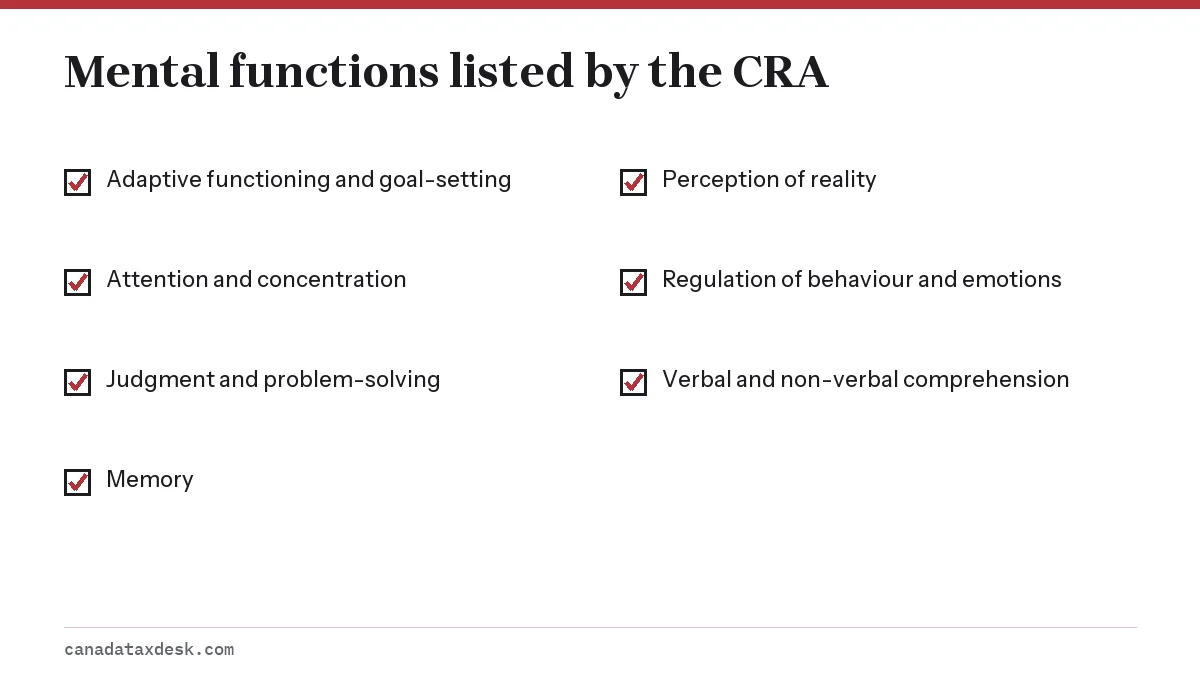
A practitioner does not need to find a problem in every function. One function that is markedly restricted can be enough. The CRA's own illustrations include a person who cannot read their surroundings accurately despite medication, a person who cannot complete simple transactions without help, and a person whose unpredictable psychotic episodes require daily supervision.
What does markedly restricted mean for disability tax credit mental functions?
Markedly restricted means the person cannot perform the function, or takes an inordinate amount of time to do so, all or substantially all of the time, even with appropriate therapy, medication and devices. The CRA generally interprets all or substantially all of the time as 90% of the time or more.
The 90% standard is where many mental health claims succeed or fail. Episodic conditions are assessed on the whole period, so a person who is severely limited during three bad months a year and functions well otherwise usually falls short. A person who is limited nearly every day, with only brief good stretches, can meet it.
Depression and anxiety
Claims for the disability tax credit for depression or anxiety are judged on the same test as any other condition. The form needs to show, in functional terms, what the person cannot do: for example, being unable to leave home to buy food, pay bills or keep appointments without another person's prompting nearly every day. A statement that the person has severe, treatment-resistant depression, with no description of daily limits, gives the CRA little to approve.
Cumulative effect
Someone who is significantly, but not markedly, restricted in two or more categories can still qualify if the restrictions exist together all or substantially all of the time and their combined effect equals one marked restriction. For example, a practitioner might find significant, but not marked, limits in both mental functions and walking; if both are present nearly all the time, their combined effect is what gets certified.
Who can certify mental functions on the T2201?
Only three types of practitioners can certify the mental functions category: medical doctors, nurse practitioners and psychologists. A counsellor, social worker, psychotherapist or occupational therapist cannot sign that section, even if they know the person best.
Those professionals can still help. A letter from a treating therapist describing daily limits, sent with the application or later in a review, gives the certifying doctor or psychologist more to rely on. The practitioner's fee for completing the form is the applicant's cost, though it can be claimed with other medical expenses. The field-by-field guide is on our T2201 form page.
What if my doctor refuses to fill out the T2201?
Ask why first. The CRA asks the certifying practitioner to use professional judgment based on your reported symptoms, medical history, direct observation and knowledge of how the condition affects you. A replacement doctor who has only just met you may not feel able to certify that, and your regular doctor may judge that the restriction falls short of the 90% standard. A refusal is not a CRA decision, so the options at this stage are practical:
- Ask another practitioner allowed to certify mental functions: a medical doctor, a nurse practitioner or a psychologist who has assessed or treats you.
- Bring evidence beyond one visit: a written record of a typical week and a letter from your treating therapist describing your daily limits.
- If you would rather wait for your regular doctor, there is no deadline to apply and the CRA can adjust up to 10 past years, so a short wait usually costs only time. The exception is a restriction that began more than about 10 years ago, where each new calendar year of delay can put the oldest year out of reach.
- Keep the legal route for the CRA's decision. Once a completed T2201 has been assessed, a denial can be reviewed, objected to within 90 days and then appealed to the Tax Court of Canada, as explained below.
Why are mental health DTC applications denied?
The CRA's notice of determination states the reason for a denial, and for mental functions the reasons tend to repeat. Comparing the notice with the form usually shows which one applies.
| What the CRA saw | Why it fails the test | What to fix |
|---|---|---|
| A diagnosis without daily examples | The CRA decides on effects, not labels | Specific tasks the person cannot do, and how often |
| Limits on some days only | Below the 90% standard | Evidence of how many days are affected, if it is most of them |
| Improvement expected within a year | Not prolonged (12 months) | A realistic duration based on treatment history |
| Signed by an unauthorized professional | Only doctors, nurse practitioners and psychologists certify this category | Have an eligible practitioner complete Part B |
| Limits caused by treatment side effects, not described | The CRA cannot link the limit to the impairment | Explain the connection on the form or in a letter |
What can I do if my mental health DTC claim is denied?
You have two formal options, and they can be used in sequence. The first is a review: send new medical information, such as a detailed letter from the certifying practitioner or a treating specialist, to the tax centre that processed the application (CRA, DTC decision).
The second is a formal objection, which must be filed within 90 days of the date on the notice of determination, online through your CRA account, on Form T400A, Objection, or by letter to the Chief of Appeals. An objection is reviewed by the CRA's Appeals Branch, which describes its aim as a fair and impartial review. If you disagree with its decision, you can appeal to the Tax Court of Canada, which must receive your notice of appeal within 90 days of the date the CRA sends its decision on the objection (CRA, P148).
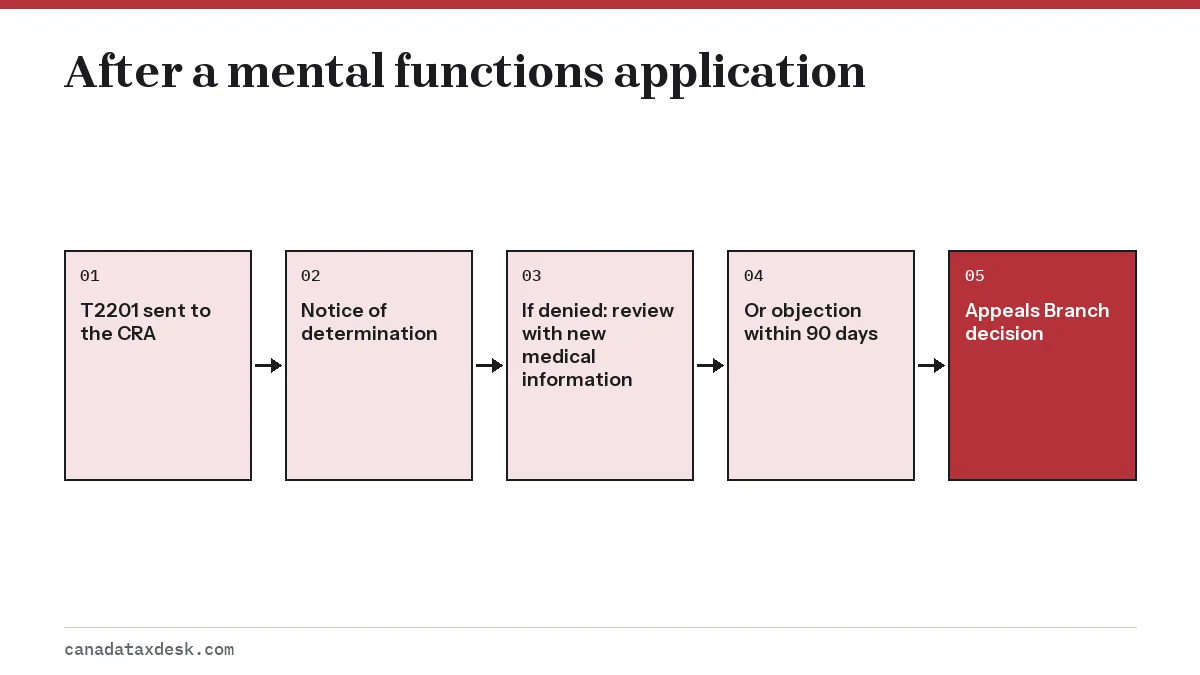
A new DTC application with a fresh T2201 is also possible at any time, and is often the better path when the original form was thin. The CRA's decision can take several weeks; see how long the CRA takes to process a DTC application for the current guidance.
Common questions
Does depression qualify for the disability tax credit?
It can, but only when a medical doctor, nurse practitioner or psychologist certifies that it markedly restricts mental functions at least 90% of the time and is expected to last 12 months or more. Many people with depression do not meet that level.
Can a psychotherapist or counsellor fill out the T2201 for anxiety?
No. For mental functions the form must be certified by a medical doctor, nurse practitioner or psychologist. A counsellor's letter can support the application but cannot replace the certification.
Does taking medication disqualify me from the DTC for mental health?
No. The CRA assesses you with your medication and therapy in place. If you are still markedly restricted despite treatment, you can qualify.
Can the DTC for a mental health condition be backdated?
Yes, up to 10 previous years, but only to the year the practitioner certifies the marked restriction began. Keep records that show when symptoms reached that level.
Should I reapply or object after a mental health DTC denial?
Object within 90 days if you believe the CRA misread a strong form. If the form itself lacked detail, a review with new medical information or a fresh application usually works better.
Sources
- CRA, Guide RC4064, Disability-related information canada.ca
- CRA, Form T2201, Disability Tax Credit Certificate canada.ca
- CRA, Getting the CRA's decision on the DTC canada.ca
- CRA, File an objection canada.ca
- CRA, How to apply for the disability tax credit canada.ca
- CRA, P148 Resolving your dispute: objection and appeal rights under the Income Tax Act canada.ca
We check figures against these official pages. Rules change; confirm anything that affects a deadline or payment with the agency before you act.
Tell us what happened
Describe your situation and our editors will use it to improve this guide. If you leave your email, we may reply with a pointer to the right page or official contact. We never share your details.