
Topic
RRSP, TFSA and FHSA: how the three accounts compare for tax
For 2026, the RRSP dollar limit is $33,810, the TFSA annual limit is $7,000 and the FHSA annual limit is $8,000 (CRA). RRSP and FHSA contributions are deductible; TFSA contributions are not. RRSP withdrawals are taxed, while TFSA withdrawals and qualifying FHSA withdrawals for a first home are tax-free. All three charge 1% per month on excess amounts.
11 guides in this topic Updated October 22, 2026
- FHSA Contribution Limit: $8,000 a Year and Carry-ForwardThe FHSA contribution limit is $8,000 of participation room per year and $40,000 over your lifetime, according to the CRA. Up to $8,000 of unused roo…
- FHSA Rules Canada: Eligibility, Limits and WithdrawalsThe main FHSA rules: you must be a Canadian resident, at least 18 and no older than 71, and a first-time home buyer to open one. You can contribute $…
- Home Buyers' Plan Repayment: New 5-Year Deferral ExplainedHome Buyers' Plan repayment for a first withdrawal made from January 1, 2022 to December 31, 2028 starts in the fifth year after the withdrawal year,…
- Home Buyers' Plan vs FHSA: Which to Use for a First HomeIn the Home Buyers' Plan vs FHSA choice, the main difference is repayment: the HBP lets you borrow up to $60,000 from your RRSPs and repay it over 15…
- Home Buyers' Plan: $60,000 RRSP Withdrawal and RepaymentThe Home Buyers' Plan (HBP) lets a first-time home buyer withdraw up to $60,000 from their own RRSPs to buy or build a qualifying home in Canada, wit…
- RRSP Contribution Limit 2026: How Your Room Is CalculatedThe RRSP contribution limit for 2026 is 18% of your 2025 earned income, to a maximum of $33,810, plus any unused room from earlier years, minus your…
- RRSP Deadline 2027: Last Day to Contribute for 2026The RRSP deadline in 2027 for contributions you want to deduct on your 2026 return is Monday, March 1, 2027. That is the 60th day of 2027, calculated…
- RRSP Over-Contribution Penalty: The $2,000 Buffer and T1-OVPAn RRSP over contribution is only penalized when your unused contributions exceed your RRSP deduction limit by more than $2,000. The excess above tha…
- RRSP Withdrawal Tax: Withholding Rates and What You OweRRSP withdrawal tax works in two stages: your financial institution withholds 10% on withdrawals up to $5,000, 20% on $5,000.01 to $15,000 and 30% ab…
- TFSA Contribution Limit 2026 & 2027: $7,000, $109,000 TotalThe TFSA contribution limit is $7,000 for 2026, the same as in 2024 and 2025. The 2027 limit has not been announced as of October 2026; the CRA usual…
- TFSA Over-Contribution Penalty: How to Fix It and Get ReliefThe TFSA over-contribution penalty is a tax of 1% per month on the highest excess amount in your TFSA in each month, for as long as the excess stays…

How do an RRSP, TFSA and FHSA differ for tax?
The RRSP, TFSA and FHSA differ mainly in when you get the tax break. A Registered Retirement Savings Plan (RRSP) gives you a deduction now and taxes the money when you take it out. A Tax-Free Savings Account (TFSA) gives no deduction, but growth and withdrawals are tax-free. A First Home Savings Account (FHSA) combines both: contributions are deductible and a qualifying withdrawal to buy a first home is not taxed.
All three are registered with the Canada Revenue Agency (CRA), which tracks your room from the slips and records your financial institution files. Investment income earned inside any of them is not reported on your return while it stays in the account.
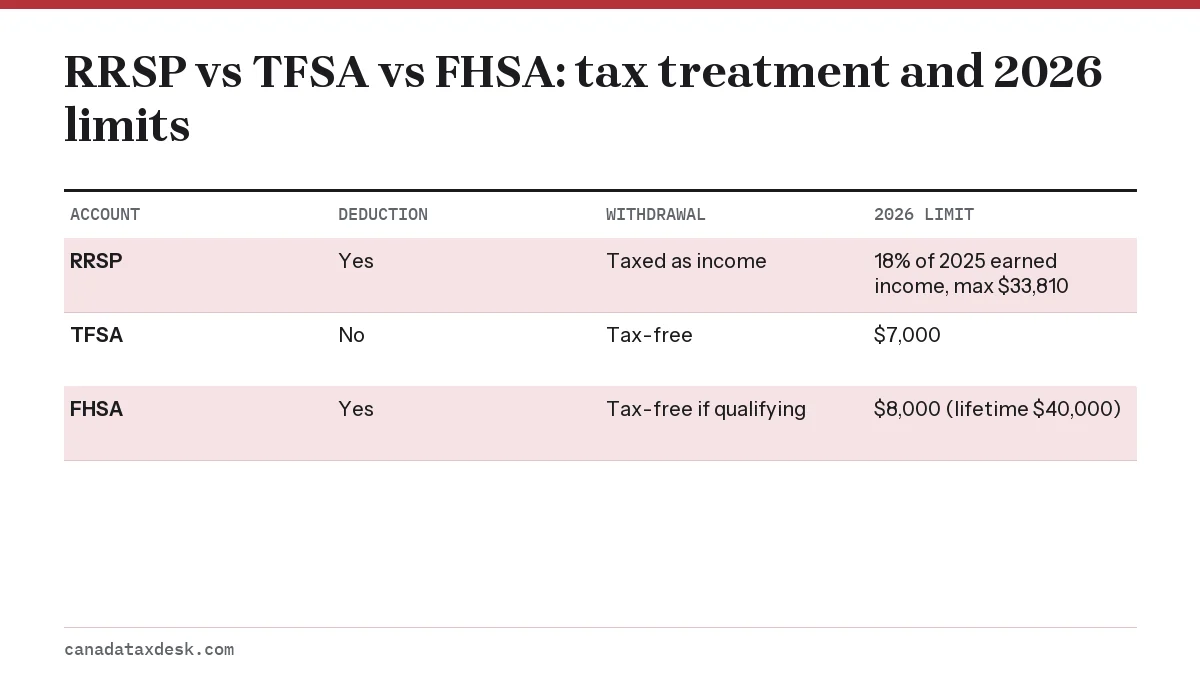
| Feature | RRSP | TFSA | FHSA |
|---|---|---|---|
| Contribution deductible? | Yes, line 20800 | No | Yes, reported on Schedule 15 |
| Withdrawals taxed? | Yes, added to income | No | No, if qualifying; otherwise yes |
| 2026 new room | 18% of 2025 earned income, up to $33,810 | $7,000 for everyone 18+ who is resident | $8,000 |
| Lifetime cap | None | None (room keeps growing) | $40,000 |
| Room comes back after a withdrawal? | No (HBP repayments aside) | Yes, on January 1 of the next year | No |
| Age limit | Contribute to your own plan until December 31 of the year you turn 71 | None after 18 | Open by the year you turn 71 |
What are the 2026 limits side by side?
The 2026 dollar limits are $33,810 for the RRSP, $7,000 for the TFSA and $8,000 for the FHSA, according to the CRA's published limits. These are ceilings, not your personal room: your actual space in each account depends on your income, age, past contributions and when you opened the account.
| Year | RRSP dollar limit | TFSA annual limit | FHSA annual limit |
|---|---|---|---|
| 2024 | $31,560 | $7,000 | $8,000 |
| 2025 | $32,490 | $7,000 | $8,000 |
| 2026 | $33,810 | $7,000 | $8,000 |
| 2027 | $35,390 | Not yet announced (usually November) | $8,000 |
The RRSP figure for 2027 is already fixed at $35,390, but the 2027 TFSA limit has not been published as of October 22, 2026. The CRA is expected to publish it in November 2026, together with the other indexed 2027 amounts such as the tax brackets and the basic personal amount. See the full year-by-year history on our TFSA contribution limit page and the calculation behind your RRSP number on the RRSP contribution limit page.
CRA RRSP contribution limits in plain terms
Your 2026 RRSP deduction limit is the lesser of 18% of your 2025 earned income or $33,810, plus unused room carried forward, minus any pension adjustment from a workplace pension. You need 2025 earned income of about $187,834 to earn the full $33,810 in new room.
The TFSA room limit if you never contributed
Someone who was 18 or older and resident in Canada in 2009 and has never contributed has $109,000 of TFSA room in 2026. That is the sum of every annual limit from 2009 to 2026. Your own number is lower if you turned 18 after 2009, arrived in Canada later, or have already contributed.
Where do I find my contribution room?
Your RRSP deduction limit and FHSA participation room are printed on your latest notice of assessment, and all three accounts show room in CRA My Account. The TFSA figure in My Account is your room as of January 1 and does not reflect contributions or withdrawals you made this year. The CRA itself says the TFSA information in your CRA account is updated only once a year, in the spring, and tells you to use your own financial records to work out your available room.
- Sign in to CRA My Account and open the RRSP, TFSA and FHSA sections.
- For the RRSP, compare the deduction limit with the RRSP deduction limit statement on your latest notice of assessment.
- For the TFSA, open the transaction summary to see what your issuers reported. Financial institutions report the prior year's activity by the end of February, so recent transactions may be missing.
- Subtract any contributions you made since January 1 yourself. Form RC343, Worksheet: TFSA contribution room, walks through the TFSA math.
- Or, once signed in, use the CRA's TFSA contribution room calculator under View TFSA details, then Contribution room, and enter the transactions it has not received yet.
- For the FHSA, check the participation room shown on the notice of assessment for the year after you opened the account.
What are the deadlines for each account?
Only the RRSP has a deadline after year end. Contributions made in the first 60 days of 2027, up to March 1, 2027, can be deducted on your 2026 return. That date is the calculated 60th day; the CRA normally confirms it in January. Full details are on our RRSP deadline 2027 page.
- RRSP: 60 days after December 31 for the prior-year deduction; your own plan must stop taking contributions after December 31 of the year you turn 71.
- TFSA: no deadline. Room simply accumulates and carries forward indefinitely.
- FHSA: contributions must be made between January 1 and December 31 to count for that year. There is no 60-day window.
- Tax return: April 30, 2027 for most people filing 2026 returns (June 15, 2027 if you or your spouse is self-employed, with payment still due April 30).
What happens if I over-contribute?
Each account charges a 1% monthly tax on excess amounts, but the details differ. The RRSP allows a $2,000 lifetime cushion before the tax starts; the TFSA and FHSA have no cushion. In each case the fastest fix is to remove the excess, because the tax runs for every month it stays in.
| Account | Tax | Return to file | Filing deadline |
|---|---|---|---|
| RRSP | 1% per month on excess above $2,000 | T1-OVP | 90 days after the end of the year |
| TFSA | 1% per month on the highest excess in the month | RC243 and Schedule A (RC243-SCH-A) | June 30 of the following year |
| FHSA | 1% per month on the highest excess in the month | RC728 and Schedule A (RC728-SCH-A) | June 30 of the following year |
Step-by-step fixes and waiver requests are covered on our TFSA over-contribution penalty and RRSP over-contribution pages. An FHSA excess can be removed tax-free with a designated withdrawal or transfer using Form RC727, and it shrinks on January 1 when new room arrives. For the RRSP, the CRA can waive or cancel the 1% tax if the excess came from a reasonable error and you are taking reasonable steps to remove it; you ask in writing with Form RC2503.
RRSP vs TFSA: which should you use first?
The RRSP vs TFSA choice mostly comes down to your tax rate now compared with your expected tax rate when you withdraw. The RRSP wins when your rate today is higher than it will be in retirement. The TFSA wins when your rate is low now, or when you may need the money before retirement.
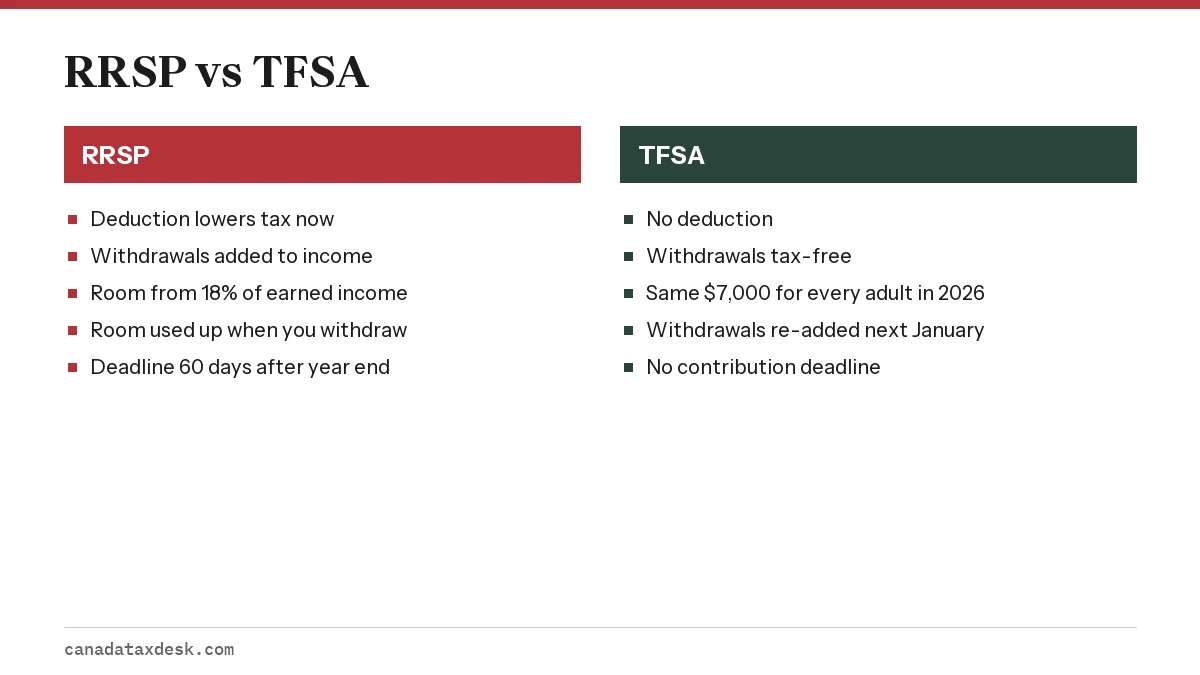
Two practical points often decide it. RRSP withdrawals are added to net income, which can reduce income-tested benefits and credits later; TFSA withdrawals are not. And an RRSP withdrawal permanently uses up that room, while a TFSA withdrawal is added back the following January. Our page on RRSP withdrawal tax shows the withholding rates on early withdrawals.
How do the accounts work together to buy a first home?
A first-time buyer can use an FHSA qualifying withdrawal and a Home Buyers' Plan (HBP) withdrawal from an RRSP for the same home, as long as the conditions for each are met at the time of each withdrawal (CRA, What is the Home Buyers' Plan). The HBP limit is $60,000 per person, and the FHSA lifetime limit is $40,000 plus growth.
- FHSA: a qualifying withdrawal never has to be paid back. See our FHSA rules guide for the conditions and Form RC725.
- HBP: money borrowed from your RRSP must be repaid over 15 years. For withdrawals from 2026 to 2028, repayments start in the fifth year after the first withdrawal. The HBP limit and repayment rules are set out on the CRA's Home Buyers' Plan page.
- TFSA: any amount can be withdrawn tax-free for any purpose, including a down payment, and the room returns the next year.
- Home buyers' amount: a separate non-refundable credit of up to $10,000 on line 31270, worth up to $1,400 federally for 2026.
For a couple who both qualify, the combined ceiling is large: $80,000 in two FHSAs plus up to $120,000 through two HBP withdrawals, before counting TFSA savings. Our Home Buyers' Plan vs FHSA comparison explains which to fund first.
Common questions
Can I have an RRSP, TFSA and FHSA at the same time?
Yes. There is no rule against holding all three, and each has its own separate room. Many first-time buyers contribute to an FHSA for the deduction and keep a TFSA for flexible savings.
Is TFSA room the same for everyone?
No. The annual limit is the same for everyone ($7,000 in 2026), but total room depends on the year you turned 18 or became a resident, what you contributed, and what you withdrew. Room only starts building once you are 18, resident and have a valid social insurance number.
When will the 2027 TFSA limit be announced?
As of October 22, 2026 the CRA has not announced the 2027 TFSA dollar limit; the 2026 limit is $7,000. The 2027 figure is part of the CRA's yearly indexation update, which is expected in November 2026. The 2027 RRSP dollar limit is already set at $35,390, and the FHSA annual limit is $8,000.
Does my RRSP room depend on my income?
Yes. New RRSP room each year is 18% of the previous year's earned income, capped at the dollar limit, and reduced by any pension adjustment. With no earned income, you get no new RRSP room, although unused room from earlier years carries forward.
Do FHSA contributions in January count for last year?
No. Unlike the RRSP, the FHSA has no 60-day rule. A contribution made in January 2027 counts toward 2027 participation room and can be deducted on the 2027 return or a later one.
Which account should I use if I earn under $50,000?
At lower incomes the RRSP deduction saves less tax, so many people favour the TFSA, or the FHSA if they plan to buy a first home, since the FHSA gives a deduction and a tax-free withdrawal. The right choice depends on your expected future income; this page is general information, not personal advice.