
FHSA rules in Canada: who qualifies, how much you can put in and how to withdraw
Short answer
The main FHSA rules: you must be a Canadian resident, at least 18 and no older than 71, and a first-time home buyer to open one. You can contribute $8,000 a year, to a $40,000 lifetime limit, and deduct it. A qualifying withdrawal for a first home is tax-free, and the account must close within 15 years of opening (CRA).
- 01Annual participation room
- $8,000 (carry forward up to $8,000)
- 02Lifetime limit
- $40,000
- 03Maximum participation period
- Ends December 31 of the 15th anniversary year, age 71, or the year after the first qualifying withdrawal, whichever is first
- 04Qualifying withdrawal form
- Form RC725
- 05Excess tax
- 1% per month on the highest excess
What is an FHSA?
A First Home Savings Account (FHSA), called the CELIAPP in French (compte d'épargne libre d'impôt pour l'achat d'une première propriété), is a registered account for saving toward a first home. Under the FHSA rules set by the Income Tax Act and administered by the CRA, contributions are tax-deductible like an RRSP, and a qualifying withdrawal to buy a home is tax-free like a TFSA. FHSAs have been available since April 1, 2023.
The account has a limited lifespan. It is built to be used for one home purchase, then closed. If you never buy, the savings can move to your RRSP without tax and without using RRSP room.
Who can open an FHSA?
You can open an FHSA if you are a resident of Canada, at least 18 (19 in provinces where that is the age of majority), no older than 71 at December 31 of the year you open it, and a first-time home buyer. FHSA issuers include banks, credit unions, and trust or insurance companies, and the issuer needs your social insurance number and date of birth.
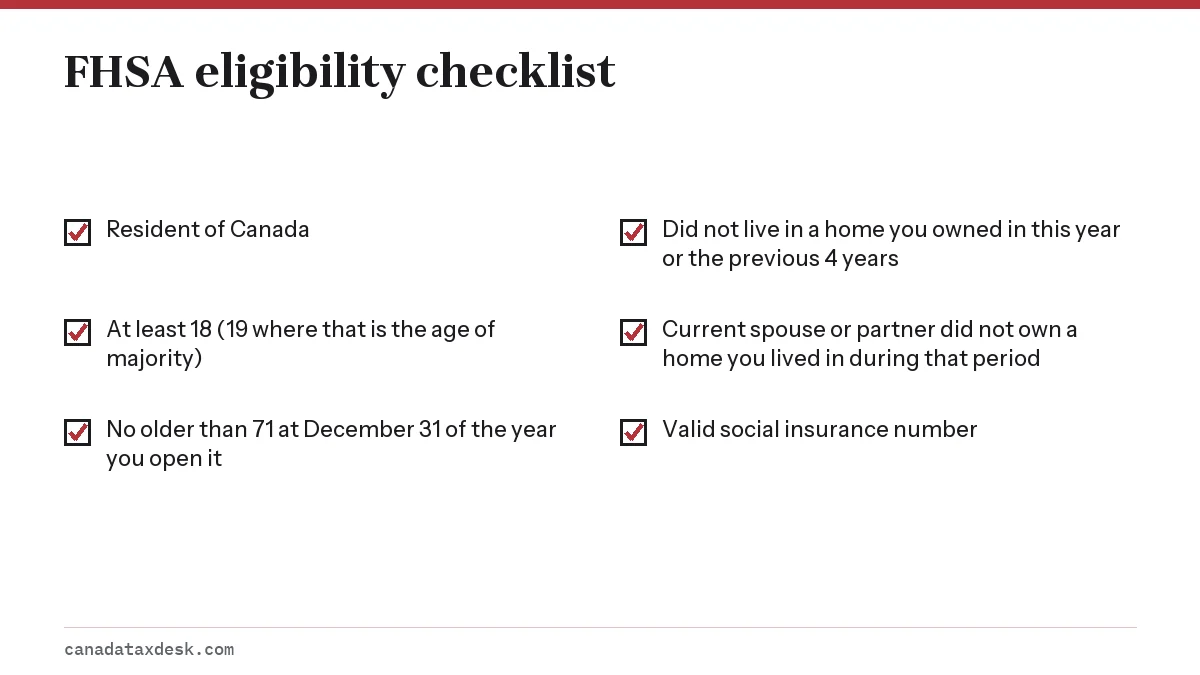
How the CRA defines a first-time home buyer for an FHSA
For opening an FHSA, you count as a first-time home buyer if you did not, at any time in the current calendar year or the previous four calendar years, live as your principal residence in a home that you owned or jointly owned. The same test applies to a home owned by your current spouse or common-law partner. If you have no spouse or partner when you open the account, only your own history counts.
Example: Sofia sold the condo she lived in during 2021. In 2026 the look-back covers 2022 to 2026, so she qualifies to open an FHSA in 2026, provided her current partner has not lived in a home they owned during those years either.
What are the FHSA contribution rules?
FHSA participation room is $8,000 in the year you open your first FHSA. Unused room carries forward, but only up to $8,000, so the most you can add in any one year is $16,000. The lifetime limit is $40,000, and it covers both contributions and transfers in from an RRSP.
| Year | Room available that year | Contributed | Total contributed |
|---|---|---|---|
| 2026 | $8,000 | $5,000 | $5,000 |
| 2027 | $11,000 ($8,000 + $3,000 carried forward) | $0 | $5,000 |
| 2028 | $16,000 (carry-forward capped at $8,000) | $16,000 | $21,000 |
| 2029 | $8,000 | $8,000 | $29,000 |
| 2030 | $8,000 | $8,000 | $37,000 |
| 2031 | $3,000 (lifetime limit remaining) | $3,000 | $40,000 |
In that example, $11,000 went unused in 2027 but only $8,000 could be carried into 2028, so $3,000 of annual room was lost. The $40,000 lifetime limit is not reduced by it, which is why the last $3,000 goes in during 2031. The full calculation, including how excess amounts affect carry-forward, is on our FHSA contribution limit page.
Room only starts when you open an account
Participation room begins in the year you open your first FHSA, not the year you became eligible. Opening an account with a small deposit starts the clock on room and lets carry-forward build, even if you cannot contribute much yet.
Deductions and timing
- Contributions must be made between January 1 and December 31 to count for that year. There is no 60-day rule.
- You can deduct them that year or carry the deduction forward indefinitely to a higher-income year.
- Only the account holder can deduct FHSA contributions. A spouse can give you money to contribute, but the room and deduction are yours.
- Transfers from an RRSP into an FHSA use FHSA room but are not deductible, since they were deducted when made to the RRSP.
- You must file Schedule 15 with your return for the year you open an FHSA, even if you contributed nothing.
FHSA rules for withdrawal: what is a qualifying withdrawal?
A qualifying withdrawal is a tax-free FHSA withdrawal made to buy or build a qualifying home. You request one by completing Form RC725, Request to Make a Qualifying Withdrawal from your FHSA, and giving it to your FHSA issuer. All of the following conditions must be met when you withdraw.
- You are a first-time home buyer at the time of the withdrawal: you did not live in a home you owned or jointly owned as your principal residence at any time in the previous four calendar years, or in the current year before the withdrawal (except the 30 days just before it).
- You have a written agreement to buy or build a qualifying home with a completion date before October 1 of the year after the withdrawal.
- You did not acquire the home more than 30 days before the withdrawal.
- You intend to occupy the home as your principal residence within one year after buying or building it.
- You are a resident of Canada from the first qualifying withdrawal until you acquire the home.
Unlike the opening test, the withdrawal test looks at your own ownership history, not your spouse's. The whole balance, including investment growth, can come out tax-free, and it never has to be repaid.
What if a withdrawal does not qualify?
Any FHSA withdrawal that does not meet the conditions is taxable. The issuer withholds income tax at source, and the full amount is added to your income for the year, with the withheld tax claimed as a credit on your return. The room is not lost for good: under the CRA's participation-room calculation, the part of a taxable withdrawal that was not needed to eliminate an excess FHSA amount becomes "re-participation room" and is added to your room from the following year. Your CRA account shows it under Savings and pension plans, View FHSA details, FHSA calculations.
What are the FHSA rules for 15 years and age 71?
Your FHSA maximum participation period ends on December 31 of the year in which the earliest of three events happens: the 15th anniversary of opening your first FHSA, the year you turn 71, or the year after your first qualifying withdrawal. By that date the account must be emptied or transferred.
| Situation | Trigger | Close by |
|---|---|---|
| Opened in 2026, never buys a home, age 30 | 15th anniversary (2041) | December 31, 2041 |
| Opened in 2026 at age 62 | Turns 71 in 2035 | December 31, 2035 |
| Opened in 2026, first qualifying withdrawal in 2028 | Year after withdrawal (2029) | December 31, 2029 |
If property is still in the account after the deadline, the CRA treats its fair market value on December 31 as income, and the account stops being tax-sheltered. Plan the closing in advance rather than letting it lapse.
Can I transfer my FHSA to an RRSP?
Yes. A direct transfer from an FHSA to an RRSP or RRIF, made with Form RC721, is tax-free and does not reduce your unused RRSP deduction room. This is the usual exit if you decide not to buy, and it effectively gives you up to $40,000 of extra retirement savings room.
- The transfer must go directly between institutions. Withdrawing the cash and depositing it yourself makes it a taxable withdrawal and an ordinary RRSP contribution.
- Transfers in the other direction, from an RRSP into an FHSA, are allowed but use FHSA room and give no new deduction.
- An FHSA-to-RRSP transfer after your participation period starts is how most people close an unused FHSA.
What are the FHSA rules for couples?
Each spouse or common-law partner can open their own FHSA if both meet the eligibility rules, giving the couple up to $16,000 of room a year and $80,000 over their lifetimes. Accounts cannot be held jointly, and each person deducts only their own contributions.
- If your partner owns the home you currently live in, you cannot open an FHSA, because the opening test includes a spouse's ownership over the past four years plus the current year.
- If you already opened an FHSA before moving into your partner's home, the account stays open, and the qualifying withdrawal test looks only at your own ownership.
- Both partners can make qualifying withdrawals for the same home.
- On a separation or divorce, FHSA savings can move to a current or former partner's FHSA, RRSP or RRIF without tax only by direct transfer, and only if that person is entitled to the amount under a court order or a written property-division agreement. Form RC723 is used, and the transfer does not use the recipient's FHSA or RRSP room. Withdrawing the money and handing it over is taxable.
- On the death of the holder, a surviving spouse or common-law partner can generally become the successor holder or receive a transfer to their own FHSA or RRSP. See the CRA's life events page for the exact rules.
A couple can also combine FHSA money with the Home Buyers' Plan, since the CRA allows an HBP withdrawal and an FHSA qualifying withdrawal for the same home. Our Home Buyers' Plan vs FHSA page explains the order to use them in, and the home buyers' amount, a non-refundable credit calculated on up to $10,000, can be claimed on top.
What happens if I contribute too much to my FHSA?
An excess FHSA amount is taxed at 1% per month on the highest excess in the month, reported on Form RC728, FHSA Return, with Schedule A. You can remove it without tax by designating a withdrawal or a transfer to an RRSP on Form RC727, and the excess shrinks automatically on January 1 when new room is added.
Over-contributions usually happen by forgetting the carry-forward cap, by transferring from an RRSP without counting it against room, or by putting withdrawn money back too soon: room from a taxable withdrawal only returns the following year, and re-contributing a qualifying withdrawal counts as a new contribution that is not deductible. The TFSA version of this problem is covered on our TFSA over-contribution penalty page, and all three accounts are compared in the RRSP, TFSA and FHSA overview.
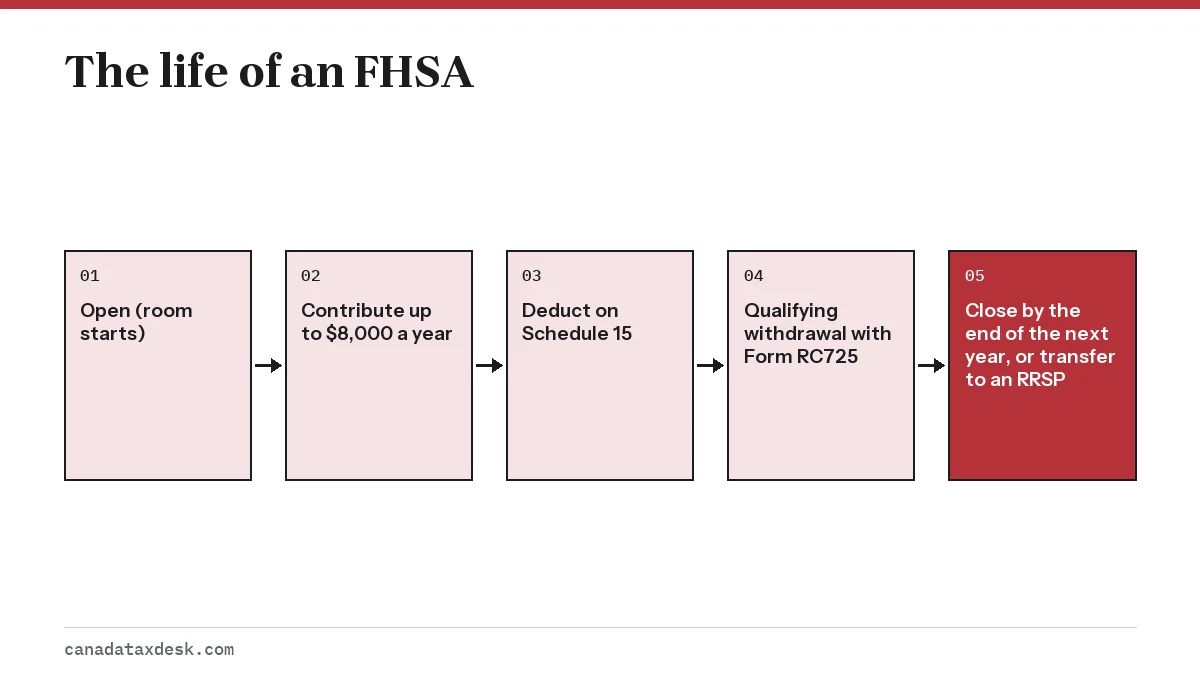
Step by step
Confirm eligibility
Check residency, age (18 to 71) and that neither you nor your spouse lived in a home either of you owned in this year or the previous four.
Open the account
Open an FHSA with an issuer such as a bank, credit union, or trust or insurance company, and give your social insurance number and date of birth.
Contribute within your room
Contribute up to $8,000 plus carry-forward (max $8,000) each calendar year, staying under the $40,000 lifetime limit.
Claim the deduction
File Schedule 15 with your return and deduct contributions now or in a later year.
Make a qualifying withdrawal
Once you have a written agreement to buy or build, give Form RC725 to your issuer and withdraw tax-free.
Close or transfer
Empty the account by December 31 of the year after your first qualifying withdrawal, or transfer unused funds to an RRSP with Form RC721.
Common questions
Can I open an FHSA if I owned a home years ago?
Yes, if you did not live in a home you owned as your principal residence in the current year or the previous four calendar years. Ownership more than four full years back does not disqualify you.
Can I use my FHSA and a TFSA for the same down payment?
Yes. TFSA withdrawals are tax-free for any purpose, so they can be combined with an FHSA qualifying withdrawal and an HBP withdrawal for the same purchase.
Do I lose my FHSA room if I do not contribute for several years?
Partly. Unused room carries forward, but only up to $8,000. Any unused room above that cap is lost, although your $40,000 lifetime limit is not reduced by it.
Is FHSA investment growth taxed?
No. Growth inside the FHSA is not taxed while it stays in the account and is tax-free when taken out as a qualifying withdrawal. It is taxable if withdrawn for any other purpose.
Can I buy a cottage or rental property with an FHSA?
Only if it is a qualifying home in Canada that you intend to live in as your principal residence within one year of buying or building it. A property bought only as a rental or a second home does not qualify.
Does the FHSA 15-year clock restart if I open a second account?
No. The 15-year period runs from the date you opened your first FHSA, regardless of how many FHSAs you open later.
Can I have more than one FHSA?
Yes. You can open more than one FHSA, with the same issuer or different ones, but your participation room for the year covers all of them combined. Contributions and RRSP transfers into every FHSA you hold count against that single limit.
Sources
- Opening your FHSAs canada.ca
- Participating in your FHSAs canada.ca
- Withdrawals and transfers out of your FHSAs canada.ca
- Closing your FHSAs canada.ca
- Tax deductions for FHSA contributions canada.ca
- What happens if you contribute or transfer too much to your FHSAs canada.ca
We check figures against these official pages. Rules change; confirm anything that affects a deadline or payment with the agency before you act.
Tell us what happened
Describe your situation and our editors will use it to improve this guide. If you leave your email, we may reply with a pointer to the right page or official contact. We never share your details.
Related guides
 RRSP, TFSA and FHSA Rules: Limits, Deadlines, Penalties
For 2026, the RRSP dollar limit is $33,810, the TFSA annual limit is $7,000 and the FHSA annual limit is $8,000 (CRA). RRSP and F…
FHSA Contribution Limit: $8,000 a Year and Carry-Forward
The FHSA contribution limit is $8,000 of participation room per year and $40,000 over your lifetime, according to the CRA. Up to…
Home Buyers' Plan vs FHSA: Which to Use for a First Home
In the Home Buyers' Plan vs FHSA choice, the main difference is repayment: the HBP lets you borrow up to $60,000 from your RRSPs…
Home Buyers' Amount: Claim Up to $10,000 on Line 31270
The home buyers' amount is a non-refundable federal credit that lets you claim up to $10,000 on line 31270 in the year you buy a…
TFSA Contribution Limit 2026 & 2027: $7,000, $109,000 Total
The TFSA contribution limit is $7,000 for 2026, the same as in 2024 and 2025. The 2027 limit has not been announced as of October…