
Topic
Tax deductions in Canada and the credits that sit beside them
Tax deductions in Canada reduce the income you are taxed on, so they save tax at your top marginal rate, while most federal tax credits are non-refundable and cut your tax by 14% of the credit amount for 2026. Deductions sit between lines 20700 and 26000 of the T1 return; credits are claimed from line 30000 onward.
13 guides in this topic Updated October 20, 2026
- Canada Caregiver Credit: Amounts, Eligibility, How to ClaimThe Canada caregiver credit is a non-refundable federal credit for supporting a spouse, child or relative who depends on you because of a physical or…
- Canada Workers Benefit 2026: Amounts, Eligibility, AdvancesThe Canada workers benefit (CWB) is a refundable tax credit for low-income workers, claimed on line 45300 with Schedule 6. For 2026 it pays up to $1,…
- Charitable Donation Tax Credit: 2026 Rates, Limits, ExamplesThe charitable donation tax credit is a non-refundable credit claimed on line 34900 with Schedule 9 for gifts to registered charities and other quali…
- Child Care Expenses Deduction: Limits per Child, Line 21400The child care expenses deduction lets you deduct what you paid for daycare, a babysitter, day camps and similar care on line 21400, so that you coul…
- Home Accessibility Tax Credit: 2026 Rule Change ExplainedThe home accessibility tax credit (HATC) is a federal non-refundable credit on up to $20,000 a year of permanent renovations that make a home safer o…
- Home Buyers' Amount: Claim Up to $10,000 on Line 31270The home buyers' amount is a non-refundable federal credit that lets you claim up to $10,000 on line 31270 in the year you buy a qualifying home in C…
- Medical Expenses Tax Credit Canada: What You Can ClaimThe medical expenses tax credit lets you claim eligible health costs above the lesser of 3% of your net income or $2,890 for 2026 returns ($2,834 for…
- Multigenerational Home Renovation Tax Credit: Who QualifiesThe multigenerational home renovation tax credit (MHRTC) is a refundable federal credit for building a self-contained secondary unit so a senior 65 o…
- Pension Income Splitting in Canada: Rules and ExamplePension income splitting lets a Canadian resident allocate up to 50% of their eligible pension income to a spouse or common-law partner by filing For…
- Personal Support Workers Tax Credit: 2026 Amount and RulesThe personal support workers tax credit (PSWTC) is a refundable federal credit equal to 5% of an eligible personal support worker's eligible earnings…
- T1-M Moving Expenses Deduction: 40 km Rule and Line 21900You claim the moving expenses deduction for Canadian taxes on Form T1-M and line 21900 when you move for a new job, a business or full-time post-seco…
- Tuition Tax Credit Canada: Claim, Transfer or Carry ForwardThe federal tuition tax credit is a non-refundable credit worth 14% of eligible post-secondary fees for 2026, claimed on Schedule 11 and line 32300 u…
- Work From Home Expenses Canada: T2200 and What to ClaimEmployees in Canada can claim work from home expenses for 2023 and later only with the detailed method: your employer must sign Form T2200, you calcu…

What is the difference between a tax credit and a tax deduction?
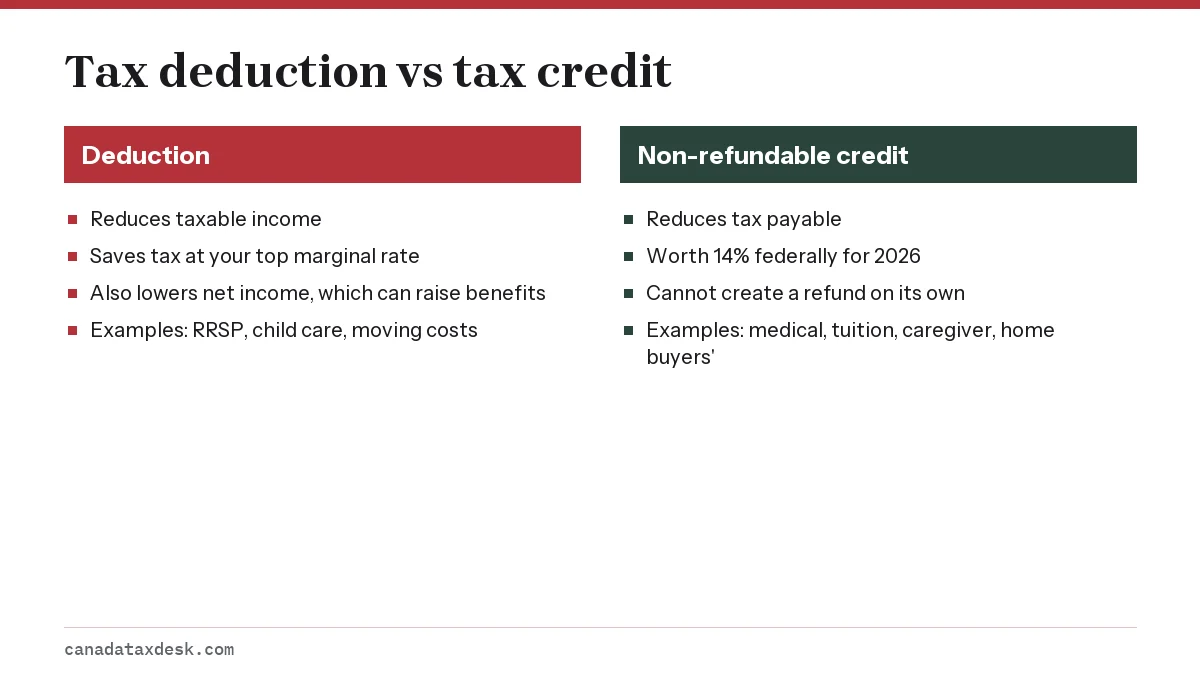
A tax deduction lowers your taxable income, while a tax credit lowers the tax calculated on that income. Tax deductions in Canada are subtracted before the tax brackets are applied, so a $1,000 deduction saves $1,000 multiplied by your highest marginal rate. A non-refundable credit is multiplied by the lowest federal rate, which is 14% for the 2026 tax year (CRA, current-year tax rates).
That difference decides which claims are worth the most to you. A deduction is worth more the higher your income, because each dollar comes off the top bracket. A non-refundable credit is worth the same percentage to almost everyone who owes tax, but it cannot create a refund on its own.
A worked comparison on a $5,000 claim
Take someone with 2026 taxable income of $90,000, which puts their top federal bracket at 20.5% (the band from $58,523.01 to $117,045). A $5,000 RRSP deduction cuts their federal tax by $1,025 ($5,000 x 20.5%). A $5,000 non-refundable credit amount, such as eligible medical expenses above the threshold, cuts federal tax by $700 ($5,000 x 14%). Provincial tax falls as well in both cases, at the province's own rates.
What tax credits can I claim in Canada?
Everyone who files gets the basic personal amount on line 30000, which is $16,452 for 2026 at net incomes up to $181,440 (CRA, T4127 January 2026). Most other tax credits in Canada depend on your circumstances: your age, your job, who you support, a disability, schooling, a home purchase or out-of-pocket health costs. Tax software asks screening questions for each one, but it only knows what you tell it.
| Credit | Return line | Amount or limit | Our guide |
|---|---|---|---|
| Basic personal amount | 30000 | $16,452 for 2026 | Everyone |
| Canada caregiver amount | 30300, 30400, 30425, 30450, 30500 | Up to $8,773 per infirm adult dependant (2026) | Caregivers |
| Canada employment amount | 31260 | $1,501 for 2026 | Employees with T4 income |
| Home buyers' amount | 31270 | Up to $10,000 for a qualifying home | First-time buyers |
| Home accessibility expenses | 31285 | Up to $20,000 of expenses a year | Seniors, people with the DTC |
| Disability amount | 31600 | $10,341 (2026) | People approved for the DTC |
| Tuition amount | 32300 | Eligible fees over $100 per institution | Post-secondary students |
| Medical expenses | 33099 and 33199 | Costs above 3% of net income or $2,890 (2026), whichever is less | Anyone with health costs |
| Donations and gifts | 34900 | 14% on the first $200 for 2026, then 29% or 33% | Anyone who gives to registered charities |
Each of the larger claims has its own guide. The medical expenses tax credit explains the 3% threshold and the 12-month window. The tuition tax credit covers transfers to a parent and carryforwards. The Canada caregiver credit covers support for an infirm spouse, child, parent or other relative, and the home buyers' amount covers the $10,000 claim in the year you buy. The charitable donation tax credit explains the two federal rates on line 34900 and why couples should put all their receipts on one return.
Two claims for housing and disability overlap with others. The disability tax credit needs an approved Form T2201 before you can claim it, and the home accessibility tax credit covers renovations that make a home safer or easier to use for a senior or a person eligible for the DTC.
What expenses are tax deductible in Canada?
Only expenses that the Income Tax Act lists are deductible for individuals; everyday living costs such as rent, groceries or a personal car are not. The common tax write-offs for employees and families are retirement savings contributions, child care, union dues, eligible moving costs and some work-from-home costs. Self-employed people deduct business expenses separately on Form T2125 before their net business income reaches the return.
| Deduction | Return line | Who uses it |
|---|---|---|
| RRSP contributions | 20800 | Anyone with RRSP room |
| FHSA contributions | 20805 | FHSA holders saving for a first home |
| Elected split-pension amount | 21000 | The pensioner who transfers pension income to a spouse |
| Child care expenses | 21400 | Parents paying for care so they can work or study |
| Moving expenses | 21900 | People who move at least 40 km closer to a new job or school |
| Employment expenses | 22900 | Employees whose employer signs Form T2200 |
Parents should read our child care expenses deduction guide for the per-child limits and the rule that the lower-income spouse usually claims. Moving costs have their own rules on distance and timing; see moving expenses tax deduction. Home office costs for employees now need the detailed method with a signed Form T2200, covered in work-from-home expenses. Couples where one person has pension income should read pension income splitting, because the deduction on line 21000 moves income to the lower-taxed spouse.
Why net income on line 23600 matters
Deductions taken before line 23600 lower your net income, which the CRA uses to test benefits and several credits. A lower net income on line 23600 can raise the Canada Child Benefit, reduce the medical expense threshold and reduce any clawback of Old Age Security. Credits do not change net income at all.
Which tax credits are refundable in Canada?
A refundable credit is paid to you even if you owe no tax, while a non-refundable credit can only reduce tax to zero. Most federal credits, including all the amounts in the table above, are non-refundable. Refundable amounts are claimed near the end of the return, after tax has been worked out.
- Refundable medical expense supplement (line 45200): for working adults with low income and high medical costs. For 2025 you needed working income of $4,390 or more and adjusted family net income under $63,374.
- Canada workers benefit (line 45300): for low-income workers; up to $1,665 for a single person and $2,869 for a family for 2026, calculated on Schedule 6.
- Multigenerational home renovation tax credit (line 45355): 14.5% for 2025 of up to $50,000 spent creating a self-contained secondary unit so a senior or an adult eligible for the DTC can live with a relative.
- Personal support workers tax credit: a refundable credit for 2026 to 2030 equal to the lesser of $1,100 and 5% of eligible pay. Proposed in Budget 2025, it became law when Bill C-15 received Royal Assent on March 26, 2026.
- Benefits paid outside the return: the GST/HST credit and Canada Child Benefit are not claimed on a line, but the CRA only pays them if you file.
Tax write-offs in Canada that people often miss
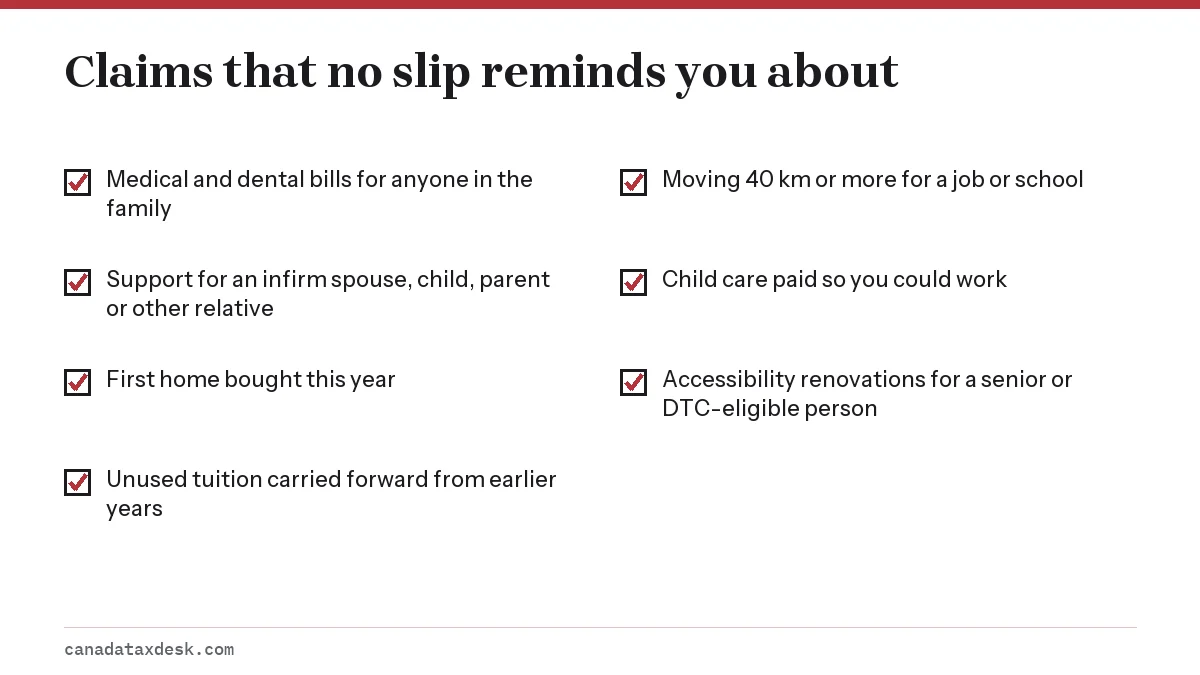
The claims most often left off a return are the ones no slip reports. Employers send a T4 and schools send a T2202, but nobody sends a slip for a dental bill, a parent you support or the first home you bought. Walk through this list before you file.
If you find a missed claim after filing, you do not need to file a new return. Use Change my return in My Account, ReFILE through certified software, or Form T1-ADJ, Adjustment Request. The CRA then sends a notice of reassessment.
What receipts should I keep for tax deductions and credits?
Keep every receipt, slip and signed form that supports a claim, even though you do not send them with a return you file online. The CRA can ask for proof in a pre-assessment review or a later processing review. Generally, keep records for six years from the end of the tax year they relate to.
- Store slips (T4, T4A, T5, T2202, RRSP and FHSA receipts) in one folder per tax year as they arrive in January and February.
- Save medical receipts that show the patient, the provider's name, the date and the amount paid; pharmacy printouts for the year are accepted.
- Keep signed statements that the CRA may request: Form T2200 for work from home, a medical practitioner's note for the caregiver amount, and Form T2201 approval for the DTC.
- Keep the purchase agreement and land registry document for a home purchase, and moving invoices with dates and addresses.
- When the CRA sends a review letter, answer by the date on it and upload copies through My Account rather than mailing originals.
If a review letter arrives, reply by its deadline. A claim the CRA cannot verify is removed and the tax is reassessed, so a missing receipt costs you the credit even when the expense was real.
Credits and deductions for the 2026 tax year and the 2027 season
Returns for 2026 are due April 30, 2027 for most people, and 2026 is the first full year at the 14% lowest federal rate. The CRA's 2026 indexation table already sets most dollar amounts for 2026 credits: the medical expense threshold is $2,890, the caregiver amount for an infirm dependant 18 or older is up to $8,773 and the disability amount is $10,341. The 2027 amounts are not yet published; the CRA usually releases them in November.
Since the 2026 tax year, the same expense can no longer be claimed under both the medical expense credit and the home accessibility credit; the change became law when Bill C-15 received Royal Assent on March 26, 2026. Plan renovation claims with that rule in mind.
Common questions
Is a tax credit better than a tax deduction in Canada?
It depends on your income. A deduction saves tax at your top marginal rate, so for someone in the 20.5% federal bracket a deduction of the same size is worth more than a 14% non-refundable credit. For someone in the lowest bracket the two are close.
Can I deduct my rent on my Canadian tax return?
Not federally. Rent is a personal living cost. Some provinces pay rent-related credits, such as Ontario's energy and property tax credit, and self-employed people can deduct the business-use share of a home, but tenants cannot deduct rent as such.
Do I need receipts to claim tax credits if I file online?
You do not send them, but you must keep them. The CRA can ask for them in a review up to several years later, and it will remove a claim you cannot support.
What happens to non-refundable credits if I have no income?
They reduce your tax to zero and the rest is usually lost for that year. A few amounts, such as tuition, can be carried forward or transferred, and refundable credits are still paid.
Can I claim a credit I forgot on last year's return?
Yes. Ask the CRA to reassess through Change my return in My Account, ReFILE or Form T1-ADJ. Adjustments are generally accepted for the previous 10 years.
Are credits and deductions the same in every province?
No. Each province and territory has its own non-refundable credits on its own form, with its own rates and amounts. Deductions are the same federally and provincially because they reduce the income both levels tax.
Sources
- CRA, Completing a tax return (lines and deductions)
- CRA, Tax rates and income brackets for individuals, current year
- CRA, Lines 33099 and 33199, eligible medical expenses
- CRA, Line 45200, refundable medical expense supplement
- CRA, Budget 2025 select measures
- CRA, Line 21900, moving expenses
- CRA, Adjustment of personal income tax and benefit amounts (2026)