
Charitable donation tax credit in Canada: how much you get back for 2025 and 2026 gifts
Short answer
The charitable donation tax credit is a non-refundable credit claimed on line 34900 with Schedule 9 for gifts to registered charities and other qualified donees. Federally, the first $200 earns the lowest tax rate, 14.5% for 2025 and 14% for 2026, and the rest earns 29%, or 33% on the part matched by taxable income above the top bracket threshold. Provinces add their own credit, and unclaimed gifts can be carried forward for 5 years.
- 01Where to claim
- Line 34900, calculated on Schedule 9
- 02Federal rate on the first $200
- 14.5% for 2025; 14% for 2026
- 03Federal rate above $200
- 29%, or 33% where taxable income is over $253,414 (2025) or $258,482 (2026)
- 04Annual limit
- 75% of net income (100% in the year of death and the year before)
- 05Carry-forward
- 5 years (10 years for ecological gifts)
- 06Refundable?
- No, it can only reduce tax you owe
How does the charitable donation tax credit work?
When you give money or property to a qualified donee, you can claim federal and provincial or territorial non-refundable tax credits (CRA, line 34900). You need an official donation receipt from the donee, or an information slip such as a T4 that shows the eligible amount.
The credit is based on the eligible amount of the gift: its fair market value minus any advantage you received. The CRA's example is a $1,000 gift that came with $150 of benefits, which leaves an eligible amount of $850.
Who counts as a qualified donee
- Registered charities, registered Canadian amateur athletic associations and registered journalism organizations.
- Registered housing corporations in Canada set up only to provide low-cost housing for the aged.
- The Government of Canada, a province or territory, registered municipalities and registered public bodies performing a government function in Canada.
- Registered universities outside Canada.
- The United Nations and its agencies, and registered foreign charities that have received a gift from the Government of Canada.
Gifts to an individual, a crowdfunding campaign for a person, or any organization that is not a qualified donee do not earn the credit, because no official receipt can be issued.
How much do you get back for a donation?
The federal credit is calculated in two tiers on Schedule 9. The first $200 of donations in the year earns the lowest federal tax rate. Everything above $200 earns 29%, except the part matched by taxable income in the top 33% bracket, which earns 33%.
| Part of your donations | 2025 | 2026 |
|---|---|---|
| First $200 | 14.5% | 14% |
| Above $200 | 29% | 29% |
| Above $200, up to your taxable income over the top bracket threshold | 33% (over $253,414) | 33% (over $258,482) |
The 2025 figures are printed on the 2025 Schedule 9. For 2026 the first $200 follows the new 14% lowest rate, and the 33% threshold matches the $258,482 start of the top bracket; the 2026 Schedule 9, expected with the 2026 tax package in early 2027, will show both.
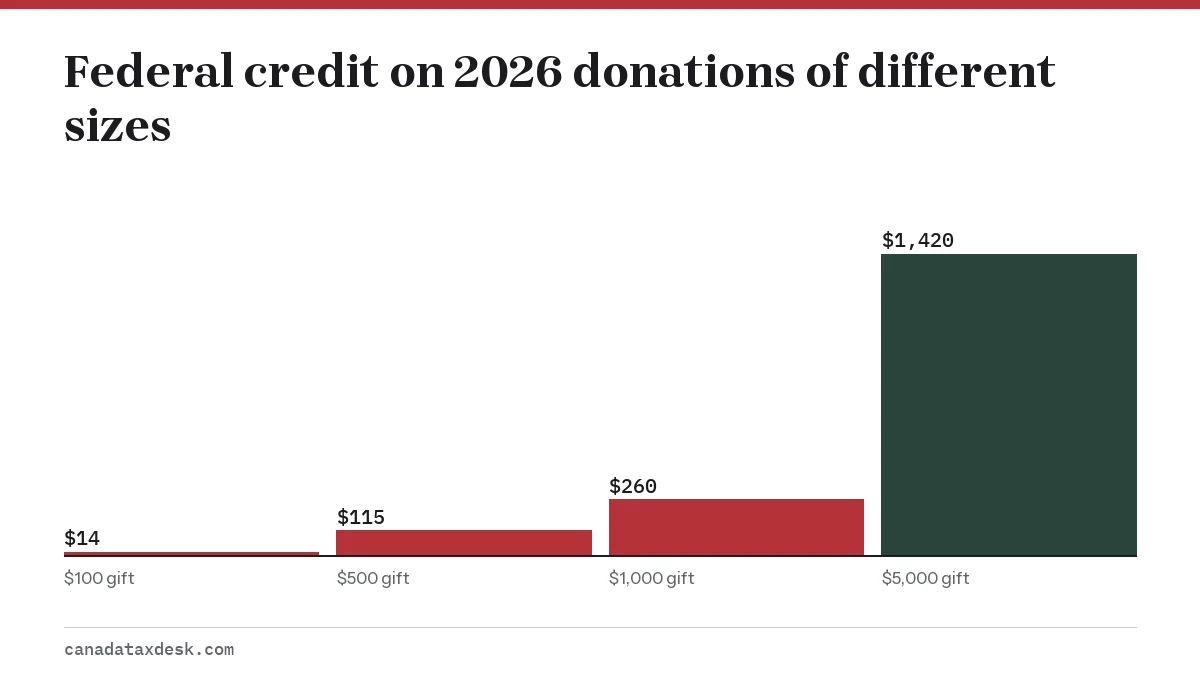
| Total donations | Calculation | Federal credit |
|---|---|---|
| $100 | $100 x 14% | $14 |
| $500 | ($200 x 14%) + ($300 x 29%) | $115 |
| $1,000 | ($200 x 14%) + ($800 x 29%) | $260 |
| $5,000 | ($200 x 14%) + ($4,800 x 29%) | $1,420 |
A high earner gets the 33% rate only on the lesser of two amounts: donations above $200, and taxable income above the threshold. Someone with $300,000 of taxable income who gives $20,000 in 2026 has $41,518 of income above $258,482, more than the $19,800 of donations above $200, so all $19,800 earns 33%: a federal credit of $6,534 plus $28 on the first $200, or $6,562.
Can you claim your spouse's donations?
Yes. Schedule 9 lets you claim gifts made by you or by your spouse or common-law partner, and unused gifts either of you made in the previous 5 years. Each gift can only be claimed once, on one return.
Because only the first $200 each year earns the low rate, combining a couple's receipts on one return gives a larger credit than splitting them. Two people who each claim $150 in 2026 get $21 each, $42 in total; one person claiming the combined $300 gets $28 + $29 = $57.
What are the limits on donation claims?
- 75% of net income: total charitable gifts claimed in a year generally cannot exceed 75% of your net income on line 23600.
- Higher limit for capital property: gifts of certain capital property add 25% of the related taxable capital gain or recaptured depreciation to the limit on Schedule 9.
- Year of death: gifts can be claimed up to 100% of the deceased person's net income, and any excess can be claimed on the return for the year before, up to 100% of that year's net income.
- Carry-forward: unclaimed gifts can be claimed in any of the next 5 years, or 10 years for ecologically sensitive land, and carried-forward amounts are used before the current year's gifts.
One timing rule from the 2025 schedule: gifts made between January 1 and February 28, 2025 that were already claimed on a 2024 return under a legislated extension cannot be claimed again on the 2025 return.
Gifts of shares, stock options, ecologically sensitive land or other capital property also have capital gains rules, calculated on Form T1170. Gifts to US charities are generally limited to 75% of the net US-source income you report on your Canadian return, with exceptions in Guide P113 for people who commute to a US job and for certain US colleges and universities.
How do you claim donations on your tax return?
- Gather your official donation receipts and any T4 or T4A slips that show payroll donations.
- Add your spouse's or partner's receipts if one of you will claim them all.
- Complete Schedule 9; tax software does this when you enter each receipt.
- Enter the federal result on line 34900 of your return.
- Use the same amounts in the donations section of your provincial or territorial Form 428 and enter that credit on line 58969; Quebec residents claim the provincial part on their Quebec return.
- Keep the receipts. Paper filers attach Schedule 9 but do not send the receipts.
The provincial part varies by province, so the total you get back depends on where you live on December 31. Our tax credits and deductions guide lists the other common claims, and the medical expenses tax credit is the other family credit where pooling on one return often pays.
Common questions
How much do I get back for a $100 donation in Canada?
Federally, $14 for a 2026 gift and $14.50 for a 2025 gift, because the first $200 earns the lowest tax rate. Your province or territory adds its own credit on top.
Can I claim my spouse's charitable donations?
Yes. Either spouse or common-law partner can claim the gifts made by both, but each receipt can only be claimed once. Putting all receipts on one return usually gives the larger credit.
How long can I carry forward donations?
Unclaimed charitable gifts can be carried forward for up to 5 years, or 10 years for gifts of ecologically sensitive land.
Is the charitable donation tax credit refundable?
No. It is a non-refundable credit that reduces tax you owe. If you owe no tax, carry the gifts forward or let your spouse claim them.
Is there a limit on how much I can claim for donations?
Generally 75% of your net income for the year, with a higher limit for some gifts of capital property and up to 100% of net income in the year of death and the year before.
Can I claim donations to a US charity?
Generally yes, if the charity would qualify as a registered charity in Canada, but the claim is usually limited to 75% of the net US-source income you report on your Canadian return.
Sources
- Line 34900, Donations and gifts canada.ca
- Line 34900: How much you can claim canada.ca
- Line 34900: How to claim canada.ca
- Schedule 9, Donations and Gifts (2025) canada.ca
- Guide P113, Gifts and Income Tax 2025 canada.ca
- Adjustment of personal income tax and benefit amounts (2026) canada.ca
We check figures against these official pages. Rules change; confirm anything that affects a deadline or payment with the agency before you act.
Tell us what happened
Describe your situation and our editors will use it to improve this guide. If you leave your email, we may reply with a pointer to the right page or official contact. We never share your details.
Related guides
 Tax Credits and Deductions in Canada: What You Can Claim
Tax deductions in Canada reduce the income you are taxed on, so they save tax at your top marginal rate, while most federal tax c…
Medical Expenses Tax Credit Canada: What You Can Claim
The medical expenses tax credit lets you claim eligible health costs above the lesser of 3% of your net income or $2,890 for 2026…
Canada's 14% Tax Rate: What the Rate Cut Means for You
The 14% tax rate in Canada is the lowest federal income tax rate, charged on the first $58,523 of taxable income for 2026. It rep…
Seniors Tax Return Canada: Credits and Filing Tips After 65
A tax return for seniors in Canada is the regular T1 return, but after 65 it adds extra credits: an age amount of up to $9,208 fo…
 Canada Tax Brackets 2026: Federal and Provincial Rates
The 2026 federal tax brackets in Canada are 14% on the first $58,523 of taxable income, 20.5% up to $117,045, 26% up to $181,440,…