
Canada caregiver credit: who qualifies, how much it is and which line to use
Short answer
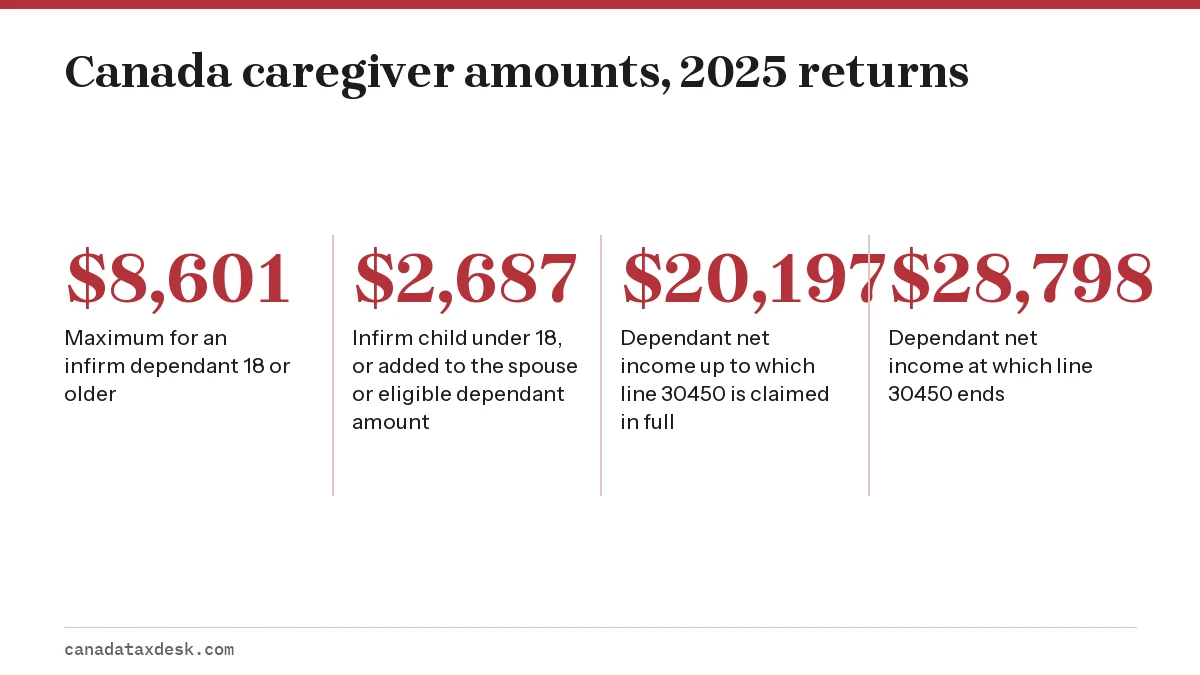
The Canada caregiver credit is a non-refundable federal credit for supporting a spouse, child or relative who depends on you because of a physical or mental impairment. For 2025 it adds up to $8,601 for an infirm dependant 18 or older, reduced once their net income passes $20,197, and $2,687 for an infirm child under 18, claimed through Schedule 5.
- 01Infirm dependant 18 or older, 2025
- Up to $8,601 (lines 30425 or 30450)
- 02Infirm child under 18, 2025
- $2,687 per child (line 30500)
- 03Dependant income where line 30450 ends, 2025
- $28,798 of net income
- 04Form used
- Schedule 5, Amounts for Spouse or Common-Law Partner and Dependants
- 052026 amounts
- Up to $8,773 (18 or older) and $2,740 (under 18), CRA indexation table
What is the Canada caregiver credit?
The Canada caregiver credit (CCC) is a non-refundable federal tax credit for people who support a family member with a physical or mental impairment. It is not a payment and there is no application: you claim it on your own tax return, through Schedule 5, and it reduces your federal tax by 14% of the amount claimed for 2026 (14.5% for 2025).
The credit replaced three older credits in 2017 (the caregiver, infirm dependant and family caregiver amounts). It is spread across several return lines, which is why people often miss part of it.
Who is an eligible dependant for the Canada caregiver credit?
Canada caregiver credit eligibility turns on two things: the person must depend on you for the basic necessities of life, such as food, shelter and clothing, and they must depend on others for personal needs and care because of an impairment. Being elderly or having low income is not enough by itself (CRA, Canada caregiver amount).
- Your spouse or common-law partner, if they are infirm.
- Your or your partner's child or grandchild, including an infirm child under 18.
- Your or your partner's parent, grandparent, brother, sister, aunt, uncle, niece or nephew who is 18 or older, infirm, and lived in Canada at some time in the year.
- A person only visiting you from abroad does not qualify.
The CRA's Schedule 5 says plainly that you cannot claim line 30450 for a dependant who has no mental or physical infirmity, and names parents and grandparents in that rule. Supporting a healthy parent financially does not earn the credit.
How much is the Canada caregiver credit amount?
For 2025 returns, the Canada caregiver credit amount is up to $8,601 for each infirm dependant 18 or older and $2,687 for an infirm spouse, eligible dependant or child under 18 (CRA, Schedule 5 for 2025). For 2026 returns, the CRA's table of indexed amounts sets them at up to $8,773 and $2,740, with the reduction for an adult dependant starting once their net income passes $20,601.
| Who you support | Line | Amount | Federal value at 14.5% (2025) |
|---|---|---|---|
| Infirm spouse or common-law partner | 30300 plus 30425 | $2,687 added to the spouse amount, and up to $8,601 on 30425 if their income allows | Up to $1,247.15 on line 30425 |
| Infirm eligible dependant 18 or older (single parent claiming line 30400) | 30400 plus 30425 | $2,687 added to line 30400, and up to $8,601 on 30425 | Up to $1,247.15 on line 30425 |
| Other infirm dependant 18 or older, such as a parent | 30450 | Up to $8,601 per person | Up to $1,247.15 |
| Infirm child under 18 | 30500 | $2,687 per child | $389.62 |
How the dependant's income reduces the amount
On line 30450 you start from a base of $28,798 and subtract the dependant's net income from line 23600 of their return, to a maximum claim of $8,601 (Schedule 5, 2025). So the full amount is available when the dependant's net income is $20,197 or less, and nothing is available at $28,798 or more. Line 30425 uses the same $28,798 base for an infirm spouse or eligible dependant whose net income is between $8,624 and $28,798, after allowing for what you already claimed on line 30300 or 30400.
Can I claim the Canada caregiver credit for elderly parents?
Yes, if your parent or grandparent is 18 or older, has a mental or physical infirmity, relies on you for basic necessities, lived in Canada at some point in the year and has net income under $28,798 (2025). They do not have to live with you under the line 30450 rules shown on Schedule 5; what matters is that they regularly and consistently depend on you for support.
Worked example for a parent
Daniel supports his father, who has advanced Parkinson's disease and a 2025 net income of $23,400 from Old Age Security and a small pension. The claim on line 30450 is $28,798 minus $23,400, or $5,398. At the 2025 federal rate of 14.5%, that cuts Daniel's federal tax by $782.71, before any provincial caregiver credit.
When brothers and sisters share the care
Two or more people who support the same dependant can split the line 30450 claim, as long as the total does not exceed the maximum for that dependant. Agree on the split before anyone files, because the CRA will reduce the claims if the total goes over. Nobody can claim line 30450 for a person if someone is already claiming them on line 30300 or 30400.
If your parent is also approved for the disability tax credit, their unused disability amount may be transferable to you on line 31800, and their medical bills can go on your line 33199 claim. See the medical expenses tax credit for how that threshold uses the parent's own income. If you are also making their home safer, the home accessibility tax credit may apply.
Do I need a doctor's note for the caregiver credit?
You do not send one with your return, but the CRA may ask for a signed statement from a medical practitioner when it reviews the claim. The statement should say what the impairment is, when it began and how long it is expected to last. You do not need this statement if the CRA has already approved Form T2201, Disability Tax Credit Certificate, for that person.
For an infirm child under 18, the statement must also say that the child is, and will likely continue to be, dependent on others for a long and continuous period of indefinite duration, and needs much more help with personal needs and care than other children of the same age. Parents of a child with a severe impairment should also read disability tax credit for a child, since DTC approval removes the need for a separate note.
Canada caregiver credit: how to apply on your return
There is nothing to apply for in advance. You claim the Canada caregiver credit by completing Schedule 5, Amounts for Spouse or Common-Law Partner and Dependants, which your tax software fills in from its dependant questions, and the totals move to the right lines of Schedule 1.
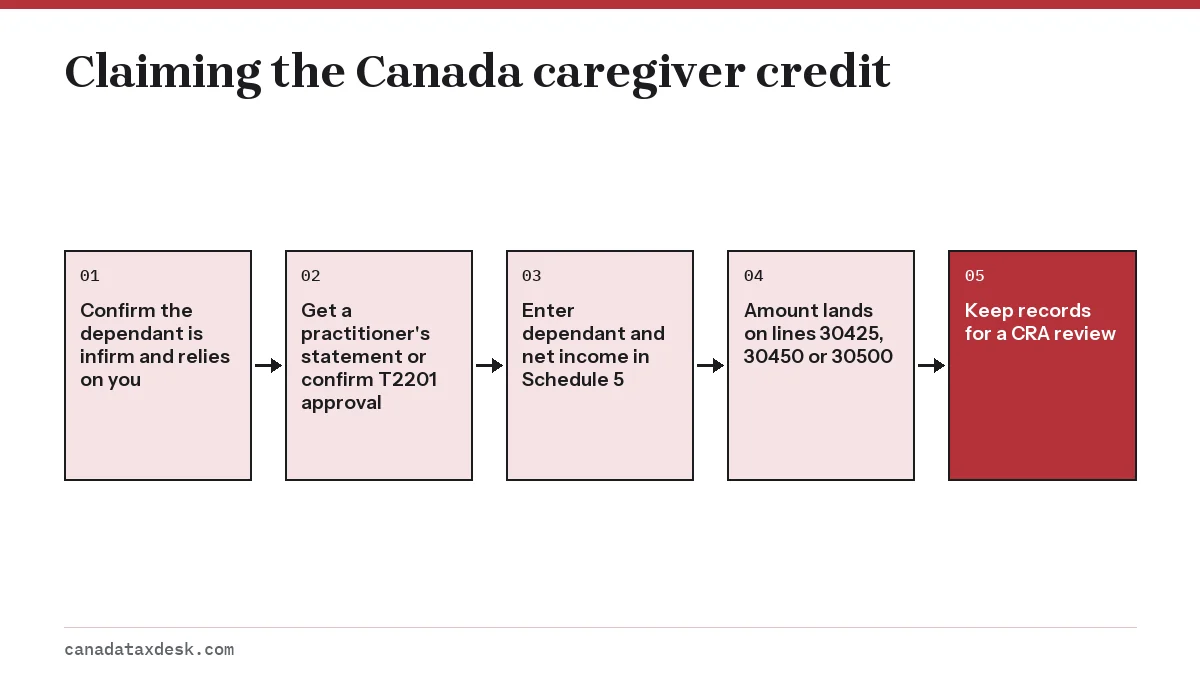
- Confirm the person meets the infirmity and dependence tests, and get their net income for the year (line 23600 of their return, or an estimate if they do not file).
- Get the practitioner's statement, or confirm that an approved T2201 is on file.
- In your software, add the person as a dependant, mark them as infirm, and enter their net income and relationship.
- Check which line the software used: 30300 or 30400 plus 30425 for a spouse or eligible dependant, 30450 for another adult relative, and 30500 with the number of children on line 30499.
- If you share the care with a sibling, enter only your agreed portion of the line 30450 amount.
- Keep the statement, proof of the person's income and records showing your support.
If you missed the credit in earlier years, ask the CRA to reassess those returns through Change my return in My Account or Form T1-ADJ. Couples caring for an infirm spouse who has pension income should also look at pension income splitting, which can shift income toward the lower-taxed partner.
Rules that stop a Canada caregiver claim
- You were required to pay support for the child and were the only parent paying it; in that case lines 30400, 30450 and 30500 are not available for that child, subject to exceptions in the year of separation.
- With shared custody, only the parent who claims line 30400 for the child can claim line 30500; if the parents cannot agree who claims, neither can.
- The dependant's net income is $28,798 or more (2025) for line 30450.
- The dependant has no infirmity, even if they rely on you financially.
The tax credits and deductions overview lists the other claims families most often combine with this one.
Step by step
Check eligibility
Confirm the person is infirm, depends on you for basic necessities and is a qualifying relative who lived in Canada in the year.
Get documentation
Obtain a signed medical practitioner's statement, unless the CRA has already approved Form T2201 for the person.
Find their net income
Get the dependant's line 23600 net income; the line 30450 amount ends at $28,798 (2025).
Complete Schedule 5
Enter the dependant in your software, which completes Schedule 5 and places the amount on lines 30300, 30400, 30425, 30450 or 30500.
Coordinate with others
If siblings share support, split the line 30450 amount so the total stays within the maximum.
Keep records
Store the statement and income proof in case the CRA asks during a review.
Common questions
Does my parent have to live with me for the caregiver credit?
Not for line 30450. Your parent must depend on you regularly and consistently for basic necessities, be infirm, and have lived in Canada during the year; a person only visiting from another country does not qualify.
Is the Canada caregiver credit paid monthly?
No. It is a non-refundable credit on your annual return that lowers the tax you owe. If you owe no tax, it does not produce a payment.
Can I claim the caregiver credit and the disability tax credit together?
Yes. The caregiver credit is yours; the disability amount belongs to the dependant, and any part they cannot use may be transferred to you on line 31800.
Can two siblings claim the caregiver credit for the same parent?
Yes, on line 30450 they can split the amount, but the combined claim cannot exceed the maximum for that parent.
What counts as infirm for the caregiver credit?
A physical or mental impairment that makes the person dependent on others for personal needs and care. It does not have to meet the stricter disability tax credit test, but a practitioner must be able to confirm it.
Can I claim the caregiver credit for my spouse?
Yes. If your spouse is infirm, $2,687 is added to the spouse amount on line 30300, and you may also claim up to $8,601 on line 30425 depending on their net income (2025 figures).
Sources
- CRA, Adjustment of personal income tax and benefit amounts (2026) canada.ca
- CRA, Canada caregiver amount canada.ca
- CRA, Schedule 5 (5000-S5) for 2025 canada.ca
- CRA, Disability tax credit canada.ca
- CRA, Tax rates and income brackets, current year canada.ca
We check figures against these official pages. Rules change; confirm anything that affects a deadline or payment with the agency before you act.
Tell us what happened
Describe your situation and our editors will use it to improve this guide. If you leave your email, we may reply with a pointer to the right page or official contact. We never share your details.
Related guides
 Tax Credits and Deductions in Canada: What You Can Claim
Tax deductions in Canada reduce the income you are taxed on, so they save tax at your top marginal rate, while most federal tax c…
Multigenerational Home Renovation Tax Credit: Who Qualifies
The multigenerational home renovation tax credit (MHRTC) is a refundable federal credit for building a self-contained secondary u…
Disability Tax Credit Eligibility for a Child: Who Claims
Disability tax credit eligibility for a child is decided on Form T2201 by comparing the child with other children of the same age…
Medical Expenses Tax Credit Canada: What You Can Claim
The medical expenses tax credit lets you claim eligible health costs above the lesser of 3% of your net income or $2,890 for 2026…
Pension Income Splitting in Canada: Rules and Example
Pension income splitting lets a Canadian resident allocate up to 50% of their eligible pension income to a spouse or common-law p…
Home Accessibility Tax Credit: 2026 Rule Change Explained
The home accessibility tax credit (HATC) is a federal non-refundable credit on up to $20,000 a year of permanent renovations that…