
Topic
Tax brackets in Canada for 2026: federal and provincial rates
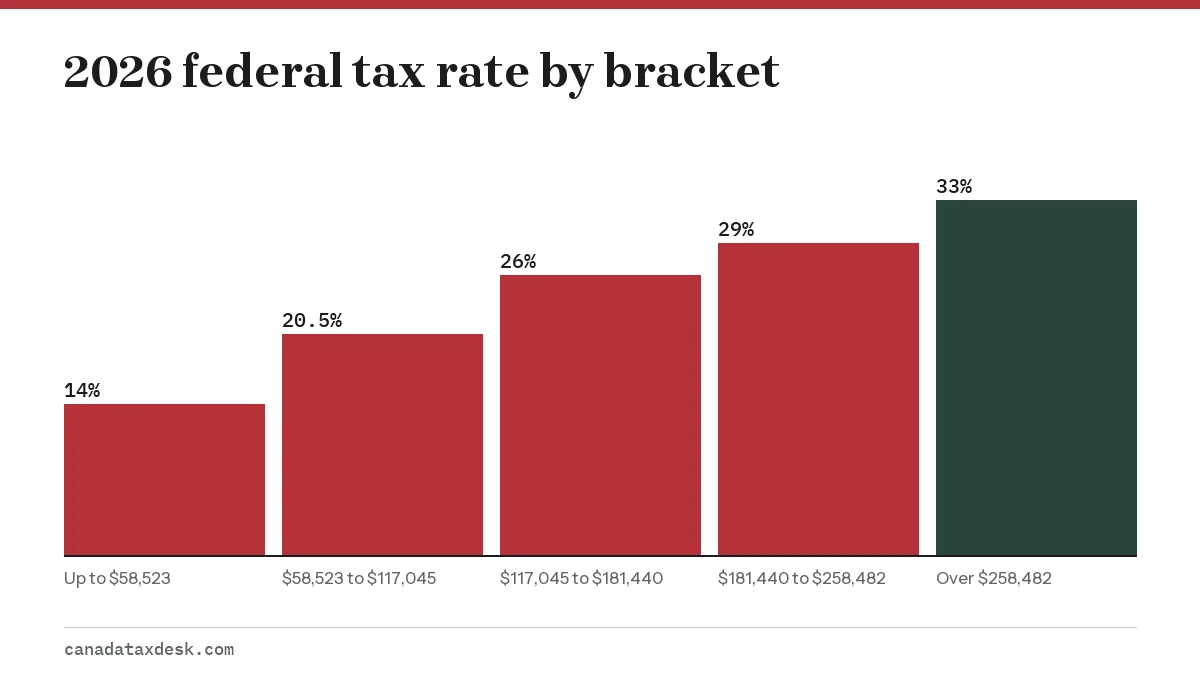
The 2026 federal tax brackets in Canada are 14% on the first $58,523 of taxable income, 20.5% up to $117,045, 26% up to $181,440, 29% up to $258,482 and 33% on income above that (CRA). Each province and territory charges its own brackets on top of these, and the 2027 brackets are not yet announced.
9 guides in this topic Updated October 20, 2026
- Alberta Tax Brackets 2026: New 8% Rate and ThresholdsAlberta's 2026 tax brackets are 8% on the first $61,200 of taxable income, 10% up to $154,259, 12% up to $185,111, 13% up to $246,813, 14% up to $370…
- BC Tax Brackets 2026: British Columbia Income Tax RatesBritish Columbia's 2026 tax brackets run from 5.6% on the first $50,363 of taxable income to 20.5% on income above $265,545, across seven bands (CRA…
- Basic Personal Amount 2026: $16,452 Federal, All ProvincesThe federal basic personal amount for 2026 is $16,452, reduced gradually for net income between $181,440 and $258,482 to a minimum of $14,829 (CRA, T…
- Canada Tax Brackets 2027: Release Timing and What to ExpectThe Canada tax brackets for 2027 are not yet announced as of October 20, 2026. The CRA usually publishes the indexed federal thresholds and the 2027…
- Canada's 14% Tax Rate: What the Rate Cut Means for YouThe 14% tax rate in Canada is the lowest federal income tax rate, charged on the first $58,523 of taxable income for 2026. It replaced the old 15% ra…
- Income Tax Calculator Canada: Estimate Your 2026 TaxThis income tax calculator for Canada estimates 2026 federal and provincial tax from your taxable income, using the CRA's 2026 brackets (14% to 33% f…
- Ontario Income Tax Brackets 2026: Combined Federal RatesOntario's 2026 income tax brackets (CRA) are 5.05% on the first $53,891 of taxable income, 9.15% up to $107,785, 11.16% up to $150,000, 12.16% up to…
- Quebec Tax Brackets 2026: 14% to 25.75% and Combined RatesThe 2026 Quebec tax brackets are 14% on taxable income up to $54,345, 19% up to $108,680, 24% up to $132,245 and 25.75% above that. Quebec sets these…
- Top-Up Tax Credit: How It Protects Your Credits in 2026The top-up tax credit is a temporary federal non-refundable credit, claimed on line 34990, that keeps a 15% value on non-refundable credit amounts ab…
What are the 2026 federal tax brackets in Canada?
For the 2026 tax year, the federal government taxes income in five bands, starting at 14% and ending at 33%. These are the Canada tax brackets you will use on the return you file in spring 2027, and the CRA published them on its current-year rates page.
| Taxable income | Federal rate | Maximum tax in the band |
|---|---|---|
| $0 to $58,523 | 14% | $8,193.22 |
| $58,523.01 to $117,045 | 20.5% | $11,997.01 |
| $117,045.01 to $181,440 | 26% | $16,742.70 |
| $181,440.01 to $258,482 | 29% | $22,342.18 |
| Over $258,482 | 33% | No upper limit |
A tax bracket is a band of taxable income that is charged one rate. Taxable income is the figure on line 26000 of your return, which is your total income minus deductions such as RRSP contributions, union dues and child care expenses. Brackets never apply to gross pay directly.
The 14% rate on the first band is new. Parliament lowered the bottom rate from 15% to 14% on July 1, 2025, so 2026 is the first calendar year taxed at 14% from January to December. Our page on the 14% lowest federal rate explains how that cut flows into credits and payroll.
How tax brackets in Canada work: a worked example
Canada uses marginal brackets, which means each rate only applies to the dollars inside its band. Earning one dollar more than a threshold raises the tax on that one dollar, not on your whole income. Nobody takes home less money because a raise moved them into a higher bracket.
Take a person in any province except Quebec with $75,000 of taxable income in 2026 and only the basic personal amount as a credit. The federal calculation runs like this:
- First $58,523 at 14%: $8,193.22.
- Next $16,477 (from $58,523 to $75,000) at 20.5%: $3,377.79.
- Tax before credits: $11,571.01.
- Subtract the basic personal amount credit: $16,452 x 14% = $2,303.28.
- Basic federal tax: $9,267.73, before CPP, EI, the Canada employment amount and any other credits.
This person's marginal rate is 20.5%, because the next dollar they earn falls in the second band. Their average federal rate is about 12.4% ($9,267.73 divided by $75,000). Provincial tax is added on a separate form, so the real marginal rate is higher once the province is included.
To run your own numbers with provincial tax included, use our Canadian income tax calculator.
Do provinces have their own tax brackets?
Yes. Every province and territory sets its own brackets, rates and personal amounts, and you pay them on top of federal tax. Outside Quebec, the CRA collects provincial tax on the same T1 return using a provincial Form 428 (for example Form ON428 for Ontario). Quebec residents file a separate provincial return with Revenu Québec.
| Province or territory | Lowest rate and first bracket | Top rate and where it starts |
|---|---|---|
| Alberta | 8% to $61,200 | 15% above $370,220 |
| British Columbia | 5.6% to $50,363 | 20.5% above $265,545 |
| Manitoba | 10.8% to $47,564 | 17.4% above $101,200 |
| New Brunswick | 9.4% to $52,333 | 19.5% above $193,861 |
| Newfoundland and Labrador | 8.7% to $44,678 | 21.8% above $1,141,275 |
| Northwest Territories | 5.9% to $53,003 | 14.05% above $172,346 |
| Nova Scotia | 8.79% to $30,995 | 21% above $157,124 |
| Nunavut | 4% to $55,801 | 11.5% above $181,439 |
| Ontario | 5.05% to $53,891 | 13.16% above $220,000, plus surtax |
| Prince Edward Island | 9.5% to $33,928 | 20% above $200,000 |
| Saskatchewan | 10.5% to $54,532 | 14.5% above $155,805 |
| Yukon | 6.4% to $58,523 | 15% above $500,000 |
| Quebec | Set by Revenu Québec | Set by Revenu Québec |
The three largest English-speaking provinces each have a detailed page with every threshold, combined rates and a worked example: Ontario tax brackets, BC tax brackets and Alberta tax brackets. Quebec works differently because residents get a 16.5% abatement off basic federal tax; see Quebec tax brackets for how the two returns fit together.
Combined federal and provincial top rates
Adding the top federal rate of 33% to the top provincial rate gives the combined top marginal rate. In 2026 that is 48% in Alberta (33% + 15%) and 53.5% in British Columbia (33% + 20.5%). Ontario reaches about 53.53% because its surtax adds 56% of provincial tax at high incomes, which turns a 13.16% top rate into an effective 20.53%.
Canada tax brackets 2026 vs 2025: what changed
Two things changed between the 2025 and 2026 federal tables. The thresholds rose by the 2.0% indexing factor, and the bottom rate dropped from a blended 14.5% for 2025 to a flat 14% for 2026. The upper four rates did not change.
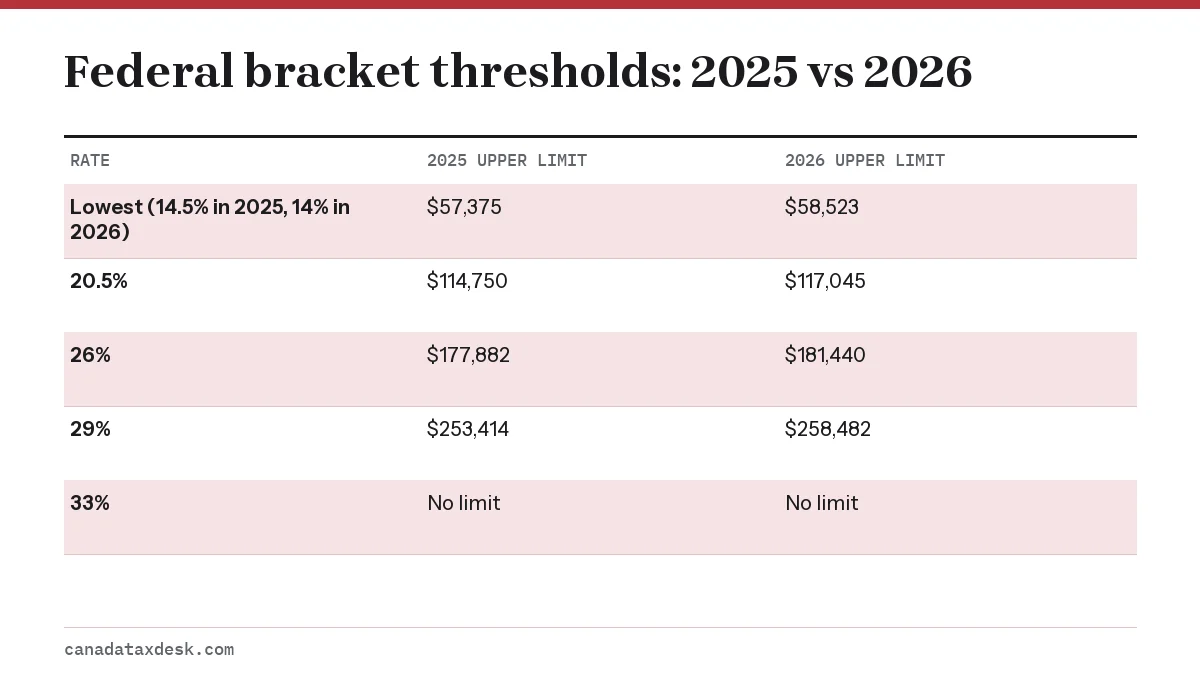
The 14.5% figure for 2025 is a blend: 15% applied for the first half of the year and 14% for the second half, and the CRA averaged them for the 2025 return. That is why the 2025 return shows a rate no one actually paid in any single month.
For the same $75,000 of taxable income, federal tax before credits falls from $11,932.50 under the 2025 table to $11,571.01 under the 2026 table, a drop of $361.49. After the basic personal amount credit (worth $2,338.71 in 2025 and $2,303.28 in 2026), the saving is $326.06. The credit is worth slightly less because it is calculated at the lower rate, which is also why the government added a temporary top-up tax credit for people with large credit claims.
Where your bracket shows up on the T1 return
You never pick a bracket yourself. Your tax software, or the paper return, applies the brackets to the amount on line 26000 in three places:
- Step 5 of the T1 return calculates federal tax on taxable income using the 2026 brackets, then subtracts federal non-refundable tax credits such as the basic personal amount and the credits for CPP and EI contributions.
- Form 428 for your province (ON428, BC428, AB428 and so on) repeats the process with provincial brackets and provincial credit amounts. Quebec residents use Revenu Québec's TP-1 return instead.
- Your notice of assessment shows the federal and provincial tax the CRA accepted. If the CRA recalculates a bracket amount, the change appears in the explanation section of the notice.
Your employer uses the same brackets during the year. Payroll withholding follows the CRA's T4127 payroll formulas, and the personal amounts you claim on Form TD1 and your provincial TD1 form reduce how much is held back from each pay cheque.
When will the 2027 tax brackets be released?
The 2027 federal brackets are not yet announced as of October 20, 2026. The CRA usually publishes the next year's indexed brackets, the basic personal amount and payroll changes in November, once the September consumer price index is known. We track that release on our 2027 tax brackets page.
Some provincial 2027 numbers are already partly known. British Columbia's Budget 2026 paused indexation of its brackets and non-refundable credits for the 2027 to 2030 tax years, so BC thresholds are set to stay at their 2026 levels. Manitoba stopped indexing its brackets and basic personal amount starting in 2025.
Tax rate topics in this section
The brackets are only half of the calculation. The other half is the set of credits that reduce the tax the brackets produce, starting with the basic personal amount for 2026, which removes federal tax on the first $16,452 of income for most people. Use the pages below by question:
- Want every threshold for your province: use the Ontario, BC, Alberta or Quebec pages linked above.
- Want to know why the 2026 rate is 14%: read the 14% lowest rate page.
- Claiming large credits such as tuition or medical expenses: check the top-up tax credit page.
- Planning for 2027 payroll or RRSP decisions: watch the 2027 brackets page for the November release.
Common questions
What tax bracket am I in if I make $60,000 in Canada?
With $60,000 of taxable income in 2026, your federal marginal rate is 20.5%, because only the first $58,523 is taxed at 14%. The top $1,477 is taxed at 20.5%. Your provincial rate is added on top.
Are tax brackets based on gross income or taxable income?
Brackets apply to taxable income on line 26000 of the T1 return, not to gross salary. Deductions such as RRSP contributions, child care expenses and union dues reduce taxable income before the brackets are applied.
Will a raise push me into a higher bracket and lower my take-home pay?
No. Only the dollars above a threshold are taxed at the higher rate. A raise that crosses from $58,523 into the 20.5% band is taxed at 20.5% federally on the portion above the line, so your after-tax pay still goes up.
What is the highest tax bracket in Canada for 2026?
The top federal rate is 33% on taxable income above $258,482. Combined with provincial tax, the highest top rates in 2026 are about 53.53% in Ontario and 53.5% in British Columbia.
Do Quebec residents use the same federal tax brackets?
Yes, Quebec residents use the same federal brackets, but they receive a 16.5% abatement that reduces basic federal tax. They file a separate provincial return with Revenu Québec, which sets its own brackets.