
The top-up tax credit: line 34990 explained for 2026
Short answer
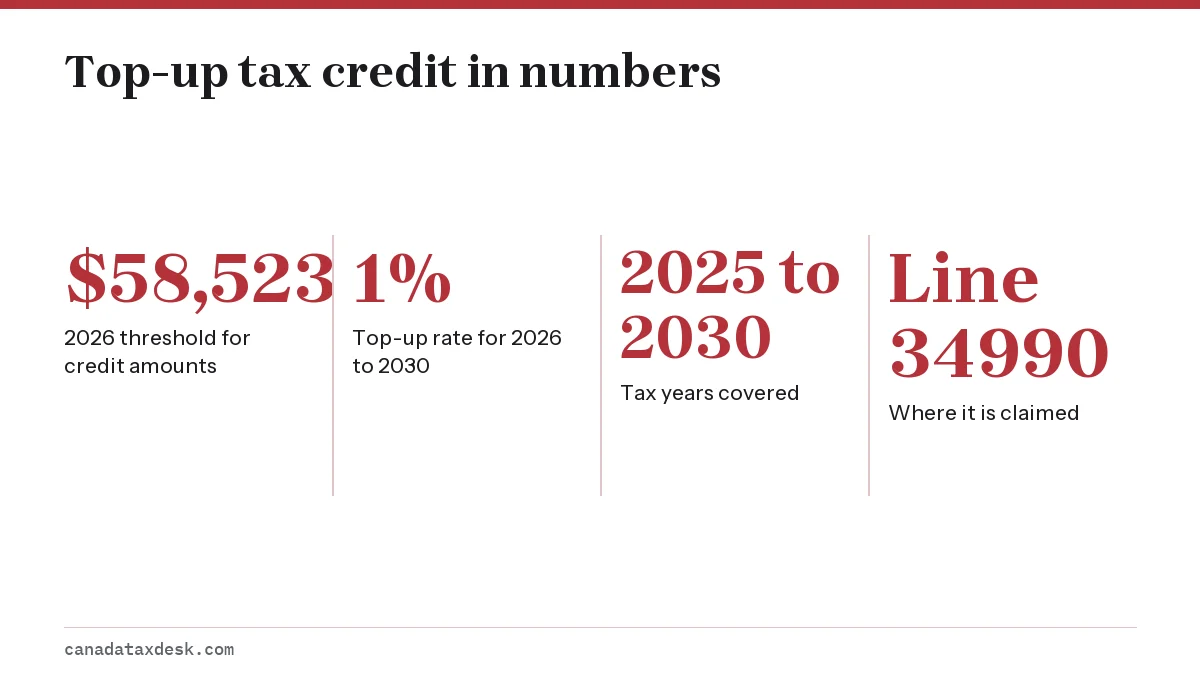
The top-up tax credit is a temporary federal non-refundable credit, claimed on line 34990, that keeps a 15% value on non-refundable credit amounts above the first bracket threshold ($58,523 for 2026). It equals 1% of the excess for 2026 to 2030 (0.5% above $57,375 for 2025). Finance Canada expects fewer than 0.3% of filers to need it.
- 01Return line
- Line 34990 of the federal return
- 022026 threshold
- $58,523 of total credit amounts
- 03Top-up rate
- 0.5% for 2025; 1% for 2026 to 2030
- 04Years available
- 2025 to 2030 tax years
- 05Share of filers affected
- Less than 0.3% (Finance Canada)
What is the top-up tax credit?
The top-up tax credit is a non-refundable federal credit that restores the old 15% value to non-refundable credit amounts claimed above the first income tax bracket threshold. The CRA describes it as effectively maintaining a 15% rate on those amounts, and you claim it on line 34990 of your return after completing a chart on the Federal Worksheet.
In plain terms, it is a small correction. Most people never reach it, because their total credit amounts are far below $58,523. It matters for people with very large claims in one year, such as heavy medical bills or high tuition.
Why was the top-up tax credit created?
It was created because of the cut to the lowest federal rate. When Bill C-4 lowered that rate from 15% to 14.5% for 2025 and 14% for 2026, it also lowered the rate used for most non-refundable credits, since the law ties the two together.
For almost everyone that trade is a gain: the tax cut on the first $58,523 of income is bigger than the loss on credits. But if your credit amounts exceed $58,523, the credit loss on the amount above that line is not matched by any tax saving, and you could end up paying more than before the cut. Finance Canada's June 2026 report says the top-up prevents that result, and the measure became law when Bill C-15 received Royal Assent on March 26, 2026.
Our page on the 14% lowest federal rate covers the rate cut itself and what it saves an average filer.
Who gets the top-up tax credit in Canada?
You benefit only if the non-refundable credit amounts you claim add up to more than the first bracket threshold for the year, and you have enough federal tax for the credit to reduce. Typical situations include:
- A large one-year medical expense claim on lines 33099 and 33199, for example full-time attendant care or a long-term care home.
- High tuition on line 32300, such as a professional degree, especially when combined with carried-forward amounts.
- A combination of the disability amount, caregiver amounts, transferred amounts and a big medical claim in the same year.
- A retroactive year of claims, where several large amounts land on one return.
Because the credit is non-refundable, it cannot create a refund on its own. If your credits already reduce federal tax to zero, the top-up does nothing for you that year.
How is the top-up credit calculated?
The calculation takes the total of your eligible non-refundable credit amounts, subtracts the first bracket threshold, and multiplies the excess by the difference between 15% and the lowest rate for the year.
| Tax year | Threshold | Lowest rate | Top-up rate on the excess |
|---|---|---|---|
| 2025 | $57,375 | 14.5% | 0.5% |
| 2026 | $58,523 | 14% | 1% |
| 2027 to 2030 | Indexed threshold, not yet announced for 2027 | 14% under current law | 1% |
- Add up the non-refundable credit amounts on your federal return that are calculated at the lowest rate (Step 5 of the return).
- Subtract the threshold for the year ($58,523 for 2026).
- If the result is positive, multiply it by 1% for 2026.
- Enter the result on line 34990. Tax software does this through the Federal Worksheet chart for line 34990.
Inside the line 34990 chart on the 2025 Federal Worksheet
The CRA's 2025 Federal Worksheet (5000-D1) does the same calculation in credit dollars rather than credit amounts. It adds two figures: line 33800 of your return, which is your total federal non-refundable credit amounts multiplied by 14.5%, and line 22 of Schedule 9, which is the credit on the first $200 of your donations. So the first $200 of charitable gifts counts toward the top-up, while gifts above $200 are credited at 29% or 33% and do not.
| Chart line | What you enter |
|---|---|
| Line 1 | Amount from line 33800 of your return |
| Line 2 | Amount from line 22 of Schedule 9 (credit on the first $200 of donations) |
| Line 3 | Line 1 plus line 2 |
| Line 4 | $8,319.38 (the $57,375 threshold multiplied by 14.5%) |
| Line 5 | Line 3 minus line 4; if negative, enter 0 |
| Line 6 | Applicable rate: 3.45% |
| Line 7 | Line 5 multiplied by 3.45%; enter this on line 34990 |
Multiplying by 3.45% turns the 14.5% credit value back into the 0.5% top-up (0.5 divided by 14.5), so the result is essentially the same as the simple formula above. The CRA has not yet released the 2026 worksheet; it will carry the 2026 threshold and rate when the 2026 tax package is published ahead of the 2027 filing season.
Worked example: a large medical claim in 2026
Take an employee with $80,000 of net and taxable income in 2026 who paid $50,000 in eligible medical expenses. Their medical threshold is 3% of net income, $2,400, because that is lower than the dollar threshold (the CRA's 2026 dollar threshold is $2,890). The example ignores CPP and EI credits for simplicity.
| Item | Amount |
|---|---|
| Basic personal amount | $16,452 |
| Canada employment amount | $1,501 |
| Medical expenses claimed ($50,000 minus $2,400) | $47,600 |
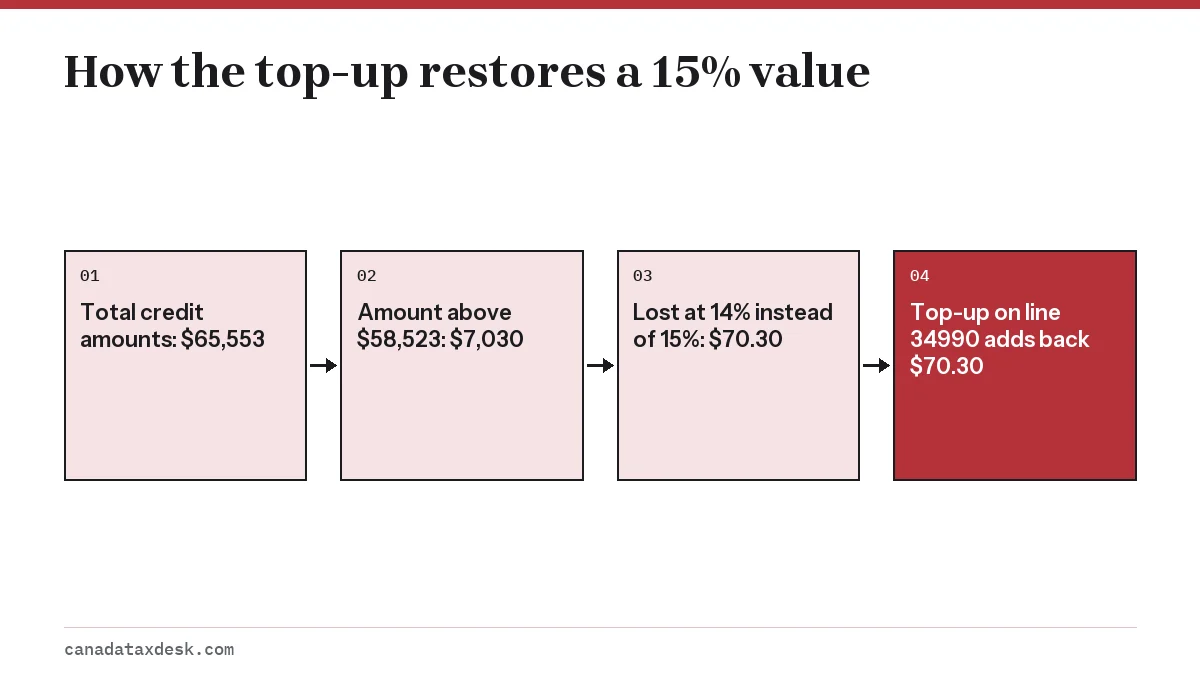
| Total credit amounts | $65,553 |
| Excess over $58,523 | $7,030 |
| Top-up tax credit at 1% | $70.30 |
Federal tax on $80,000 is $12,596.01. Credits at 14% are $9,177.42, and the top-up adds $70.30, leaving federal tax of $3,348.29. Under the old 15% rate the same person would also have owed $3,348.29, so the top-up exactly cancels the loss this person would otherwise have taken from the rate cut. Without it, they would pay $70.30 more than before.
How long does the top-up tax credit last?
The top-up tax credit applies for the 2025 to 2030 tax years, according to Finance Canada. It first appeared on 2025 returns filed in spring 2026, and the 2026 return filed in 2027 is the first year at the full 1% top-up rate.
Nothing in current law extends it past 2030. The threshold rises with the first federal bracket each year; the 2027 threshold is not yet announced; the CRA usually publishes its indexed figures in November, so expect it in November 2026. See our 2027 brackets page for release timing, and 2026 brackets for the current threshold.
What to do if you think you missed it
If your 2025 return had credit amounts above $57,375 and line 34990 is blank on your notice of assessment, you can ask for a change through Change my return in My Account or on Form T1-ADJ. To see how much tax you actually owe after credits, run your numbers through our income tax calculator.
Common questions
Is the top-up tax credit refundable?
No. It is a non-refundable credit, so it can only reduce federal tax you would otherwise pay. It cannot create or increase a refund when your tax is already zero.
Do I have to apply for the top-up tax credit?
There is no application. You claim it on line 34990 of your federal return, and tax software calculates it from the Federal Worksheet when your credit amounts exceed the threshold.
How much is the top-up tax credit worth?
For 2026 it is 1% of your credit amounts above $58,523. Someone with $70,000 of credit amounts would get $114.77, while most filers get nothing because their credits are below the threshold.
Does the top-up credit apply to provincial tax?
No. It is a federal credit tied to the federal rate cut. Provinces set their own credit rates on their Form 428, and Quebec on its own return.
Can I get the top-up credit for my 2025 return?
Yes, if your non-refundable credit amounts for 2025 were above $57,375. The 2025 rate is 0.5% of the excess, and you can request a change if you did not claim it.
Do charitable donations count toward the top-up tax credit?
Only the first $200. The 2025 Federal Worksheet chart adds the credit on the first $200 of donations, from line 22 of Schedule 9, to your other credits. Gifts above $200 are credited at 29% or 33%, rates the cut did not change, so they are not part of the top-up.
Sources
- CRA, Line 34990 Top-up tax credit canada.ca
- CRA, What you need to know for the 2026 tax-filing season canada.ca
- Finance Canada, Report on the Impact of Reducing the Lowest Marginal Personal Income Tax Rate on Non-Refundable Tax Credits canada.ca
- CRA, Tax rates and income brackets for individuals, 2025 canada.ca
- CRA, Lines 33099 and 33199 Eligible medical expenses canada.ca
- CRA, 5000-D1 Federal Worksheet (2025), chart for line 34990 canada.ca
- CRA, Indexation adjustment for personal income tax and benefit amounts canada.ca
We check figures against these official pages. Rules change; confirm anything that affects a deadline or payment with the agency before you act.
Tell us what happened
Describe your situation and our editors will use it to improve this guide. If you leave your email, we may reply with a pointer to the right page or official contact. We never share your details.
Related guides
 Canada Tax Brackets 2026: Federal and Provincial Rates
The 2026 federal tax brackets in Canada are 14% on the first $58,523 of taxable income, 20.5% up to $117,045, 26% up to $181,440,…
Medical Expenses Tax Credit Canada: What You Can Claim
The medical expenses tax credit lets you claim eligible health costs above the lesser of 3% of your net income or $2,890 for 2026…
Income Tax Calculator Canada: Estimate Your 2026 Tax
This income tax calculator for Canada estimates 2026 federal and provincial tax from your taxable income, using the CRA's 2026 br…
Change My Return CRA: Fix a Mistake on Your Tax Return
Change my return is the CRA's online service in My Account for correcting a personal tax return that has already been assessed. I…