
Income tax calculator for Canada: estimate your 2026 tax and refund
Short answer
This income tax calculator for Canada estimates 2026 federal and provincial tax from your taxable income, using the CRA's 2026 brackets (14% to 33% federally) and personal amounts. Add the tax already withheld from your T4 slips and it estimates your refund or balance owing on the return you file by April 30, 2027.
- 01Tax year calculated
- 2026 (return filed in 2027)
- 02Federal rates used
- 14%, 20.5%, 26%, 29%, 33%
- 03Federal basic personal amount
- $16,452 (reduced above $181,440)
- 042026 CPP employee maximum
- $4,230.45 plus $416 CPP2
- 052026 EI employee maximum
- $1,123.07
How does this income tax calculator for Canada work?
The calculator follows the same order as the T1 return. It starts from your income, subtracts deductions to reach taxable income (line 26000), applies the 2026 federal and provincial brackets, then subtracts non-refundable credits. What remains is your estimated income tax for the year.
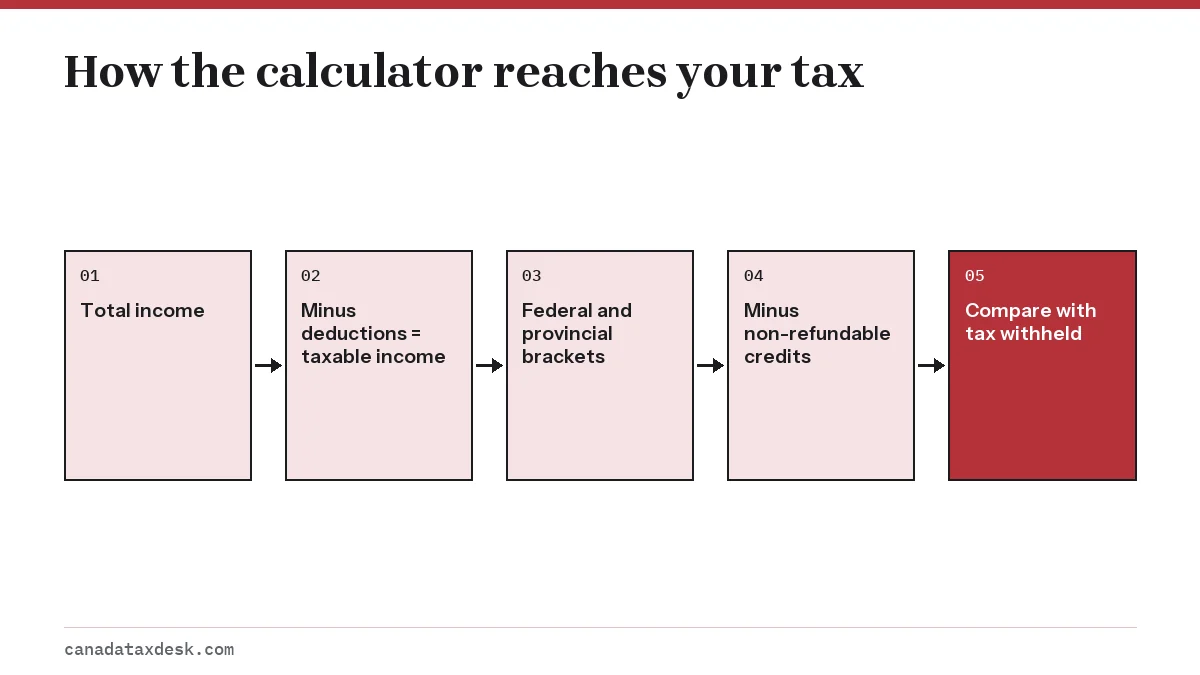
To turn that into a tax refund estimate, the calculator compares your estimated tax with the income tax deducted at source (box 22 of each T4 slip) plus any instalments you paid. A positive difference is a refund; a negative one is a balance owing due April 30, 2027.
The federal figures come from the CRA's 2026 rate table and the January 2026 T4127 payroll formulas. The provincial step uses your province's 2026 brackets and basic personal amount, and the calculator gives a result only when every 2026 figure for that province is loaded. If it shows a notice that your province's figures are not in the calculator yet, follow the federal steps on this page and use the full 2026 brackets on our Ontario, Alberta, BC or Quebec pages, or the lowest and top rate for every province on our federal and provincial brackets page.
What inputs do you need for a tax return estimate?
Gather your slips before you start; a tax return estimator is only as good as the numbers you enter. Everything below is printed on documents you receive by the end of February 2027 or can see in CRA My Account.
| Input | Where the number comes from |
|---|---|
| Employment income | T4 box 14 (all T4 slips added together) |
| Other income | T4A, T5, T4E and other slips, plus self-employment net income |
| RRSP and FHSA deductions | Receipts for contributions made after March 2, 2026 and up to March 1, 2027 that you have not already deducted |
| Other deductions | Child care, union dues, moving expenses, support paid |
| Province of residence | Where you lived on December 31, 2026 |
| Tax already paid | T4 box 22, T4A box 22, and instalments shown in My Account |
Federal and provincial steps in the calculation
The calculator runs two separate calculations and adds them, because every province except Quebec collects its tax on Form 428 inside the federal return.
- Federal tax on taxable income using the 2026 bands: 14% to $58,523, 20.5% to $117,045, 26% to $181,440, 29% to $258,482 and 33% above.
- Federal credits at 14%: the basic personal amount of $16,452 (gradually reduced to $14,829 between $181,440 and $258,482 of net income), the Canada employment amount of $1,501 if you have employment income, and the base CPP and EI contributions.
- Provincial tax using your province's brackets, minus provincial credits at the province's lowest rate.
- Provincial extras where they apply, such as the Ontario surtax and Ontario Health Premium.
- Total tax minus tax paid gives the refund or balance owing.
Quebec residents need a different path: federal tax is reduced by the 16.5% Quebec abatement and provincial tax is filed with Revenu Québec on its own return. See our Quebec tax brackets page for those rates.
How much tax will I pay in Canada? Example results
The table shows federal results for three employees outside Quebec in 2026, each with only employment income, the basic personal amount and the Canada employment amount. CPP and EI are shown as payroll deductions; the credits for them would lower federal tax a little further.
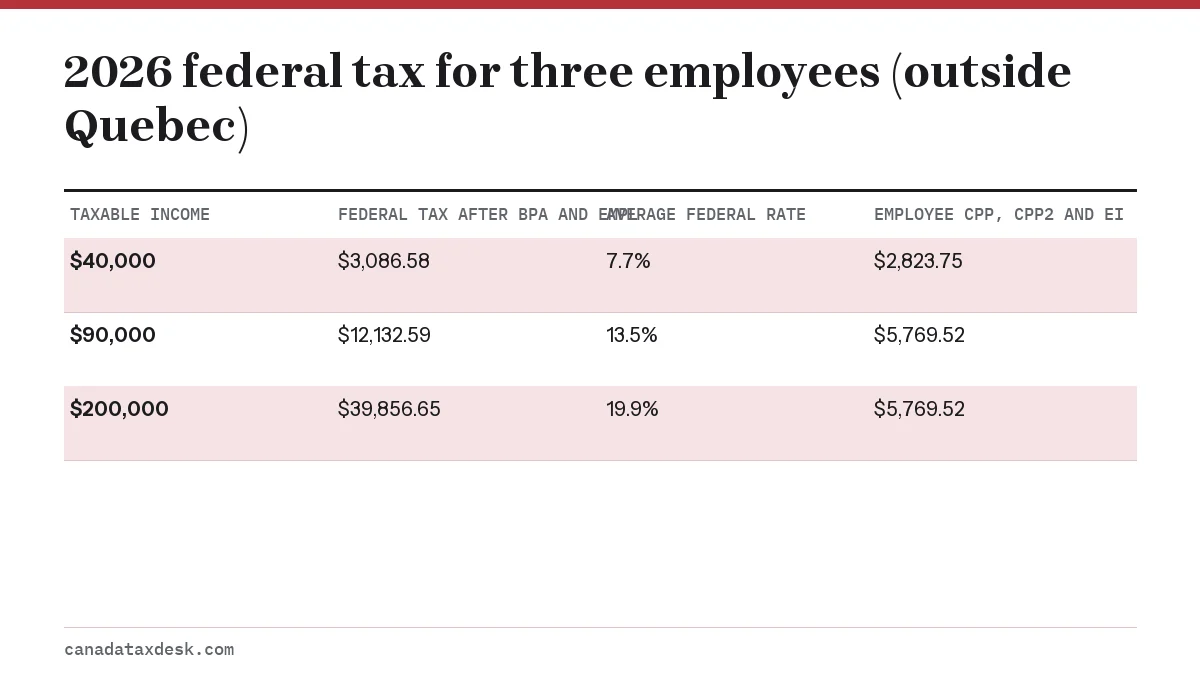
The $200,000 earner's basic personal amount is $16,061 rather than $16,452, because the amount starts to shrink once net income passes $181,440. Provincial tax would be added to each row using your province's own brackets and credits.
These are the 2026 figures. If you are planning for next year, the 2027 brackets, basic personal amount and CPP earnings limit are not published yet; the CRA's indexed 2027 figures are expected in November 2026. See 2027 tax brackets for what is known so far.
Does the tax refund calculator include CPP and EI?
Yes, for employees. CPP and EI are not income tax, but they come off the same pay cheque and they create credits and a deduction on your return, so the calculator estimates them.
- CPP: 5.95% of employment earnings between $3,500 and $74,600, up to $4,230.45 for 2026.
- CPP2: 4% of earnings between $74,600 and $85,000, up to $416.
- EI: 1.63% of insurable earnings up to $68,900, up to $1,123.07.
Self-employed people pay both the employee and employer shares of CPP (11.9% up to a maximum of $8,460.90 for 2026, plus 8% CPP2) and usually no EI. For that situation use the self-employed tax calculator, which works from T2125 net income.
How accurate is a tax estimate?
An estimate is usually close for someone with employment income and a few common deductions. It can drift when your return includes items a short form cannot capture.
- Credits the calculator does not ask about, such as tuition, medical expenses, donations, the disability amount, the spouse or common-law partner amount, or amounts transferred from a spouse.
- Capital gains, eligible dividends and the dividend tax credit, which use their own gross-up and credit rules.
- Social benefits repayment of EI or OAS at higher incomes.
- Provincial credits and reductions for low income, which differ by province.
Use the result as a planning number, for example to decide on an RRSP contribution before March 1, 2027. The figure that counts is the one on your notice of assessment after you file.
Common questions
How do I estimate my tax refund in Canada?
Estimate your total federal and provincial tax for 2026, then subtract the income tax already deducted, which is box 22 on your T4 slips, plus any instalments. If more was deducted than you owe, the difference is your likely refund.
Why is my refund smaller than the calculator shows?
Common reasons are a second job whose withholding was too low, income from a slip you forgot, or a benefit repayment. The CRA may also keep part of a refund to pay other government debts.
Can I use the calculator for my 2025 return?
No. It uses 2026 rates and amounts. The 2025 year had a blended 14.5% lowest federal rate and lower thresholds, so a 2026 calculation will not match a 2025 return. For a 2025 return, certified tax software works out the tax as you enter your slips, and NETFILE accepts 2025 returns until January 29, 2027.
Does the calculator include the Ontario surtax and health premium?
Its formula includes both: a surtax of 20% of basic Ontario tax above $5,818 plus 36% above $7,446, and a health premium of $0 to $900 depending on taxable income. The calculator shows an Ontario result only once the health premium schedule is loaded; until then, our Ontario tax brackets page works both out at $75,000 and $150,000.
Should I enter my gross pay or my net pay?
Enter gross employment income from T4 box 14, before any deductions were taken off your pay. Net pay has already had tax, CPP and EI removed, so using it would understate your income and your tax.
How do I use my T4 slip with this calculator?
Enter box 14 as employment income and box 22 as income tax already deducted. The calculator works out CPP, CPP2 and EI from box 14 itself, so you do not enter boxes 16, 16A and 18; instead, compare its estimate with those boxes to check what your employer took off. With more than one T4, add the boxes together.
Sources
- CRA, Canadian income tax rates for individuals, current and previous years canada.ca
- CRA, T4127 Payroll Deductions Formulas, January 2026 canada.ca
- CRA, RRSP, DPSP, TFSA limits, YMPE and YAMPE canada.ca
- Finance Canada, Quebec Abatement canada.ca
We check figures against these official pages. Rules change; confirm anything that affects a deadline or payment with the agency before you act.
Tell us what happened
Describe your situation and our editors will use it to improve this guide. If you leave your email, we may reply with a pointer to the right page or official contact. We never share your details.
Related guides
 Canada Tax Brackets 2026: Federal and Provincial Rates
The 2026 federal tax brackets in Canada are 14% on the first $58,523 of taxable income, 20.5% up to $117,045, 26% up to $181,440,…
Basic Personal Amount 2026: $16,452 Federal, All Provinces
The federal basic personal amount for 2026 is $16,452, reduced gradually for net income between $181,440 and $258,482 to a minimu…
Self-Employed Tax Calculator Canada: Tax and CPP Estimate
This self-employed tax calculator for Canada estimates your 2026 federal and provincial income tax plus CPP and CPP2 on net busin…
Canada Tax Brackets 2027: Release Timing and What to Expect
The Canada tax brackets for 2027 are not yet announced as of October 20, 2026. The CRA usually publishes the indexed federal thre…
Canada's 14% Tax Rate: What the Rate Cut Means for You
The 14% tax rate in Canada is the lowest federal income tax rate, charged on the first $58,523 of taxable income for 2026. It rep…