
Topic
First time filing taxes in Canada: a step-by-step guide
First time filing taxes in Canada means sending the CRA a T1 return for the first year you had income or lived here, and for tax year 2026 that return is due April 30, 2027. You can file online with NETFILE-certified software and simply leave the access code blank, because first-time filers have never received a notice of assessment.
6 guides in this topic Updated October 22, 2026
- Age Amount Tax Credit 2026: Up to $9,208 at 65 and OlderThe federal age amount tax credit for 2026 in Canada is up to $9,208 for anyone 65 or older on December 31, 2026. It shrinks by 15% of net income abo…
- International Student Tax Return Canada: Must You File?Whether you need an international student tax return in Canada depends on your residency status, not your study permit. Most full-time students who m…
- Line 23500: Social Benefits Repayment on Your Tax ReturnLine 23500 social benefits repayment is the deduction for Old Age Security or Employment Insurance benefits you must pay back because your income was…
- Newcomer Tax Return Canada: Filing in Your First YearNewcomer tax filing in Canada starts on the day you establish significant residential ties, usually the day you arrive to live here. From that date y…
- Seniors Tax Return Canada: Credits and Filing Tips After 65A tax return for seniors in Canada is the regular T1 return, but after 65 it adds extra credits: an age amount of up to $9,208 for 2026 and a pension…
- Student Tax Return Canada: Credits and Tips for StudentsA student tax return in Canada is the regular T1 return, and most students should file one every year even with low income. Scholarships are usually…
What does first time filing taxes in Canada involve?
A first tax return is the first T1 Income Tax and Benefit Return the Canada Revenue Agency (CRA) receives under your social insurance number. Until that return is assessed, the CRA has no income history for you, which is why several services stay closed to first-time filers.
The return itself is the same form everyone files. What changes is the setup: you have no NETFILE access code, no carryforward amounts from past years, no CRA account yet, and possibly a date of entry to Canada to report. The rest of this page walks through each of those points in order.
For the 2026 tax year, most people must file and pay any balance by April 30, 2027, a Friday. Self-employed people and their spouses or common-law partners have until June 15, 2027 to file, but any amount owing is still due April 30 (CRA, important dates for individuals).
Why file your first return if you had little or no income?
File because the return is how the CRA decides who gets benefit and credit payments, not only who owes tax. The CRA says filing every year is a requirement to keep receiving the benefits you qualify for, and a first return with zero income still opens those doors.
- Benefit payments: the quarterly credit the CRA now lists as the Canada Groceries and Essentials Benefit, the Canada Child Benefit and most provincial credits are calculated from your return. Payment dates and amounts are published by the CRA and Service Canada on their own benefit pages.
- A refund of tax already taken: if an employer withheld income tax from a part-time job and your income was below the $16,452 basic personal amount for 2026, the federal portion comes back to you.
- RRSP room: 18% of earned income becomes registered retirement savings plan room, up to the annual limit ($33,810 for 2026 and $35,390 for 2027). Room only builds when a return reports the income.
- Carryforwards: unused tuition amounts and student loan interest are recorded only after a return is filed.
- Access to CRA services: registering for a CRA account and signing up for direct deposit through your bank both depend on having a filed return.
What documents do you need for a first time tax return in Canada?
You need your SIN, every tax slip issued to you for the year, receipts for anything you plan to claim, and a few personal details the software will ask for. Slips for 2026 must be issued by the end of February 2027, so wait until early March before filing if you expect more than one.
| Slip | What it reports | Typical first-time filer |
|---|---|---|
| T4 | Employment income and deductions (box 14 is income) | Anyone with a part-time or summer job |
| T4A | Scholarships (box 105), commissions and other income | Students with awards; gig or contract workers |
| T2202 | Eligible tuition and months of enrolment | Post-secondary students |
| T4E | Employment Insurance benefits | Anyone laid off during the year |
| T5 | Bank interest and investment income | Newcomers with Canadian savings accounts |
Newcomers also need the exact date they became a resident, and anyone who moved provinces needs to know where they lived on December 31, because that province sets the provincial tax for the whole year. Newcomers also apply for benefits separately: form RC151 for the Canada Groceries and Essentials Benefit (an online web form if you have no children under 19, or the paper form with proof of birth if you do), or form RC66 instead if you are eligible for the Canada Child Benefit, because the CRA uses it to assess both.
How to file your first tax return in Canada online
The fastest route is NETFILE, the CRA service that accepts returns sent directly from certified tax software. The CRA publishes a list of certified products, and several are free. For the 2026 season NETFILE opened on February 23, 2026; the opening date for the 2027 season is not yet announced and is usually published in the fall.
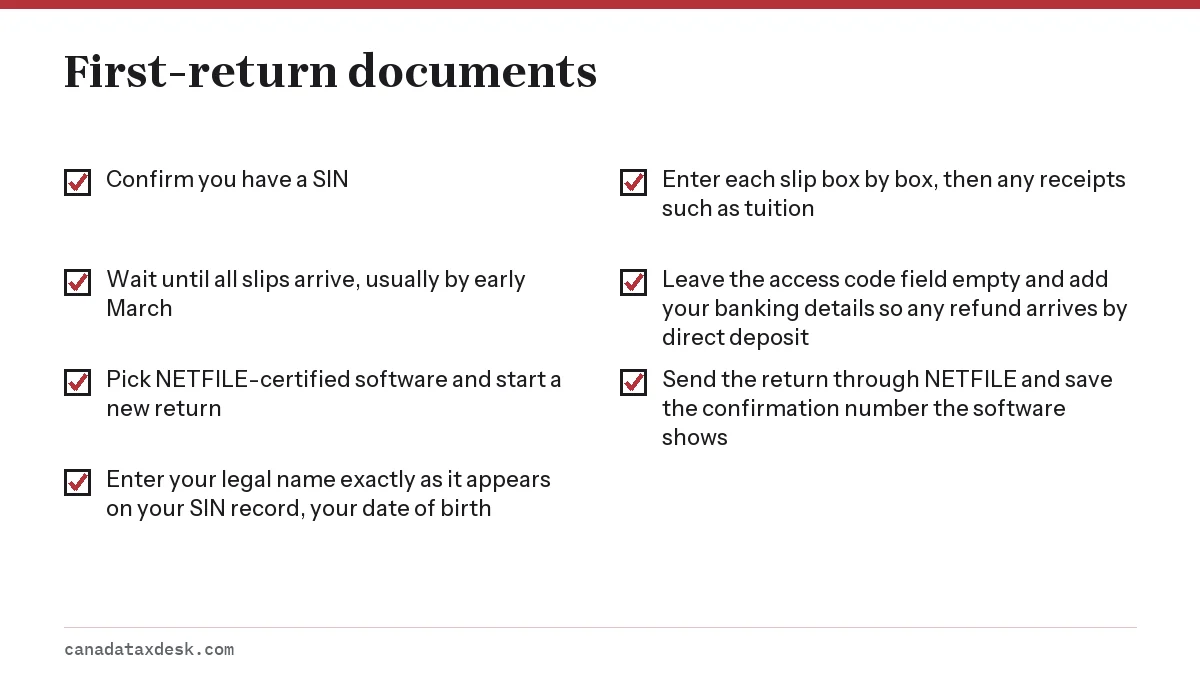
- Confirm you have a SIN. NETFILE accepts a SIN or a CRA temporary tax number (TTN) starting with 01 or 03, and the CRA may issue a TTN when Service Canada cannot give you a SIN. Without either, file on paper with a letter explaining why you do not have a SIN.
- Wait until all slips arrive, usually by early March.
- Pick NETFILE-certified software and start a new return, answering yes when it asks whether this is your first return.
- Enter your legal name exactly as it appears on your SIN record, your date of birth, your address and your marital status on December 31.
- Enter each slip box by box, then any receipts such as tuition, rent (in provinces with a rent credit) or medical costs.
- Leave the access code field empty and add your banking details so any refund arrives by direct deposit.
- Send the return through NETFILE and save the confirmation number the software shows.
Can you NETFILE a first time tax return in Canada?
Yes. The access code is optional, and the CRA uses it only to confirm identity and pre-validate returns from people who already have an assessment on file. A newcomer whose SIN starts with 0 can also use NETFILE, as long as none of the other NETFILE exclusions apply.
Other ways to file
Paper returns are still accepted, but the CRA says they usually take at least 8 weeks to process, against about 2 weeks for an online return. People with a modest income and a simple situation can use a free tax clinic run by the Community Volunteer Income Tax Program, where volunteers prepare and send the return at no charge.
Which guide fits your first return: newcomer, student or senior?
The steps above apply to everyone, but the claims and traps differ a lot by situation. Use the table to find the page written for you.
| Your situation | Main issue on the first return | Read |
|---|---|---|
| Moved to Canada as a permanent resident or worker | Part-year residency, world income, prorated credits | Newcomer tax filing in Canada |
| Studying in Canada on a study permit | Whether you are a resident at all, and claiming tuition | International student tax return |
| Canadian student or 18-year-old with a first job | Scholarships, tuition transfers, refunds of withheld tax | Student tax return guide |
| Turning 65 or newly retired | New credits, pension splitting, OAS clawback | Tax return for seniors |
Two narrower pages support the seniors guide: the age amount on line 30100, and the line 23500 social benefits repayment, which covers how an OAS or EI clawback appears on the return.
What happens after your first return is filed?
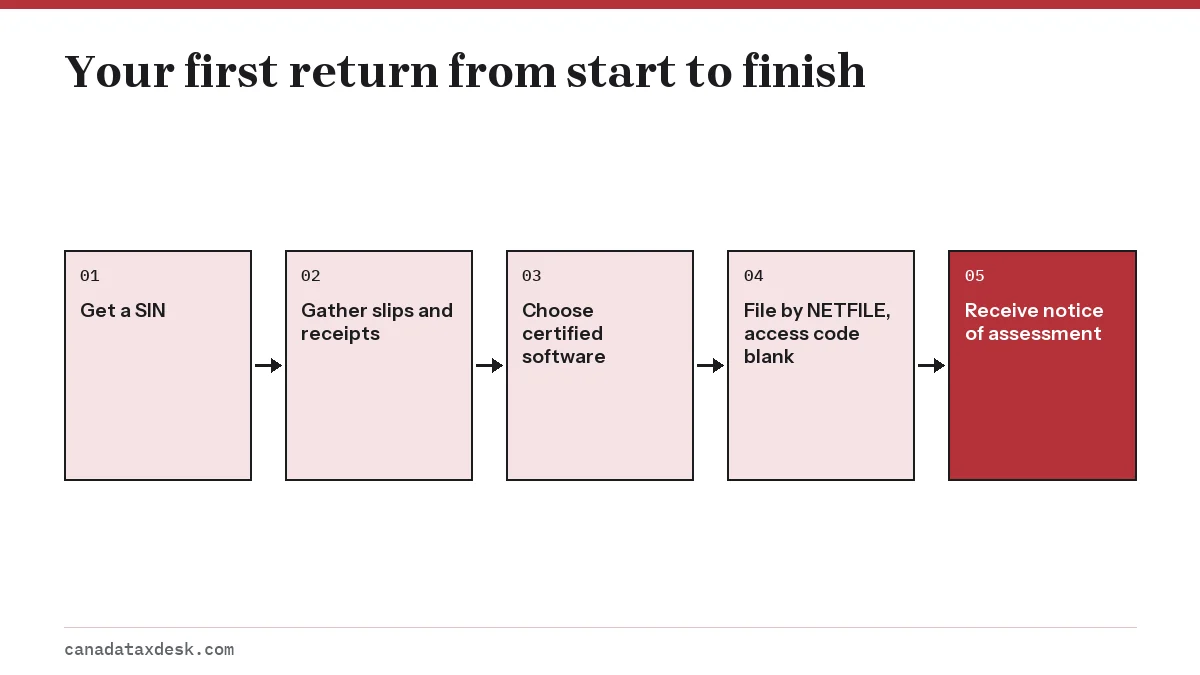
The CRA's service standard is to issue a notice of assessment within 2 weeks of an online return. That notice confirms your income, your refund or balance, your RRSP deduction limit and any unused tuition. Our notice of assessment guide explains each part of it.
- Keep the notice: it holds the 8-character access code you will enter next year (see where to find the NETFILE access code).
- Register for a CRA account using figures from the assessed return. Since February 9, 2026 the CRA no longer sends notices through tax software: they appear in your CRA account, and if you have no account yet the notice is mailed to the address on file.
- Pay any balance by April 30, 2027 to avoid interest. If you file late with a balance, the penalty is 5% of the amount owing plus 1% per full month, up to 12 months.
- Set up direct deposit so refunds and benefit payments arrive faster.
Common mistakes when first time filing taxes with the CRA
- Filing before every slip arrives. A missing T4A or T5 leads to a reassessment months later, often with interest.
- Typing a name that does not match the SIN record. The CRA matches your name, date of birth and SIN, and details that do not line up can stop a first NETFILE transmission.
- Skipping the return because income was low. This delays benefit payments and loses the RRSP room the income would have created.
- Claiming tuition you already transferred. A student who signed tuition over to a parent cannot also carry that same amount forward.
- Leaving out the date of entry. Newcomers who skip it get the full-year basic personal amount on the draft, which the CRA will correct.
Common questions
Do I need a CRA account to file my first tax return?
No. You can file through NETFILE-certified software or on paper without one. In practice you can only register for a CRA account after your first return is assessed, because registration asks for figures from a past return.
Will the CRA file my first tax return automatically?
No. Bill C-31 proposes letting the CRA file a return automatically for some low-income people, but it had not received Royal Assent as of mid-October 2026, and the Taxpayers' Ombudsperson raised concerns about the measure on October 5, 2026. For now, a first return is filed the usual way: with NETFILE-certified software, on paper or at a free tax clinic.
What if I file my first tax return late?
If you owe nothing, the CRA charges no late-filing penalty, but benefit payments may be delayed until the return is processed. If you owe tax, the penalty is 5% of the balance plus 1% for each full month late, up to 12 months.
Is there an age limit for filing a first return in Canada?
No. There is no minimum age. A teenager with a T4 from a summer job can file to get back income tax withheld and start building RRSP room.
Which tax year do I file first?
File for the first year you had income in Canada or became a resident. If that was 2026, your first return covers January 1 to December 31, 2026, or from your arrival date if you moved here during the year.
How long does a first-time refund take?
The CRA aims to assess online returns within 2 weeks, and a refund usually follows the notice. First returns are sometimes selected for extra identity checks, which can add time.