
Topic
GST/HST for small business in Canada: the full cycle from registration to payment
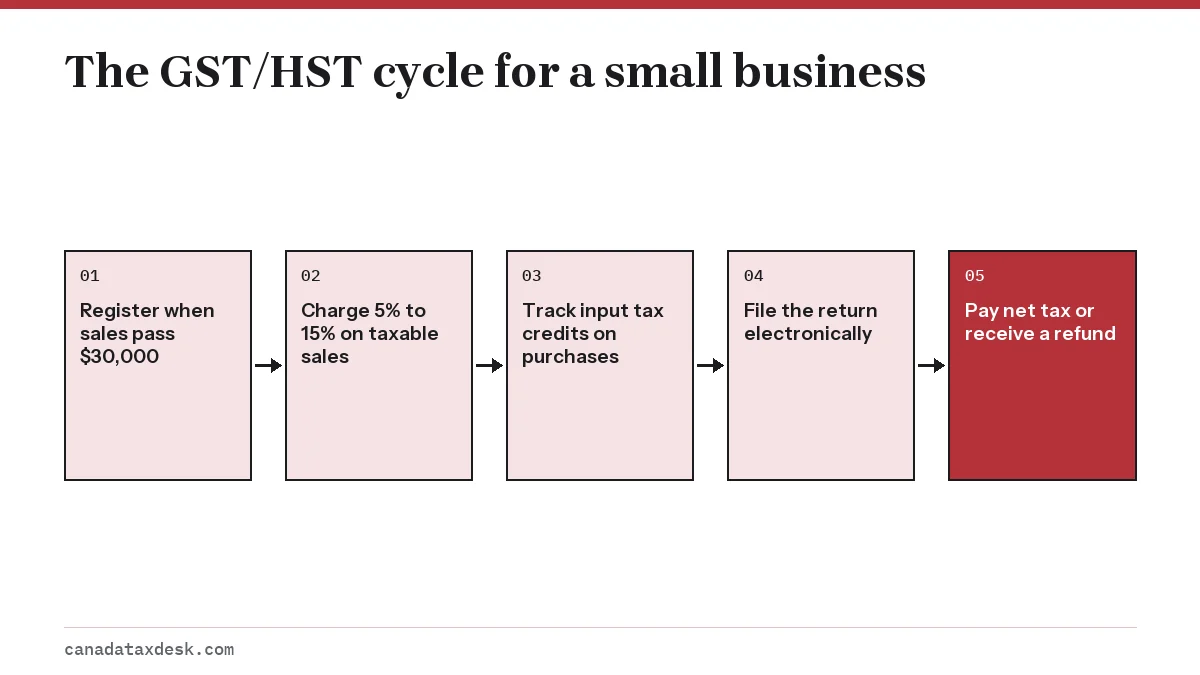
A Canadian small business must register for GST/HST once its taxable sales pass $30,000 in one calendar quarter or over four consecutive quarters, then charge 5% GST or 13% to 15% HST depending on the province, and file a GST/HST return electronically for every reporting period. Most small businesses are annual filers; monthly and quarterly filers file and pay within one month of each period.
12 guides in this topic Updated October 22, 2026
- GST Instalments (CRA): Due Dates, $3,000 Rule and AmountsGST instalments are due one month after the end of each fiscal quarter, so a December 31 year end means April 30, July 31, October 31 and January 31.…
- GST Late Filing Penalty: CRA Formula, Interest and ReliefThe GST late filing penalty is 1% of the amount owing plus 25% of that 1% for each complete month the return is late, up to 12 months, so it can reac…
- GST NETFILE Deadline: GST/HST Due Dates by Filing PeriodThe GST NETFILE deadline is one month after the end of the reporting period for monthly and quarterly filers, and three months after fiscal year end…
- GST NETFILE: How to File Your GST/HST Return OnlineGST NETFILE (officially GST/HST NETFILE) is the CRA's free online form for filing a GST/HST return without signing in to a CRA account: you enter you…
- GST Quick Method: Rates, Eligibility and Worked ExampleThe GST quick method lets an eligible small business remit a fixed percentage of its tax-included sales instead of tracking input tax credits on ever…
- GST Small Supplier Threshold: The $30,000 Rule ExplainedYou are a GST small supplier if your worldwide taxable sales, including those of associated businesses, are $30,000 or less both in any single calend…
- GST/HST Access Code: Find It Online or Get a New OneYou can find your GST/HST access code online: sign in to your CRA business account, open your GST/HST (RT) account and select View return details. Wi…
- GST/HST Registration: How to Register for a GST/HST NumberGST/HST registration is mandatory once a business stops being a small supplier, which happens when taxable sales pass $30,000 in one calendar quarter…
- HST Rates by Province 2026: GST, HST, PST and QST TableHST rates by province in 2026 are 13% in Ontario, 14% in Nova Scotia and 15% in New Brunswick, Newfoundland and Labrador and Prince Edward Island. Ev…
- How to File a GST Return in Canada: Lines and StepsTo file a GST return in Canada, total your sales and the GST/HST you charged for the period, subtract the GST/HST you paid on business purchases (inp…
- How to File a Nil GST/HST Return Online, Step by StepTo file a nil GST return, sign in to My Business Account and file the return for that period with zero amounts, or use the GST/HST NETFILE form with…
- Uber GST Number: Needed From Ride One, Uber Eats at $30,000GST/HST registration for Uber drivers is required from the day you start giving paid rides, whatever you earn, because the CRA treats commercial ride…
What GST/HST means for a small business in Canada
GST/HST is the federal sales tax a registered business adds to most sales and later sends to the Canada Revenue Agency (CRA). The Goods and Services Tax (GST) is 5% across Canada. In five Atlantic and central provinces it is combined with a provincial portion into a single Harmonized Sales Tax (HST).
The business is a collector, not the payer. Your customer pays the tax, you hold it, and on each GST/HST return you subtract the tax you paid on your own business purchases (your input tax credits) before sending the difference. If you paid out more than you collected, the CRA refunds the gap.
This hub walks through the whole GST/HST small business cycle in the order you meet it: deciding whether to register, charging the right rate, keeping records, filing the GST/HST return, and paying on time. Each step links to a page that goes deeper.
Do I need to charge GST/HST?
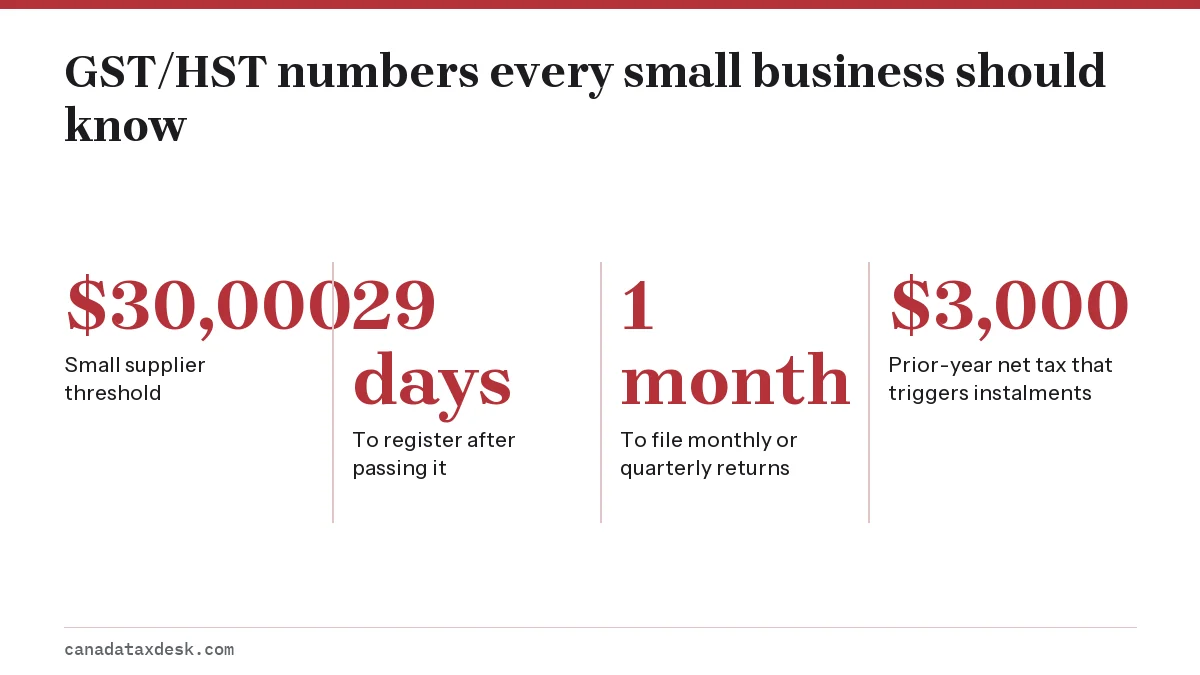
You need to charge GST/HST once you stop being a small supplier, which happens when your worldwide taxable sales pass $30,000 in a single calendar quarter or over the last four consecutive calendar quarters (CRA, When to register for and start charging the GST/HST). Sales of your associates count toward the total. Sales of capital property, goodwill and financial services do not.
Crossing the line in one quarter means you charge tax on the very sale that pushed you over. Crossing it over four quarters gives you until the end of the following month. Either way, you then have 29 days to register. The two tests and their timing are worked through with dates on our GST small supplier threshold page.
Businesses that must register from the first dollar
Taxi businesses and commercial ride-sharing drivers must register for GST/HST even when their fares are well under $30,000. Registration starts on the day they begin driving. See GST/HST for Uber and ride-share drivers for what that means on each trip.
Other thresholds
- Public service bodies such as non-profits and municipalities: $50,000 in taxable supplies.
- Charities and public institutions: a $250,000 gross revenue test as well as the $50,000 taxable supplies test.
- Non-residents: the usual thresholds, plus a possible security deposit on registration.
How GST/HST registration works
Registration gives you a 15-character GST/HST account number: your 9-digit Business Number (BN) followed by a program identifier such as RT0001. You put this number on invoices so business customers can claim credits for the tax you charge them.
Most sole proprietors and corporations outside Quebec register through Business Registration Online, which requires a CRA account. Since November 3, 2025, the CRA no longer accepts new registrations by phone; the few cases the online service cannot handle, such as reactivating a closed program account, go on Form RC1 by mail. Businesses in Quebec register for GST with Revenu Quebec instead of the CRA. Our GST/HST registration guide lists every piece of information the application asks for.
What is the GST/HST rate in my province?
As of April 1, 2025, the GST/HST rate is 5% in Alberta, British Columbia, Manitoba, Saskatchewan, Quebec and the three territories; 13% HST in Ontario; 14% HST in Nova Scotia; and 15% HST in New Brunswick, Newfoundland and Labrador and Prince Edward Island (CRA, GST/HST calculator). Nova Scotia's rate dropped from 15% to 14% on that date.
| Province or territory | Tax charged | Rate | Separate provincial tax |
|---|---|---|---|
| Alberta, NWT, Nunavut, Yukon | GST | 5% | None |
| British Columbia, Manitoba, Saskatchewan | GST | 5% | Yes (PST or RST) |
| Quebec | GST | 5% | Yes (QST 9.975%) |
| Ontario | HST | 13% | No |
| Nova Scotia | HST | 14% | No |
| New Brunswick, Newfoundland and Labrador, PEI | HST | 15% | No |
The rate depends on where the supply is made, which is usually where the customer receives the goods or service, not where your office is. A Calgary web designer billing a Toronto client generally charges 13% HST. Place-of-supply rules and examples are on our HST rates by province page.
Provincial sales taxes in British Columbia, Manitoba, Saskatchewan and Quebec are separate systems. Registering for GST/HST does not register you for them, and they are not reported on the GST/HST return.
Charging GST/HST and tracking input tax credits
Once registered, add the correct rate to every taxable sale and show your GST/HST number on invoices. Keep two running totals through each period: tax collected or collectible on sales, and tax paid on business purchases. Those two figures become lines 103 and 106 of your return.
Input tax credits (ITCs) are how you recover GST/HST paid on purchases used in your business, such as equipment, software, rent and supplies. You need a receipt with the supplier's details; for purchases of $100 or more the receipt must also show the supplier's GST/HST number. Before claiming a large ITC, you can confirm a supplier's number with the CRA's GST/HST Registry.
Worked example: one quarter for an Ontario consultant
| Item | Amount |
|---|---|
| Fees billed before tax | $40,000 |
| HST collected at 13% | $5,200 |
| HST paid on laptop, rent and software (ITCs) | $1,300 |
| Net tax to remit | $3,900 |
The consultant keeps $1,300 of the tax collected and sends $3,900. If a big equipment purchase had pushed ITCs above $5,200, the return would show a refund instead.
How do I file a GST/HST return?
You file a GST/HST return online for every reporting period, including periods with no sales. Since reporting periods beginning in 2024, all registrants except charities and selected listed financial institutions must file electronically; a paper return draws a $100 penalty the first time and $250 for each later one (CRA, GST/HST filing penalties).
| Method | Access code needed? | Best for |
|---|---|---|
| My Business Account or Represent a Client | No | Owners and accountants with a CRA account |
| GST/HST NETFILE online form | Yes, 4 digits | Filing without signing in |
| Certified accounting software | Yes, 4 digits | Businesses already keeping books in software |
| Participating financial institution | No | Filing and paying at your bank |
For line-by-line help, read how to file a GST return. If you file outside a CRA account, you will need the 4-digit code covered in finding your GST/HST access code, and the online form itself is explained in our GST NETFILE guide. A period with no activity still needs a nil GST/HST return.
When is my GST/HST return due?
Monthly and quarterly GST/HST returns are due one month after the end of the reporting period. Most annual filers have three months after their fiscal year end. Sole proprietors with business income and a December 31 year end file by June 15 but must pay by April 30 (CRA, Reporting requirements and deadlines).
| Annual taxable supplies | Assigned period | Can choose |
|---|---|---|
| $1,500,000 or less | Annual | Quarterly or monthly |
| $1,500,001 to $6,000,000 | Quarterly | Monthly |
| More than $6,000,000 | Monthly | Monthly only |
When a due date lands on a weekend or a CRA-recognized public holiday, the return and payment are on time if received the next business day. Every date for each filing frequency is laid out on our GST/HST filing deadlines page.
Instalments for annual filers
An annual filer whose net tax for the previous fiscal year was $3,000 or more generally pays quarterly instalments, each due one month after the end of a fiscal quarter. Paying one quarter of last year's net tax on time avoids instalment interest even if this year's tax turns out higher. Details are in our GST/HST instalments page.
What happens if a GST/HST return is late?
A late return with a balance owing costs 1% of the balance plus 25% of that 1% for each full month late, up to 12 months. Using the example above, a $3,900 balance filed three full months late costs $39 plus $29.25, or $68.25, before interest. A late return that shows a refund or nil balance has no late-filing penalty.
Unfiled GST/HST returns also have personal consequences for sole proprietors: the CRA can hold back an income tax refund until missing GST/HST returns are filed.
Simpler options: the quick method of accounting
The quick method lets an eligible business remit a fixed percentage of its tax-included sales instead of adding up input tax credits on day-to-day expenses. It is open to businesses whose annual taxable sales, including those of associates and including GST/HST, are $400,000 or less. Bookkeepers, tax preparers, lawyers, accountants and financial institutions cannot use it.
For a business with a permanent establishment in a GST-only province, the CRA's guide RC4058 lists remittance rates of 1.8% for businesses that buy goods for resale and 3.6% for service businesses, with a 1% credit on the first $30,000 of eligible sales each year. You elect in with Form GST74. Whether it saves money is worked through on our quick method page.
Common questions
Is GST/HST charged on top of the price?
Usually yes. Registered businesses add GST/HST to the selling price unless they clearly show that the price already includes tax. Receipts should show either the tax amount or a statement that tax is included.
Can I charge GST if I am not registered?
No. Only GST/HST registrants may charge and collect the tax. A small supplier who has not registered must not add GST/HST to invoices.
Do I report GST/HST collected as income on my personal return?
No. GST/HST you collect belongs to the CRA and is not business income. Your income tax return uses sales net of GST/HST, and expenses are claimed net of any input tax credits you recover. The quick method is the exception: on Form T2125, the tax you collect but do not remit, and the 1% credit, are added to your business income.
Does GST/HST registration also cover BC PST or Quebec QST?
No. PST in British Columbia and Saskatchewan, RST in Manitoba and QST in Quebec are registered and reported separately with each provincial authority.
What if I overcharged a customer GST/HST?
Refund or credit the excess to the customer and issue a credit note. You then report the adjustment on your GST/HST return so you do not remit tax you ended up not collecting.
How often do I need to file GST in Canada?
As often as your reporting period requires, and the CRA assigns that period from your annual taxable supplies: annual at $1,500,000 or less, quarterly from $1,500,001 to $6,000,000, and monthly above $6,000,000. Most small businesses file once a year, but you can choose a more frequent period. You file for every period, even one with no sales.
How do I change my GST/HST filing frequency?
Sign in to My Business Account or Represent a Client in your CRA account, or mail Form GST20, Election for GST/HST Reporting Period, to your tax centre. An annual or quarterly filer can elect a more frequent period. A monthly or quarterly filer can move to a less frequent one only if, after 12 months, taxable supplies fall below the threshold for the assigned period, and the CRA does not make that change automatically.
Sources
- When to register for and start charging the GST/HST
- GST/HST calculator (and rates)
- Reporting requirements and deadlines
- GST/HST filing penalties
- Calculate your net GST/HST (regular or quick method)
- RC4058 Quick Method of Accounting for GST/HST
- Make changes to your GST/HST account (reporting period)
- Businesses: Go online to register for a business number or CRA program account (CRA tax tip, October 28, 2025)