
GST small supplier: how the $30,000 threshold really works
Short answer
You are a GST small supplier if your worldwide taxable sales, including those of associated businesses, are $30,000 or less both in any single calendar quarter and over the last four consecutive calendar quarters. Small suppliers do not have to register for or charge GST/HST. Once you exceed $30,000 under either test, you must register within 29 days.
- 01Threshold for most businesses
- $30,000 in taxable sales
- 02Measured over
- One calendar quarter and four consecutive quarters
- 03Deadline to register once over
- 29 days
- 04Public service bodies
- $50,000
- 05Taxi and ride-share drivers
- No small supplier exemption
What is a GST small supplier?
A GST small supplier is a person whose total taxable sales stay at or under $30,000 in a calendar quarter and over the most recent four calendar quarters combined. Being a small supplier is an exemption from registering: you do not charge GST/HST, and you do not file GST/HST returns (CRA, When to register for and start charging the GST/HST).
The flip side is that a small supplier who is not registered cannot recover the GST/HST it pays on its own purchases. That is why some small businesses give up the exemption on purpose, as explained in our GST/HST registration guide.
What counts toward the $30,000
| Counts toward $30,000 | Does not count |
|---|---|
| Taxable sales in Canada, before expenses | Exempt supplies, such as most residential rent |
| Zero-rated sales, such as basic groceries and exports | Financial services |
| Taxable sales made outside Canada (worldwide total) | Sales of capital property, such as equipment you used in the business |
| Sales of associated businesses | Goodwill on the sale of a business |
Gross revenue is what matters, not profit. A freelancer who bills $32,000 over four quarters and spends $20,000 on costs has still crossed the line.
Is the GST small supplier threshold $30,000 per year or per quarter?
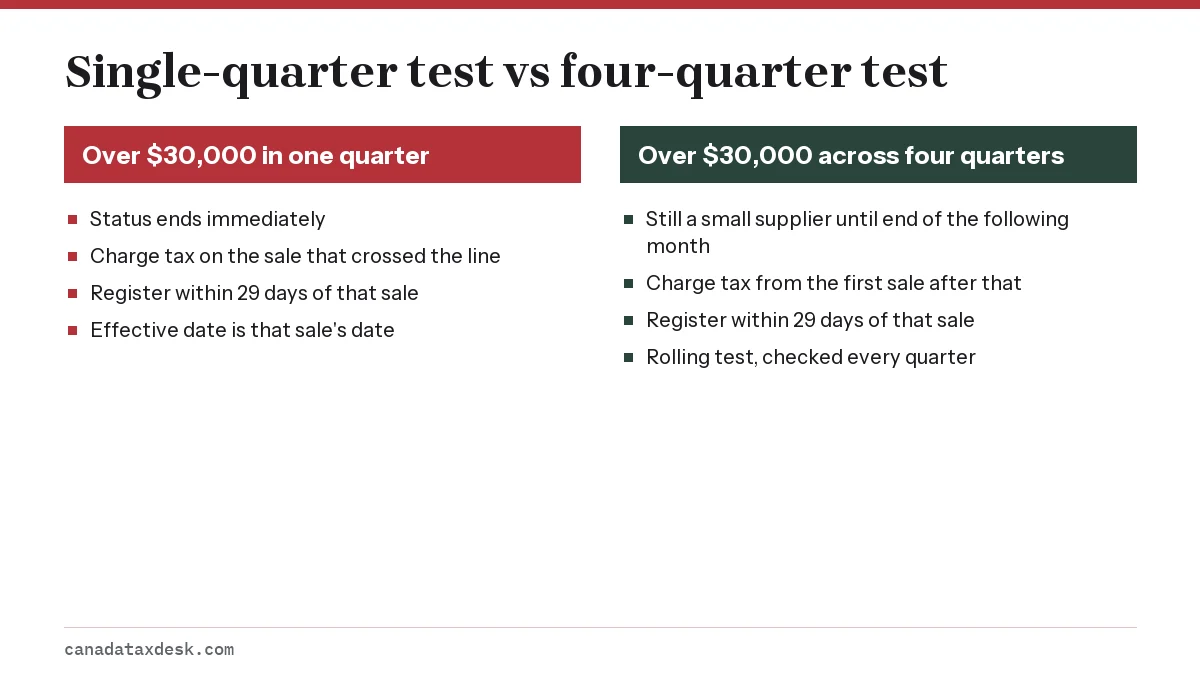
It is neither a calendar year nor a single quarter alone: the GST small supplier threshold applies two tests at the same time, and failing either one ends your small supplier status. They differ in when you have to start charging tax.
The single-quarter test
If your taxable sales go over $30,000 within one calendar quarter (January to March, April to June, July to September or October to December), you stop being a small supplier immediately. You must charge GST/HST on the very sale that took you over, even though you have no GST number yet, and register within 29 days.
Example: a Winnipeg contractor bills $9,000 in July 2026 and $14,000 in August. On September 18, 2026, a $10,000 invoice pushes the quarter to $33,000. That invoice must include 5% GST, and registration is due by October 17, 2026.
The four-quarter test
If no single quarter tops $30,000 but four consecutive quarters together do, you remain a small supplier until the end of the month after the quarter in which you crossed the line. You start charging on your first sale after that, and register within 29 days of that sale.
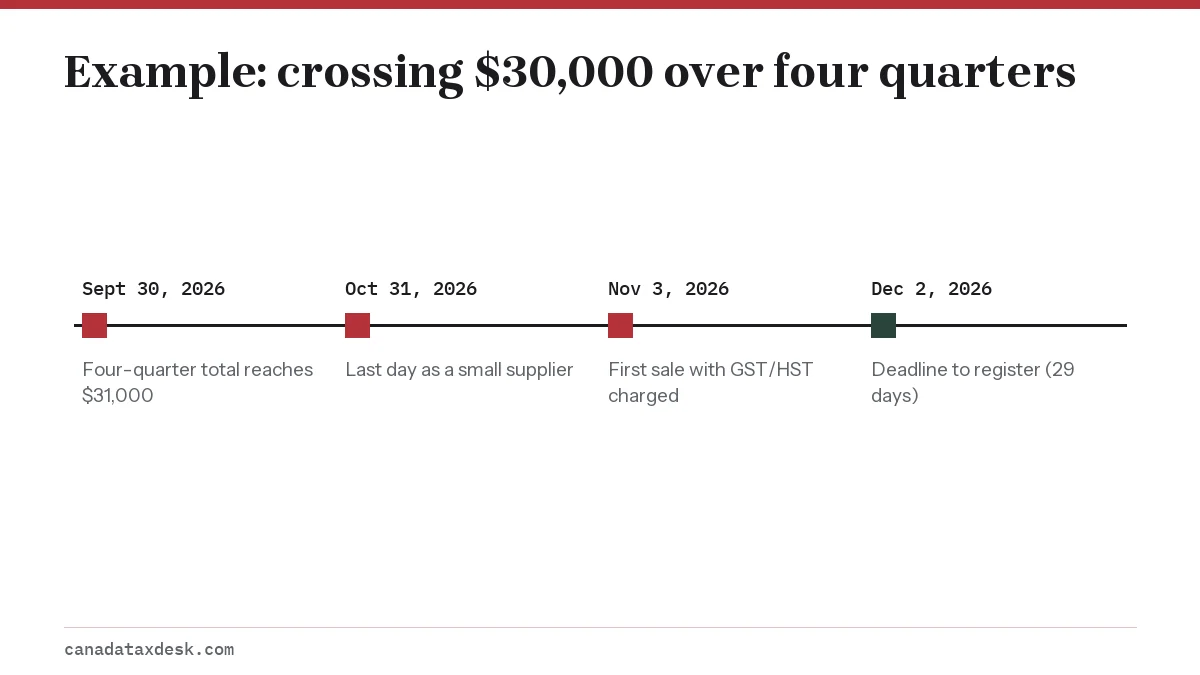
Example: an Ottawa graphic designer earns $6,000, $7,500, $8,500 and $9,000 in the four quarters from October 2025 to September 2026, a total of $31,000. She stays a small supplier through October 31, 2026. Her first invoice after that, dated November 3, 2026, carries 13% HST, and she must register by December 2, 2026.
What happens when I go over $30,000?
Going over $30,000 ends the GST small supplier exemption and starts a 29-day registration clock. Your effective date of registration is the date you started having to charge tax, not the date you apply.
- Identify the exact sale or date that ended your small supplier status, using the two tests above.
- Start charging GST/HST on sales from that point, at the rate for where each sale is made. See HST rates by province.
- Register within 29 days through the CRA's Business Registration Online or Form RC1.
- Put your new GST/HST number on invoices, and reissue any invoices sent after the effective date without tax if you can.
- File your first return for the reporting period that includes your effective date.
If you realize months later
You owe GST/HST on taxable sales from the date you should have registered, whether or not you collected it. If you cannot recover it from customers, you pay it from your own funds. Registering promptly and filing the missed periods limits interest and penalties.
Do I have to charge GST if I am a small supplier?
No, and you must not. Only GST/HST registrants may charge the tax, so an unregistered small supplier who adds GST to an invoice is collecting money it is not entitled to collect. If a customer asks for your GST number and you are not registered, say that you are a small supplier and are not registered.
A small supplier who has registered voluntarily is a different case. Once registered, you must charge GST/HST on all taxable sales even though your sales are under $30,000, and you must stay registered for at least one year.
GST small supplier rules with exceptions
The $30,000 GST/HST small supplier threshold is the rule for most businesses, but several groups follow different numbers or cannot use the exemption at all.
| Who | Rule |
|---|---|
| Taxi businesses and commercial ride-sharing drivers | Must register from the first ride; no small supplier exemption |
| Public service bodies (non-profits, municipalities, schools and similar) | $50,000 in taxable supplies instead of $30,000 |
| Charities and public institutions | Small supplier if gross revenue is $250,000 or less, or taxable supplies are $50,000 or less |
| Non-residents selling only event admissions in Canada | Not treated as small suppliers |
| Non-resident digital and platform sellers | Separate digital economy registration rules |
Drivers for ride-hailing apps are the group most often caught out, because they assume the $30,000 rule protects them. What they must register for and charge is covered on our GST/HST for Uber drivers page. For the rest of the GST/HST cycle, see our GST/HST small business hub.
Common questions
Does the $30,000 small supplier threshold include GST?
No. You compare your taxable sales before tax with the $30,000 limit. As an unregistered small supplier, you should not be charging GST/HST anyway.
Do I combine income from two businesses for the small supplier test?
Yes, if both are yours as a sole proprietor. The test applies to the person, so taxable sales from every business you run are added together, along with sales of associated businesses.
Does employment income count toward the $30,000?
No. Wages from a job are not taxable supplies. Only sales of goods and services from your own business count.
Do I stop being a registrant if my sales drop below $30,000?
No. Once registered you stay registered until you ask the CRA to cancel, even if sales fall back under the threshold. Cancelling is optional and has conditions.
Do online marketplace and craft market sales count toward the small supplier threshold?
Yes. Taxable sales through any channel, including online marketplaces and in-person markets, count toward the $30,000 total.
Sources
- When to register for and start charging the GST/HST canada.ca
- RC4022 General Information for GST/HST Registrants canada.ca
We check figures against these official pages. Rules change; confirm anything that affects a deadline or payment with the agency before you act.
Tell us what happened
Describe your situation and our editors will use it to improve this guide. If you leave your email, we may reply with a pointer to the right page or official contact. We never share your details.
Related guides
 GST/HST for Small Business: Register, Charge, File and Pay
A Canadian small business must register for GST/HST once its taxable sales pass $30,000 in one calendar quarter or over four cons…
GST/HST Registration: How to Register for a GST/HST Number
GST/HST registration is mandatory once a business stops being a small supplier, which happens when taxable sales pass $30,000 in…
Uber GST Number: Needed From Ride One, Uber Eats at $30,000
GST/HST registration for Uber drivers is required from the day you start giving paid rides, whatever you earn, because the CRA tr…
HST Rates by Province 2026: GST, HST, PST and QST Table
HST rates by province in 2026 are 13% in Ontario, 14% in Nova Scotia and 15% in New Brunswick, Newfoundland and Labrador and Prin…