
GST/HST registration for Uber drivers: required from the first ride, Uber Eats only after $30,000
Short answer
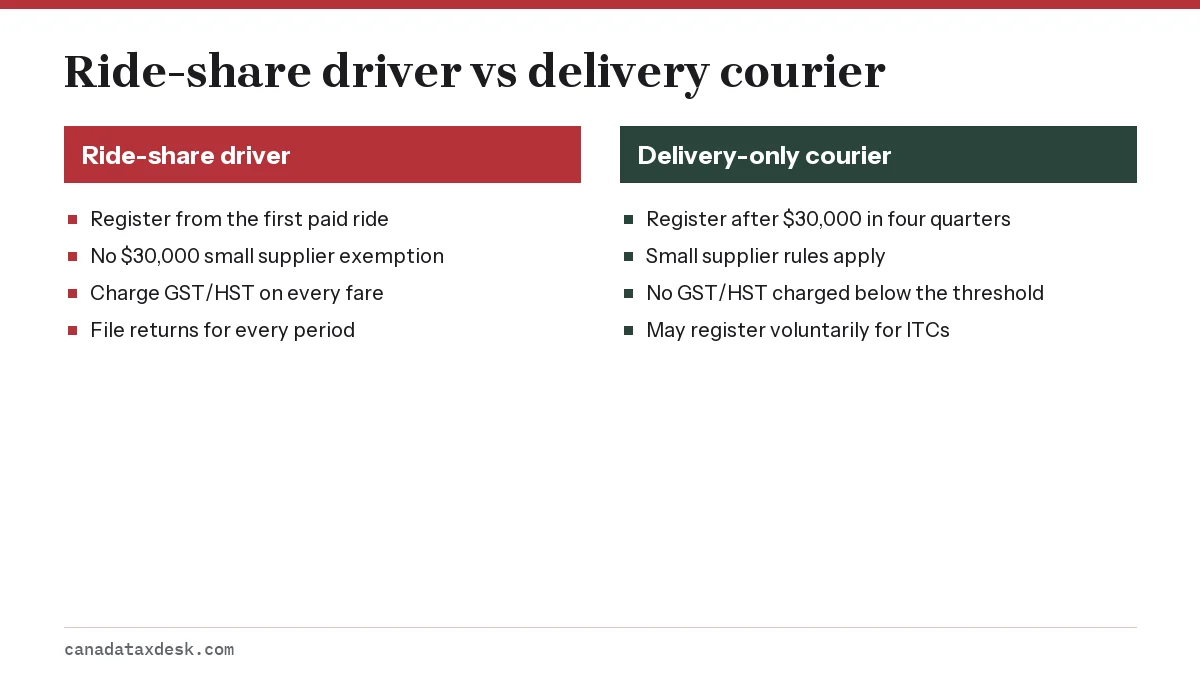
GST/HST registration for Uber drivers is required from the day you start giving paid rides, whatever you earn, because the CRA treats commercial ride-sharing drivers as taxi businesses and the $30,000 small supplier exemption does not apply. Food delivery couriers are different: if they only deliver, they register once sales pass $30,000. Registered drivers file GST/HST returns and can claim input tax credits on fuel and repairs.
- 01Ride-share registration starts
- The day you give your first paid ride
- 02Small supplier exemption for rides
- Does not apply
- 03Delivery-only couriers
- Register after $30,000 in four calendar quarters
- 04Time to apply
- Within 29 days of the effective date
- 05No ITC on
- Insurance and loan interest
- 06Rule in force since
- July 1, 2017
Why do Uber drivers need a GST/HST number from the first ride?
Since July 1, 2017, the Excise Tax Act definition of a taxi business has included people who transport passengers for fares by motor vehicle within a municipality when the ride is arranged through an app or other electronic platform (CRA GST/HST Info Sheet GI-196). Taxi businesses must register for GST/HST even if they are small suppliers, so a self-employed Uber or Lyft driver needs a GST number for Uber work immediately.
The CRA's registration page says your effective date of registration is the day you start supplying taxable passenger transportation, and you then have 29 days to apply. Driving a few weekends a year does not change this: the $30,000 threshold that protects most small side businesses does not apply to commercial ride-sharing.
How to register
- Have your Social Insurance Number, address, the date you started driving and an estimate of annual fares ready.
- Apply through Business Registration Online, which needs a CRA account, or register by phone or by mailing Form RC1.
- Choose the effective date as your first day of driving, even if that date has passed.
- Receive your 15-character GST/HST number (9-digit Business Number plus RT0001) and give it to the platform in your driver tax settings.
- Note the reporting period the CRA assigns you; most new drivers are annual filers.
Drivers based in Quebec register with Revenu Quebec, which administers both GST and QST there. The general registration steps and documents are also covered in our GST/HST registration guide.
Do Uber Eats couriers need to register for GST/HST?
Not at first. The CRA says a driver who only provides delivery services, through apps such as Uber Eats or SkipTheDishes, registers for GST/HST once sales exceed the $30,000 small supplier threshold over four calendar quarters. Below that, a delivery-only courier charges no GST/HST and files no GST/HST returns.
Mixing the two changes the picture. If your combined ride-share and delivery income is under $30,000, the CRA says you charge GST/HST only on the rides, not on the deliveries. Once the combined total passes $30,000, you are no longer a small supplier and tax applies to both. A courier can also choose to register voluntarily to claim input tax credits.
Who collects the GST/HST on Uber fares?
The legal responsibility stays with the driver. The CRA's sharing economy page says it is still your responsibility to make sure GST/HST is charged and collected on all fares, and GI-196 notes that a platform may handle some obligations only where the driver has authorized it.
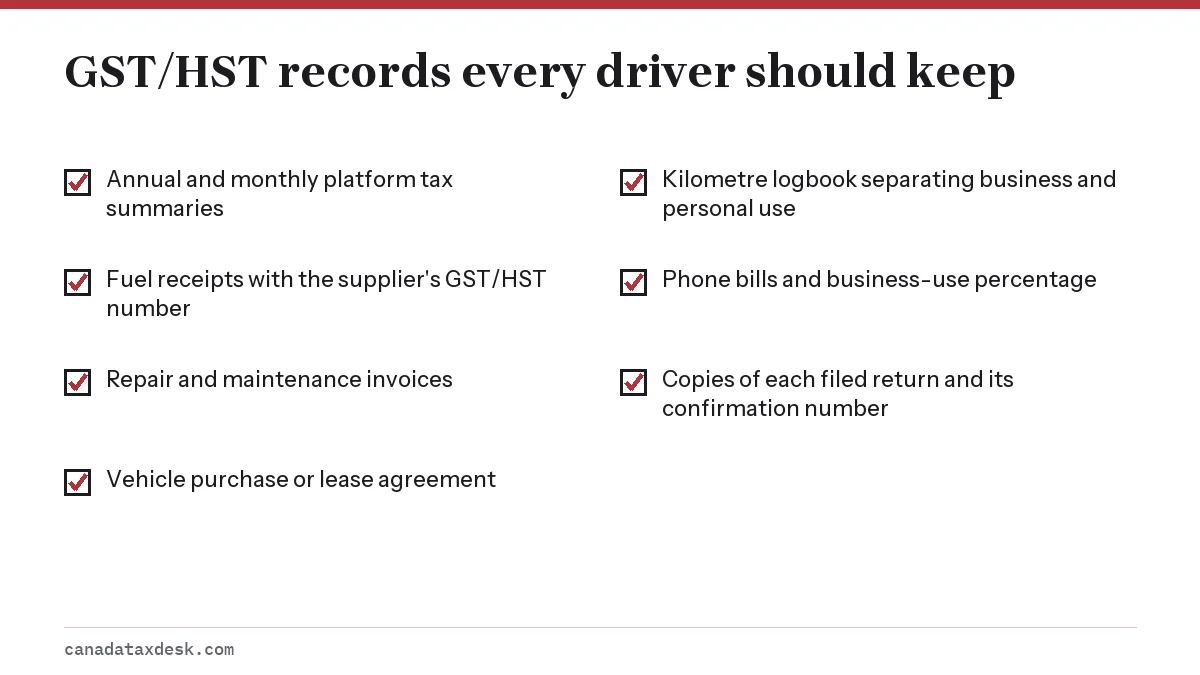
In practice, check your platform's annual tax summary. It shows the fares and the GST/HST attributed to your rides, which are the starting figures for your return. If a fare was charged tax-included, back out the tax with the CRA fractions: 5/105 in a GST-only province, 13/113 in Ontario, 14/114 in Nova Scotia and 15/115 in New Brunswick, Newfoundland and Labrador and PEI.
Can Uber drivers claim input tax credits on vehicle costs?
Yes. The CRA's page for taxi and ride-sharing drivers lists fuel, vehicle repairs and vehicle leases as expenses that can qualify for input tax credits. Insurance and interest do not qualify, because no GST/HST is charged on them.
- Claim only the business-use share when the car is also used personally. A driver whose logbook shows 60% ride-share kilometres claims 60% of the tax on fuel and repairs.
- Keep receipts showing the supplier's GST/HST number for purchases of $100 or more.
- A vehicle purchase or lease is also subject to the passenger vehicle rules; the CRA's taxi guidance and your logbook determine what can be claimed.
- Under the quick method, credits on everyday costs are replaced by the flat rate, but tax on capital property such as the vehicle can still be claimed.
GST/HST is only half of a driver's tax picture. Fares net of GST/HST are business income on Form T2125 with your T1 return, and CPP applies to the profit; see our Uber driver taxes in Canada page and the GST/HST small business hub for the full cycle.
Common questions
Do Uber drivers need a GST number if they earn less than $30,000?
Yes. Commercial ride-sharing drivers must register for GST/HST from their first paid ride, whatever their earnings, because the small supplier exemption does not apply to taxi-type businesses.
What happens if I drove for Uber without registering for GST/HST?
Register now with an effective date equal to your first day of driving, then file returns for each past reporting period. The CRA can assess the GST/HST that should have been collected, plus interest, so acting before it contacts you limits the cost.
Do I need to register for GST/HST for Uber Eats only?
Not until your delivery sales pass $30,000 over four calendar quarters. Delivery-only couriers are treated like other small suppliers.
Can Uber drivers use the quick method?
Yes. The CRA confirms drivers can elect the quick method if annual revenue including GST/HST stays at $400,000 or less, and they must keep using it for at least a year once elected.
Is my GST/HST number the same as my Business Number?
Your GST/HST number is your 9-digit Business Number followed by RT0001. Platforms usually ask for the full 15-character number.
Sources
- GI-196 GST/HST and Commercial Ride-sharing Services canada.ca
- When to register for and start charging the GST/HST canada.ca
- Sharing economy: taxes and the platform economy canada.ca
- GST/HST information for taxi operators and commercial ride-sharing drivers canada.ca
- Tax obligations for commercial ridesharing and delivery services canada.ca
- RC4058 Quick Method of Accounting for GST/HST canada.ca
We check figures against these official pages. Rules change; confirm anything that affects a deadline or payment with the agency before you act.
Tell us what happened
Describe your situation and our editors will use it to improve this guide. If you leave your email, we may reply with a pointer to the right page or official contact. We never share your details.
Related guides
 GST/HST for Small Business: Register, Charge, File and Pay
A Canadian small business must register for GST/HST once its taxable sales pass $30,000 in one calendar quarter or over four cons…
Uber Driver Taxes Canada: Income, Expenses and GST/HST
Uber drivers in Canada are self-employed: you report all fares and tips as business income on Form T2125, deduct platform fees an…
GST/HST Registration: How to Register for a GST/HST Number
GST/HST registration is mandatory once a business stops being a small supplier, which happens when taxable sales pass $30,000 in…
GST NETFILE: How to File Your GST/HST Return Online
GST NETFILE (officially GST/HST NETFILE) is the CRA's free online form for filing a GST/HST return without signing in to a CRA ac…
GST Quick Method: Rates, Eligibility and Worked Example
The GST quick method lets an eligible small business remit a fixed percentage of its tax-included sales instead of tracking input…