
GST quick method: rates, who qualifies and whether it saves you money
Short answer
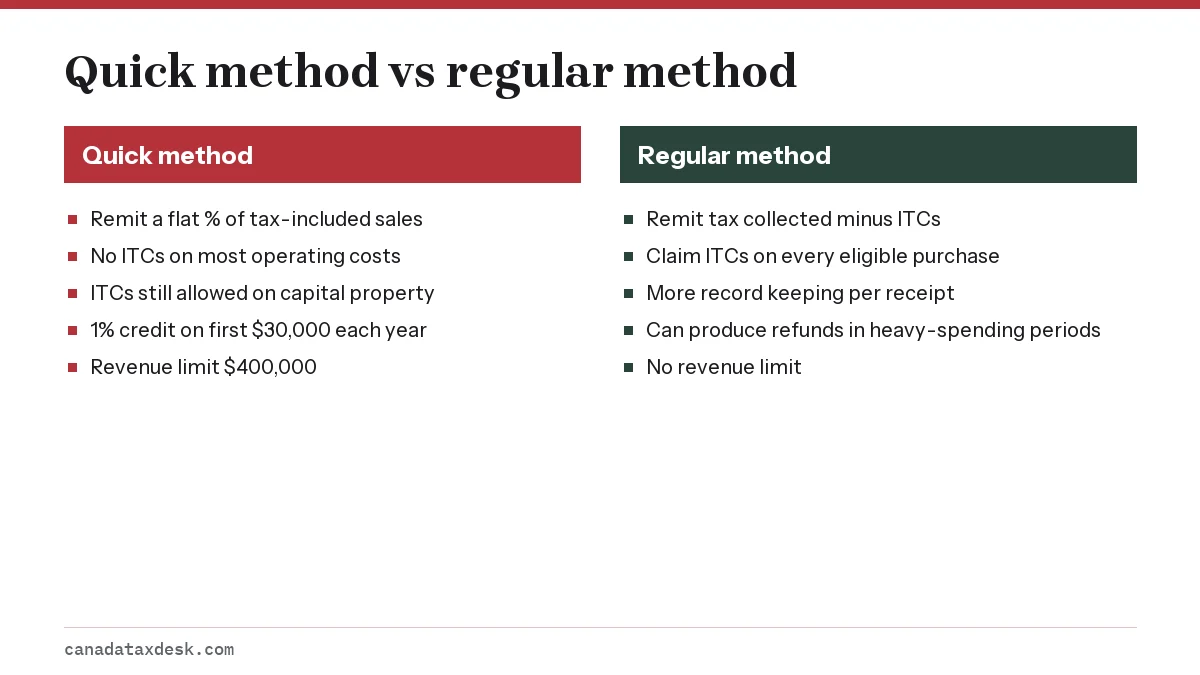
The GST quick method lets an eligible small business remit a fixed percentage of its tax-included sales instead of tracking input tax credits on everyday expenses. It is open to most businesses with $400,000 or less in annual taxable revenue including GST/HST, you elect in with Form GST74, and you get a 1% credit on the first $30,000 of eligible sales each year.
- 01Revenue limit
- $400,000 including GST/HST
- 02Service business rate, GST-only province
- 3.6% of tax-included sales
- 03Resale business rate, GST-only province
- 1.8% of tax-included sales
- 04Annual credit
- 1% of the first $30,000 of eligible sales (max $300)
- 05Election form
- GST74, or online in My Business Account
- 06Still claimable
- ITCs on capital property and real property
What is the GST quick method?
The GST quick method is an optional way to calculate net GST/HST. You still charge customers the normal 5%, 13%, 14% or 15%, but instead of subtracting the tax you paid on each purchase, you remit a flat percentage of your total sales including tax. The CRA explains it in guide RC4058, Quick Method of Accounting for GST/HST.
The difference between the tax you collect and the flat amount you remit stays with the business. It stands in for the input tax credits (ITCs) you would otherwise claim on operating costs such as supplies, fuel and phone bills, so the method pays off for businesses with low taxable expenses.
Who can use the quick method?
You can use the quick method if your annual worldwide taxable supplies, including GST/HST, zero-rated sales and the sales of associated businesses, are $400,000 or less. RC4058 measures this over either the first four or the last four consecutive fiscal quarters out of your most recent five.
Sales of real property, capital assets, goodwill and financial services are left out of that $400,000 total.
Businesses that cannot use it
- Bookkeeping, financial consulting, tax consulting and tax return preparation services
- Lawyers, accountants and actuaries
- Listed financial institutions
- Charities and public institutions
- Non-profit organizations with 40% or more government funding
- Municipalities, school and university authorities, and hospital authorities
Taxi operators and ride-share drivers are allowed to use it, which is why it comes up often on our GST/HST page for Uber drivers.
What are the GST quick method rates?
Your rate depends on two things: the type of business, and the province where your permanent establishment is compared with the province where you make the sale. Businesses that buy goods for resale get lower rates, but only if the cost of goods bought for resale in the previous fiscal year, including GST/HST, is at least 40% of their taxable sales including GST/HST. Everyone else uses the service rates.
| Permanent establishment in | Sales taxed at | Resale businesses | Service businesses |
|---|---|---|---|
| GST-only province or territory | 5% | 1.8% | 3.6% |
| Ontario | 13% | 4.4% | 8.8% |
| Nova Scotia | 14% | 4.7% | 9.4% |
| New Brunswick, Newfoundland and Labrador, PEI | 15% | 5.0% | 10.0% |
Cross-border sales use different rates. An Alberta service business selling into Ontario remits 10.5% of those 13% HST sales, while an Ontario service business selling to a GST-only province remits 1.8% of those sales. RC4058 has the full grid for every combination, and our HST rates by province table shows which rate applies where.
How does the quick method work in Quebec for GST and QST?
If your business is in Quebec, Revenu Québec administers both the GST and the QST, and the QST has its own quick method with its own rates. You multiply your tax-included taxable sales made in Canada by the GST rate and your tax-included taxable sales made in Quebec by the QST rate, then subtract the 1% reduction for each tax if you qualify for it (Revenu Québec, The Quick Method of Accounting for Calculating GST and QST Remittances).
| Item | GST | QST |
|---|---|---|
| Retailers and wholesalers buying goods for resale | 1.8% | 3.4% |
| Other businesses, mostly services | 3.6% | 6.6% |
| Annual taxable sales limit, taxes included | $400,000 | $418,952 |
| The 1% reduction applies to the first | $30,000 of sales each fiscal year | $31,421 of sales each fiscal year |
| Where the 1% reduction goes | Line 107 of the GST/HST return | Line 207 of the QST return |
The lower rates have the same 40% test: the cost of goods bought for resale, not counting basic groceries, must be at least 40% of total annual taxable sales. Revenu Québec's list of businesses that cannot use the quick method closely matches the federal one, including bookkeeping, tax return preparation, legal, accounting and actuarial services. If you also make sales in provinces where HST applies, the rates can differ, and Revenu Québec refers you to guide RC4058.
Worked example: quick method vs regular method
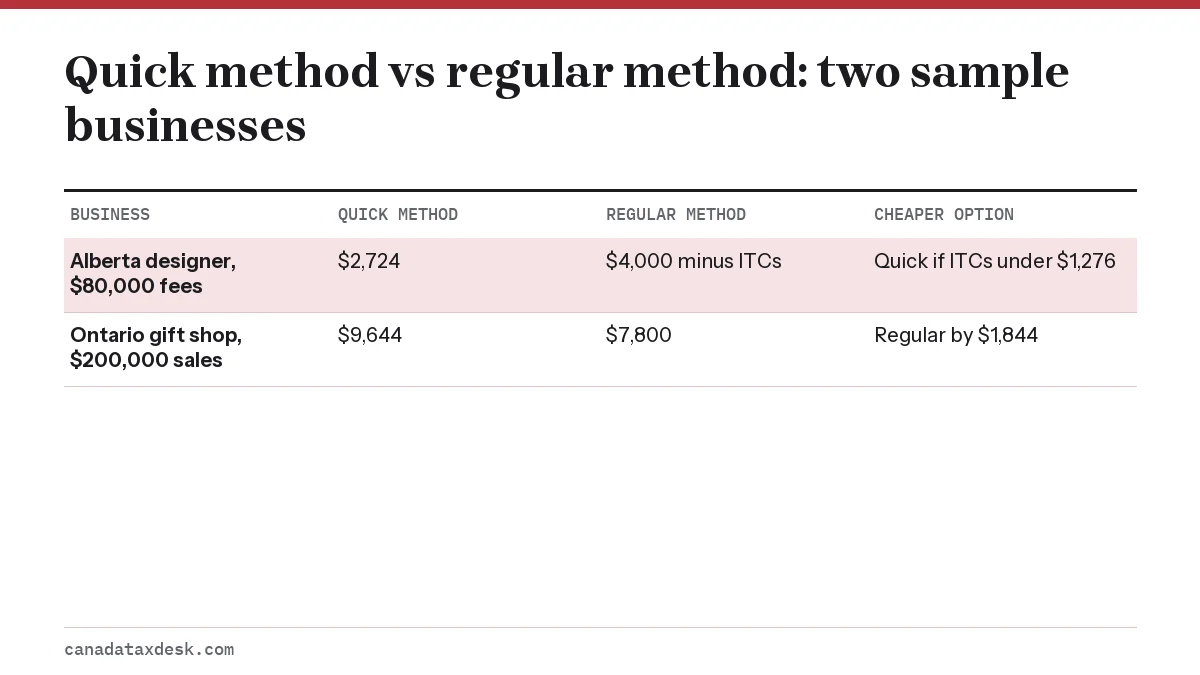
The two examples below use the CRA rates above. They show why the answer to "is the quick method worth it?" depends mostly on how much GST/HST you pay on your costs.
Example 1: Alberta graphic designer (service business)
| Step | Amount |
|---|---|
| Fees before tax | $80,000 |
| GST charged at 5% | $4,000 |
| Tax-included sales | $84,000 |
| Quick method: 3.6% x $84,000 | $3,024 |
| Less 1% credit on first $30,000 | -$300 |
| GST remitted under the quick method | $2,724 |
Under the quick method the designer keeps $1,276 of the GST collected. Under the regular method she would remit $4,000 minus her ITCs, so the quick method wins unless she paid more than $1,276 of GST on operating costs, which at 5% means more than $25,520 of taxable expenses. Her laptop purchase would still earn a separate ITC, because capital property is claimed outside the quick method.
Example 2: Ontario gift shop (resale business)
The shop sells $200,000 of goods before tax, collecting $26,000 of HST, for $226,000 including tax. At the 4.4% resale rate it would remit $9,944 minus the $300 credit, or $9,644. Its inventory cost $120,000 plus $15,600 HST, and rent and other costs carried $2,600 HST, so the regular method gives $26,000 minus $18,200 of ITCs, or $7,800. Here the regular method is $1,844 cheaper. (The shop does qualify for the resale rate: $135,600 of tax-included inventory is 60% of $226,000.)
How do I elect the GST quick method, and when must I stop?
You make the GST quick method election on Form GST74, Election and Application to Use the Quick Method of Accounting, or online through My Business Account or Represent a Client. The election must start on the first day of a reporting period.
- Annual filers: file the election by the first day of the second fiscal quarter of the year you want it to start.
- Monthly and quarterly filers: file it by the due date of the return for the first period it covers.
Once in, you generally stay in while you remain eligible, and you must use the method for at least a year before revoking it. If you revoke, you must wait at least one year from the date the revocation took effect before electing again.
When you have to leave the quick method
You must stop once your revenue goes over $400,000 or you start a type of business that is excluded. For annual filers the stop takes effect at the start of the next fiscal year; for monthly and quarterly filers the timing depends on which measurement period went over, as set out in RC4058.
The return itself is filed the usual way and by the usual deadline, covered in how to file a GST return and our GST/HST filing deadlines page. If your quick method remittance reaches $3,000 a year as an annual filer, the next year may bring GST/HST instalments.
Common questions
Is the GST quick method worth it?
It usually is for service businesses with few taxable costs, such as consultants, designers and tutors who work from home. It usually is not for businesses that buy a lot of taxable inventory or supplies, because they lose the input tax credits on those purchases.
Can I claim input tax credits under the quick method?
Only on capital property such as computers and vehicles, real property, and goods bought before the election took effect. Most operating expense credits are replaced by the flat rate.
Do I still charge customers 5% or 13% under the quick method?
Yes. Customers see the normal GST or HST rate. The quick method only changes how much of the collected tax you send to the CRA.
Is there a GST quick method calculator?
The calculation is simple enough to do by hand: multiply your tax-included sales by your remittance rate, then subtract 1% of the first $30,000 of those sales. Compare the result with GST/HST collected minus the ITCs you would claim.
Where do quick method amounts go on the GST/HST return?
According to RC4058, the amount you calculate with your remittance rate goes on line 103, and the 1% credit is entered on line 107 as an adjustment that reduces net tax.
Is the tax I keep under the quick method taxable income?
Yes. On Form T2125, the CRA has you add the GST/HST collected on quick method sales, minus your quick method remittance, to your gross sales, and report the 1% credit (maximum $300) as other income on line 8230. Revenu Québec gives the same rule for the GST and QST: the tax collected but not remitted under the quick method must be included in your income.
Sources
- RC4058 Quick Method of Accounting for GST/HST canada.ca
- GST/HST information for taxi operators and commercial ride-sharing drivers canada.ca
- How to file a GST/HST return canada.ca
- The Quick Method of Accounting for Calculating GST and QST Remittances (Revenu Québec) revenuquebec.ca
- Applicable Rates, Quick Method (Revenu Québec) revenuquebec.ca
- Form T2125, Part 1: Business income canada.ca
We check figures against these official pages. Rules change; confirm anything that affects a deadline or payment with the agency before you act.
Tell us what happened
Describe your situation and our editors will use it to improve this guide. If you leave your email, we may reply with a pointer to the right page or official contact. We never share your details.
Related guides
 GST/HST for Small Business: Register, Charge, File and Pay
A Canadian small business must register for GST/HST once its taxable sales pass $30,000 in one calendar quarter or over four cons…
How to File a GST Return in Canada: Lines and Steps
To file a GST return in Canada, total your sales and the GST/HST you charged for the period, subtract the GST/HST you paid on bus…
GST Instalments (CRA): Due Dates, $3,000 Rule and Amounts
GST instalments are due one month after the end of each fiscal quarter, so a December 31 year end means April 30, July 31, Octobe…
GST NETFILE Deadline: GST/HST Due Dates by Filing Period
The GST NETFILE deadline is one month after the end of the reporting period for monthly and quarterly filers, and three months af…
HST Rates by Province 2026: GST, HST, PST and QST Table
HST rates by province in 2026 are 13% in Ontario, 14% in Nova Scotia and 15% in New Brunswick, Newfoundland and Labrador and Prin…