
Topic
Disability tax credit (DTC) in Canada: how it works from start to finish
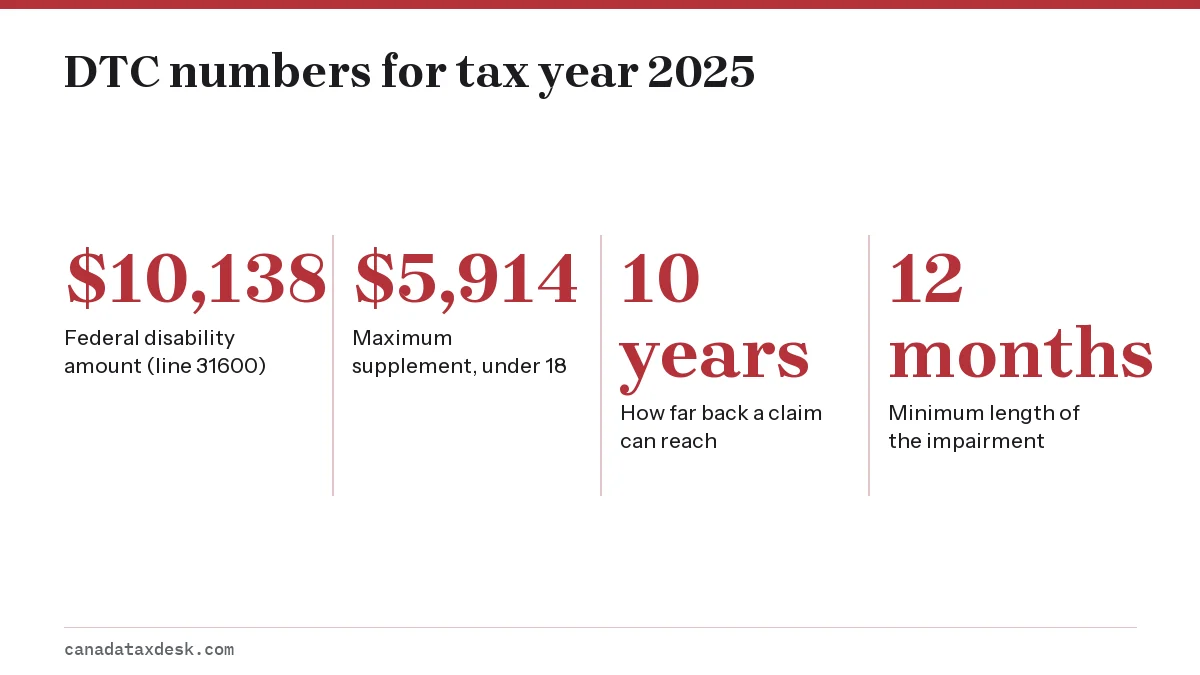
The disability tax credit (DTC) is a non-refundable federal credit worth a disability amount of $10,138 for 2025 (line 31600), plus a supplement of up to $5,914 for a person under 18. You qualify only after the CRA approves Form T2201, certified by a medical practitioner, and approval can reach back up to 10 years.
8 guides in this topic Updated October 20, 2026
- Disability Tax Credit Amount: What It Is Worth by YearThe federal disability tax credit amount for 2025 is $10,138, which reduces federal tax by about $1,470 at the 14.5% credit rate. A person under 18 c…
- Disability Tax Credit Eligibility for Mental HealthDisability tax credit eligibility for mental health conditions depends on the category called mental functions necessary for everyday life: a medical…
- Disability Tax Credit Eligibility for a Child: Who ClaimsDisability tax credit eligibility for a child is decided on Form T2201 by comparing the child with other children of the same age: the impairment mus…
- Disability Tax Credit Eligibility: Who Qualifies and WhyDisability tax credit eligibility requires an impairment that has lasted or will last at least 12 continuous months and that markedly restricts a bas…
- Disability Tax Credit Processing Time: Up to 8 Weeks (2026)As of October 2026, the CRA says a Form T2201, Disability Tax Credit Certificate, may take up to 8 weeks to process, citing higher than normal intake…
- Disability Tax Credit Retroactive Payments: Up to 10 YearsDisability tax credit retroactive payments are refunds the CRA issues after it reassesses up to 10 previous tax returns once Form T2201 is approved f…
- How to Apply for the Disability Tax Credit Online or by MailA disability tax credit application is made on Form T2201: you complete Part A online in your CRA account, by phone or on paper, and an eligible medi…
- T2201 Form: Completing the Disability Tax Credit CertificateThe T2201 form, Disability Tax Credit Certificate, is the only way to apply for the disability tax credit. You complete and sign Part A; an eligible…
What is the disability tax credit?
The disability tax credit is a federal, non-refundable tax credit for people who have a severe and prolonged impairment in physical or mental functions. It lowers the income tax a person, or a family member supporting them, owes on the T1 return. It is not a cheque and it is not paid monthly.
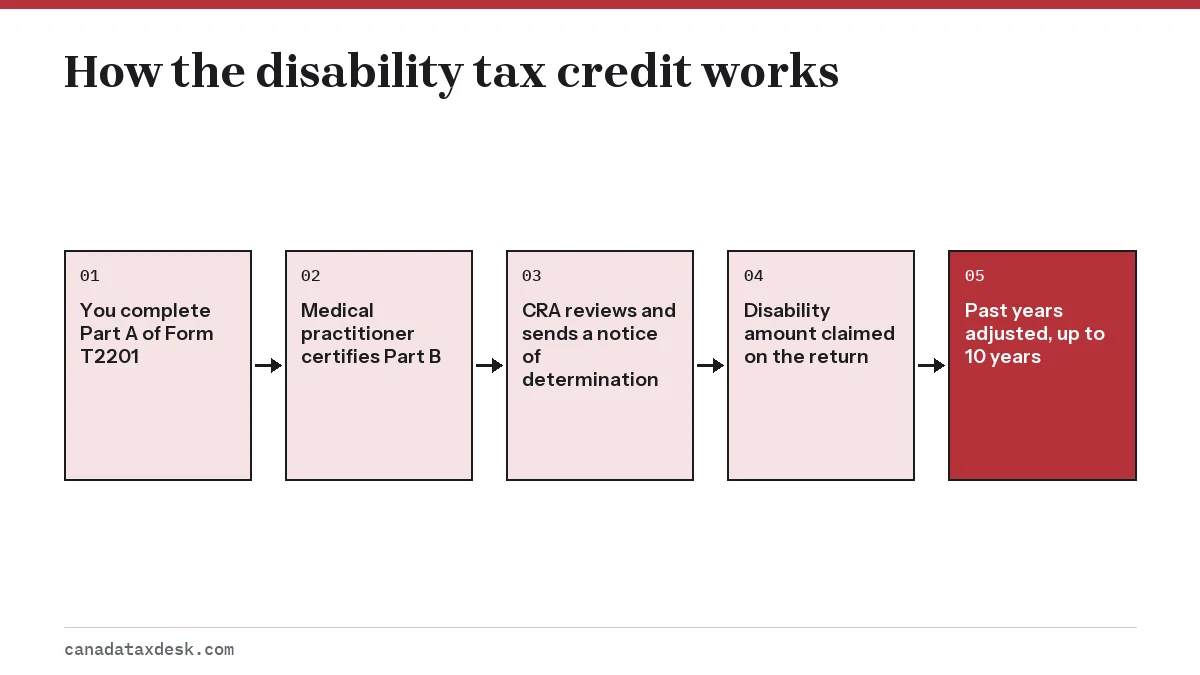
The Canada Revenue Agency (CRA) runs the DTC in two stages. First the CRA decides whether you are eligible, based on Form T2201 signed by a medical practitioner. Only after approval can the disability amount be claimed on a return, for the current year and for up to 10 earlier years (CRA, Claiming the DTC).
Who qualifies for the disability tax credit in Canada?
You qualify when a medical practitioner certifies that your impairment is severe and prolonged and the CRA accepts that certification. Prolonged means the impairment has lasted, or is expected to last, at least 12 continuous months. Severe is measured by how much the impairment restricts everyday activities, not by the name of the diagnosis (CRA, Guide RC4064).
The CRA looks at nine areas: walking, mental functions necessary for everyday life, dressing, feeding, eliminating (bowel or bladder), hearing, speaking, vision, and life-sustaining therapy. A person can also qualify through the cumulative effect of several significant restrictions that together equal one marked restriction.
The detailed tests, including the "3 times longer" and "90% of the time" standards, are on our disability tax credit eligibility guide. Children qualify under the same rules, compared with other children of the same age; see DTC for children.
How much is the DTC worth on a tax return?
For 2025, the federal disability amount is $10,138 and the under-18 supplement is up to $5,914. Because the credit is calculated at the lowest federal rate, the 2025 federal saving is about $1,470 for an adult ($10,138 x 14.5%), and about $2,328 when the full child supplement also applies.
Every province and territory adds its own disability amount on line 58440 of its provincial form. For 2025 that amount is $10,298 in Ontario, $9,699 in British Columbia and $17,219 in Alberta, each worth a provincial tax saving at the province's own rate. The year-by-year numbers and worked examples are on the disability tax credit amount page.
How do you apply for the disability tax credit with the CRA?
You apply by sending Form T2201, Disability Tax Credit Certificate, to the CRA. You complete Part A, and a medical practitioner who is allowed to certify your type of impairment completes Part B. Both parts must travel the same way: both online or both on paper (CRA, How to apply).
- Online: sign in to your CRA account, choose Benefits and credits, then Apply for DTC. You get a reference number that your practitioner uses once to send Part B through the CRA's digital form.
- Paper: download the T2201 fillable PDF, complete Part A, have the practitioner complete and sign Part B by hand, and mail it to the Jonquière, Sudbury or Winnipeg tax centre.
- Do not upload a T2201 through the Submit documents service in your CRA account; the CRA does not accept DTC forms that way.
A walk-through of every field is on the T2201 form page, and the order of steps, from booking the appointment to the decision, is on the disability tax credit application guide.
Can I claim the disability tax credit for previous years?
Yes. If the CRA confirms you were eligible in earlier years, the disability amount can be applied to up to 10 previous tax years. Part A of the T2201 lets you ask the CRA to adjust those returns for you, or you can request the changes yourself online after approval.
Past-year amounts range from $8,001 for 2016 to $10,138 for 2025. Each adjusted year produces a notice of reassessment and, where tax was paid, a refund plus any interest the CRA owes. Our DTC retroactive claims page covers how far back the CRA will go in practice.
Who can claim the credit if the person with the disability has no tax to pay?
Any part of the disability amount the person cannot use can be transferred. A spouse or common-law partner claims it on line 32600 through Schedule 2. Another supporting family member, such as a parent, grandparent, child or sibling the person relied on for food, shelter or clothing, claims it on line 31800.
| Who claims | Line | Typical situation |
|---|---|---|
| The person with the impairment | 31600 | Adult with enough income to owe tax |
| A supporting relative (not a spouse) | 31800 | Parent claiming for a child, adult child supporting a parent |
| A spouse or common-law partner | 32600 (Schedule 2) | Partner with low or no taxable income |
The amount can be split between two or more supporting relatives, but the total claimed cannot exceed the maximum for the year.
What else does DTC approval open up?
Approval matters beyond the credit itself. The CRA's decision page lists the Registered Disability Savings Plan (RDSP), the disability supplement of the Canada Workers Benefit, the Child Disability Benefit and the Canada Disability Benefit as programs linked to DTC eligibility (CRA, DTC decision).
Approval also affects other tax claims. An approved T2201 can replace the practitioner's statement needed for the Canada caregiver credit, and DTC-eligible buyers can use the home buyers' amount without being first-time buyers. The fee a practitioner charges to complete the form can be included with your medical expenses.
What happens if the CRA denies a DTC application?
The CRA mails, or posts to your CRA account, a notice of determination stating the decision and the years covered. If it says you are not eligible, you have two routes: ask for a review by sending new medical information, or file a formal objection within 90 days of the date on the notice.
Before either step, read the reasons given. Many refusals come from Part B describing a diagnosis without describing the effect on daily activities, or from answers that show the restriction is present less than 90% of the time. Processing and status checks are covered on how long the CRA takes to process the DTC.
Do you need to pay a company to get the DTC?
No. Applying is free, and the CRA does not require a representative. Some firms charge a share of the refund to prepare the application and request the past-year adjustments.
Parliament passed the Disability Tax Credit Promoters Restrictions Act to cap those fees at $100 for help with the T2201 and $100 per year adjusted. The CRA states the regulations came into force on November 15, 2021 but are suspended until further notice because of a court injunction (CRA, promoters regulations). As of September 2026 no fee cap is being enforced, so read any contract carefully.
Disability tax credit on the tax return for 2026 and the 2027 season
For 2026 the disability amount is $10,341, according to the CRA's table of indexed personal tax amounts for 2026, up from $10,138 for 2025. The line 31600 page normally shows it once the 2026 T1 package is released in January 2027.
Common questions
Is the disability tax credit a monthly payment?
No. The DTC reduces income tax on the annual return. Monthly amounts people mention usually come from linked programs such as the Child Disability Benefit or the Canada Disability Benefit, which are separate from the credit itself.
Does the disability tax credit have an income limit?
The DTC itself has no income test for adults. What matters is whether the person, or someone supporting them, owes income tax that the non-refundable credit can reduce.
Do I have to reapply for the DTC every year?
Not if your notice of determination has no expiry date. If it lists an end year, you must send a new T2201 before claiming the credit for later years.
Can I get the disability tax credit if I am on ODSP or AISH?
Provincial disability assistance does not decide DTC eligibility. The CRA applies its own test on Form T2201, so a person on ODSP, AISH or similar support must still apply and be approved.
Is DTC approval the same as qualifying for the Canada Disability Benefit?
No, but it is linked. DTC approval is a condition the CRA lists for the Canada Disability Benefit, which has its own application and income rules.
Sources
- CRA, Adjustment of personal income tax and benefit amounts (2026)
- Disability tax credit (DTC)
- Claiming the credit: Disability tax credit
- Line 31600, Disability amount for self
- CRA's decision: Disability tax credit
- Questions and answers on the Disability Tax Credit Promoters Restrictions Regulations
- Guide RC4064, Disability-Related Information 2025