
Uber driver taxes in Canada: reporting fares, claiming car costs and handling GST/HST
Short answer
Uber drivers in Canada are self-employed: you report all fares and tips as business income on Form T2125, deduct platform fees and the business share of vehicle and phone costs, and pay income tax and 11.9% CPP on the profit. Ride-share drivers must also register for GST/HST from the first paid ride, with no $30,000 threshold.
- 01Tax status
- Self-employed, reported on Form T2125
- 02GST/HST for ride-share drivers
- Must register from the first fare (since July 1, 2017)
- 03GST/HST for delivery-only couriers
- Register once taxable sales pass $30,000
- 04Platform reporting to the CRA
- Annual information return due January 31, starting with 2024
- 052026 return due
- June 15, 2027; pay by April 30, 2027
How are Uber drivers taxed in Canada?
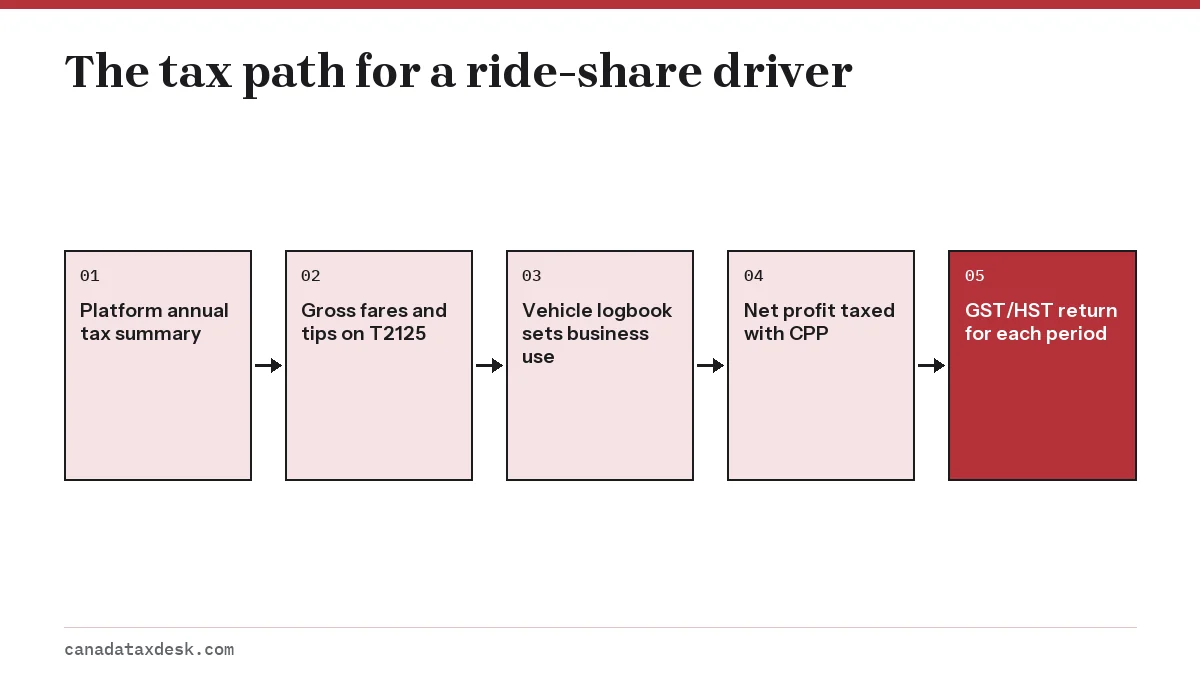
Uber driver taxes in Canada work like any other small business: the CRA treats you as self-employed, not as an Uber employee, so no tax or CPP is withheld from your payouts. You report gross fares and tips as business income on Form T2125, subtract your expenses, and the profit is taxed at your normal federal and provincial rates with CPP at 11.9% on top.
The same applies to Uber Eats, Lyft, DoorDash, SkipTheDishes and similar apps. The difference between ride-share and delivery work shows up mostly on the GST/HST side, covered further down. The overview of self-employed taxes in Canada explains the parts that apply to every sole proprietor.
Using the Uber Canada tax summary
Uber, like most platforms, provides an annual tax summary in the driver or courier account after the year ends. It is not a CRA slip and you do not file it, but it is the easiest starting point for your gross income and for the fees the platform kept. Download it from your account; the platform's own help pages show where it sits.
- Take the gross amount riders or customers paid, including tips, as your income. Do not start from the net payout that reached your bank.
- Record the service fee or commission the platform kept as an expense; it is a cost of earning the income.
- Check which GST/HST amounts the summary lists, and match them to your GST/HST returns.
- Add any income from other apps, since each platform issues its own summary.
What expenses can Uber drivers claim?
Drivers can deduct any reasonable cost of earning ride-share or delivery income. The biggest items are the platform's service fees and the business share of the vehicle. Costs that serve both personal and work use, such as the car and phone, are deducted only in proportion to work use.
- Platform service fees, booking fees and commissions.
- Fuel or charging, insurance, repairs, maintenance, car washes, licence and registration, by business-kilometre share.
- Lease payments or interest on a car loan, by business share, within the passenger-vehicle limits: for a lease or loan that starts in 2026, up to $1,100 a month of lease payments before tax and $350 a month of interest.
- Capital cost allowance on a car you own: Class 10 at 30%, or Class 10.1, also at 30%, for a passenger vehicle bought in 2026 for more than $39,000 before tax, with the claimable cost capped at $39,000. Zero-emission passenger vehicles go in Class 54, with a $61,000 ceiling before tax.
- Phone and data plan, business share, plus phone mounts and chargers.
- Parking fees and tolls paid while working (not parking tickets).
- Delivery bags and bicycle or e-bike costs for couriers.
Worked example: a part-time ride-share driver
Say your car travelled 25,000 km in 2026 and your logbook shows 18,000 km with the app on and a passenger or trip in progress, or driving to pick one up. Business use is 72%. If fuel, insurance, maintenance and registration totalled $9,000, the deductible vehicle cost is $6,480, plus 72% of any CCA. A $900 phone plan used 80% for driving gives another $720.
Vehicle records Uber drivers should keep
The CRA asks for a logbook showing the date, destination, purpose and kilometres for each business trip, and the odometer reading at the start and end of the year. Many drivers use the trip history in the app for rides and add their own notes for driving between trips and for personal driving.
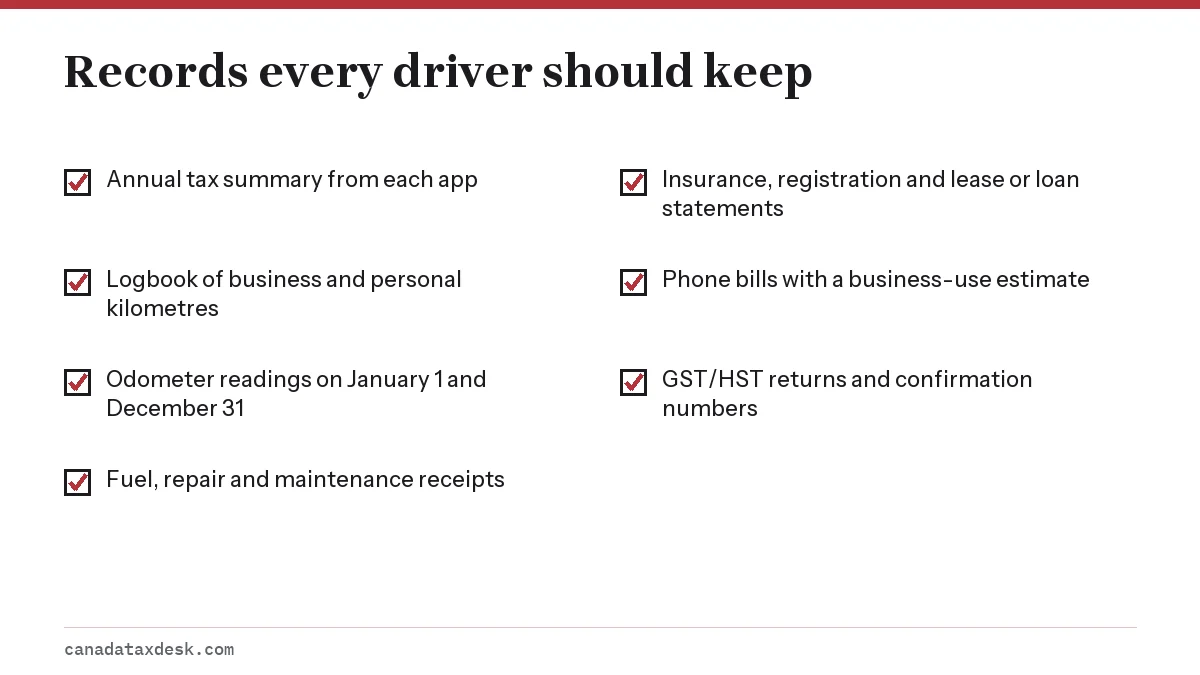
Personal kilometres matter as much as business ones. If you drive to the grocery store with the app off, that trip is personal. Once you have a full 12-month logbook, a three-month sample in later years is enough if your business use stays within 10% of the base year.
Do Uber drivers need to register for GST/HST?
Yes. Since July 1, 2017, anyone who provides commercial ride-sharing services must register for GST/HST the moment they start, even if they earn far less than $30,000 a year. The small supplier exemption does not apply to ride-share or taxi drivers. You then file GST/HST returns for every reporting period, including periods with no trips.
A ride-sharing company that you authorize can take on some of the GST/HST obligations for you, so check your driver agreement and tax summary to see what the platform handles. You can claim input tax credits for GST/HST paid on fuel, repairs, maintenance, washes and vehicle purchases or leases, but not on insurance or loan interest, which are not taxed. Drivers with annual sales of $400,000 or less can choose the quick method.
The GST/HST filing steps for drivers, including reporting periods and the access code, are in GST/HST for Uber drivers.
Do Uber Eats couriers pay tax?
Yes. Uber Eats taxes in Canada follow the same income tax rules as ride-share: delivery earnings and tips are business income on Form T2125, and CPP applies to the profit. Couriers who deliver food only are not covered by the mandatory ride-share registration rule, so they must register for GST/HST only once their worldwide taxable sales pass $30,000 in a calendar quarter or over four consecutive quarters.
If you do both rides and deliveries, you are already registered because of the ride-share work, and your GST/HST return must cover all your taxable sales. See GST/HST registration for the steps if you are near the $30,000 line.
How to file an Uber tax return in Canada
- Download the annual tax summary from each app you used in 2026.
- Total gross fares, delivery fees and tips across all platforms.
- Total your platform fees and each vehicle and phone cost, then apply your business-use percentages.
- Complete Form T2125 with an industry code for taxi or ride-share or couriers; the T2125 guide covers each part.
- Let Schedule 8 calculate CPP on the profit; if you also have a T4 job, the CPP already deducted there counts toward the maximum.
- File your GST/HST return for the period and make sure sales match the T2125.
- Pay any balance by April 30, 2027 and file the T1 by June 15, 2027.
How much should Uber drivers set aside for tax?
Set aside two separate amounts from every weekly payout. First, all the GST/HST included in your fares, which belongs to the government. Second, a share of your profit for income tax and CPP; for a driver with a moderate income that is often in the range of 20% to 25% of profit, and more if you also earn a salary.
Drivers who add platform income to a full-time job often face a bigger bill than expected, because the job already uses up the lower tax brackets. Once your tax owing passes $3,000 in two years, the CRA will also expect quarterly instalments. Estimate your number with the self-employed tax calculator and review the deductible business expenses you may be missing.
Step by step
Download platform summaries
Get the annual tax summary from each ride-share or delivery app you used.
Calculate gross income
Add gross fares, delivery fees and tips from all platforms.
Total expenses
Add platform fees and apply business-use percentages to vehicle and phone costs using your logbook.
Complete Form T2125
Enter income and expenses and carry the net profit to your T1 return.
File GST/HST returns
Report fares and input tax credits on your GST/HST return for each reporting period.
Pay and file
Pay any balance by April 30, 2027 and file the return by June 15, 2027.
Common questions
Does Uber send a T4A to drivers in Canada?
Drivers are self-employed, so they do not get a T4 as employees would. Uber provides an annual tax summary in the driver account, and under the digital platform reporting rules it gives drivers a copy of the information it reports to the CRA.
Can I claim my whole car payment as an Uber driver?
No. You claim only the business-use share of lease payments or loan interest, and loan principal is never deductible. A purchased car is written off through capital cost allowance at 30% a year, again by business share.
Can Uber drivers claim a per-kilometre rate instead of actual car costs?
No. A self-employed driver deducts the business share of actual vehicle costs, worked out from the logbook. The 2026 rates of 73 cents per kilometre for the first 5,000 km and 67 cents after that are Finance Canada's limits on tax-free allowances employers pay employees, so they do not apply to app drivers.
Do I need to charge GST/HST if I only drive a few hours a week for Uber?
Yes. Commercial ride-sharing drivers must register for GST/HST from their first fare regardless of how much they earn. The $30,000 small supplier threshold does not apply to ride-sharing.
Are tips from Uber taxable in Canada?
Yes. Tips paid through the app or in cash are business income and must be included in gross income on Form T2125.
What if I did not report Uber income in past years?
Correct the returns before the CRA contacts you, using Change my return, ReFILE or Form T1-ADJ, and file any missing GST/HST returns. The CRA's Voluntary Disclosures Program may reduce penalties in some cases, but it is not available once the CRA has started action on the issue.
Sources
- Sharing economy: ride-sharing income canada.ca
- GST/HST Info Sheet GI-196, Commercial ride-sharing services canada.ca
- Taxi operators and commercial ride-sharing drivers canada.ca
- Reporting Rules for Digital Platforms canada.ca
- T2125 Statement of Business or Professional Activities canada.ca
- Motor vehicle records canada.ca
- Finance Canada, 2026 automobile deduction limits and expense benefit rates canada.ca
We check figures against these official pages. Rules change; confirm anything that affects a deadline or payment with the agency before you act.
Tell us what happened
Describe your situation and our editors will use it to improve this guide. If you leave your email, we may reply with a pointer to the right page or official contact. We never share your details.
Related guides
 Self-Employed Taxes in Canada: Income, CPP and Deadlines
Self-employed taxes in Canada are paid on business profit, not on gross sales: you report income and expenses on Form T2125, pay…
Uber GST Number: Needed From Ride One, Uber Eats at $30,000
GST/HST registration for Uber drivers is required from the day you start giving paid rides, whatever you earn, because the CRA tr…
T2125 Form: How to Report Self-Employment Income in Canada
The T2125, Statement of Business or Professional Activities, is the CRA form a sole proprietor or partner files with the T1 retur…
Business Expenses List Canada: Self-Employed Deductions
Business expenses are tax deductible in Canada when you incur them to earn business income, they are reasonable, and they are not…
CPP for Self-Employed People: 2026 Rates and Maximums
For 2026, CPP for self-employed people is 11.9% of net self-employment earnings between $3,500 and $74,600, up to $8,460.90, plus…