
CRA instalment payments: who must pay, how much and when
Short answer
CRA instalment payments are quarterly prepayments of income tax and CPP, required when your net tax owing is more than $3,000 ($1,800 in Quebec) for the current year and for either of the two previous years. For 2027 they are due March 15, June 15, September 15 and December 15. Late or short payments attract compound daily instalment interest.
- 01Threshold
- Net tax owing over $3,000 ($1,800 in Quebec) this year and in one of the two prior years
- 022027 due dates
- March 15, June 15, September 15, December 15
- 03Farmers and fishers
- One payment, due December 31
- 04Reminders
- February (March and June payments), August (September and December payments)
- 05Rate on overdue amounts, Q4 2026
- 7%, compounded daily
- 06Penalty applies when
- Instalment interest for the year exceeds $1,000
What are CRA instalment payments?
Instalment payments to the CRA are partial payments of the current year's income tax that you send during the year, instead of paying the whole amount on April 30 of the following year. They exist because no one withholds tax from self-employment, rental, investment or some pension income. The instalments are credited to your account and applied when your return is assessed.
Instalments are not a penalty and not extra tax. If you pay more in instalments than your final bill, the difference comes back as a refund after you file.
Who must pay tax instalments to the CRA?
You must pay 2027 instalments if your net tax owing is more than $3,000 for 2027 and was also more than $3,000 in either 2026 or 2025. In Quebec the threshold is $1,800, because Revenu Quebec collects provincial tax separately. Net tax owing is the amount you would otherwise pay in one lump sum at the balance-due date, and it includes CPP on self-employment earnings and any voluntary EI premiums.
| 2025 net tax owing | 2026 net tax owing | 2027 expected | Instalments required? |
|---|---|---|---|
| $1,200 | $2,500 | $5,000 | No, neither prior year was over $3,000 |
| $4,000 | $1,500 | $5,000 | Yes, 2025 was over $3,000 |
| $800 | $6,500 | $6,000 | Yes, 2026 was over $3,000 |
| $4,000 | $6,500 | $2,800 | No, 2027 will be $3,000 or less |
The last row matters: if you get a reminder but your current-year net tax owing will be $3,000 or less, you do not have to pay. Most first-year freelancers are not caught by the rule, but a second strong year usually is, which is why the self-employed taxes overview flags instalments early.
CRA instalment payment dates for 2027
The four instalment payment dates for the 2027 tax year are Monday, March 15; Tuesday, June 15; Wednesday, September 15; and Wednesday, December 15, 2027. The last 2026 instalment is due Tuesday, December 15, 2026. When a due date falls on a weekend or public holiday recognized by the CRA, a payment received on the next business day is on time.
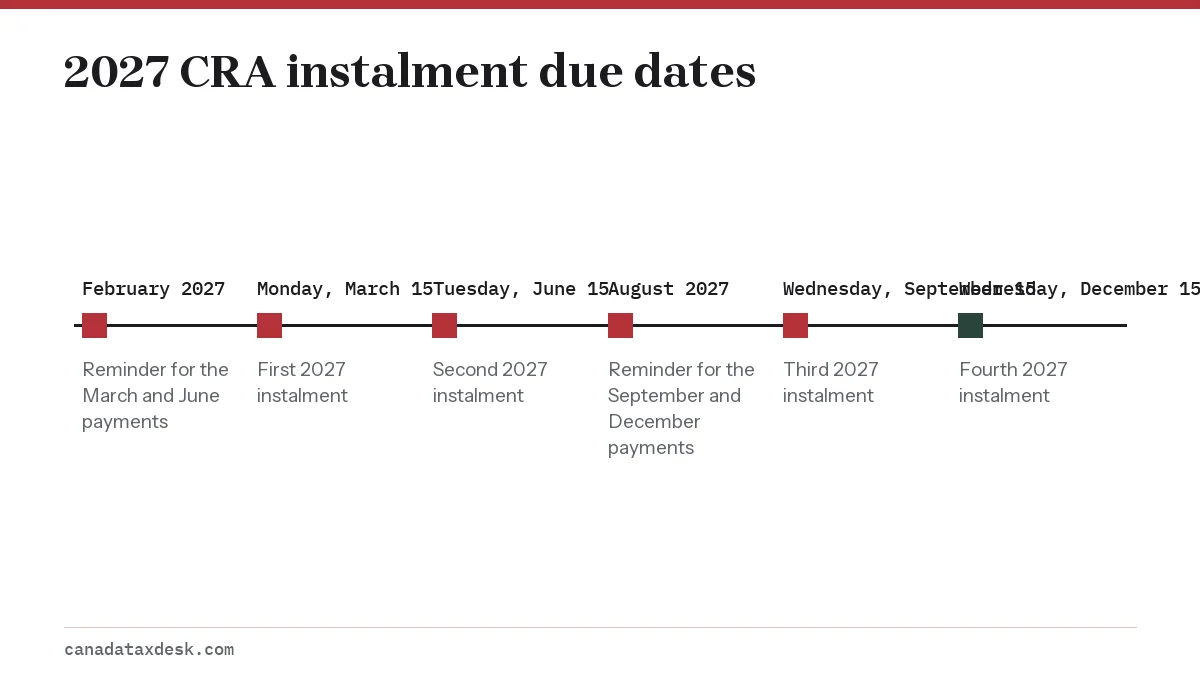
Farmers and fishers have a single instalment due December 31 and receive their reminder in November. For how these dates line up with the April 30 payment date and the June 15 filing date, see the self-employed tax deadline page.
How are instalments calculated? The three options
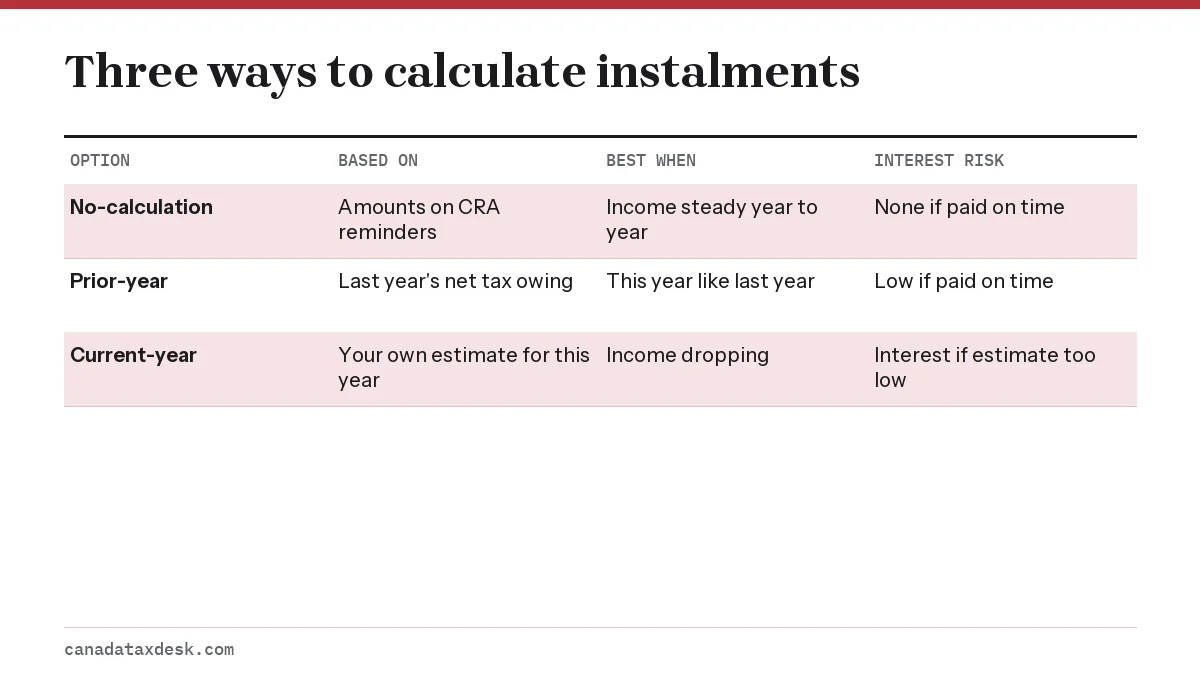
The CRA lets you choose among three ways to work out the amounts. Whichever you pick, the CRA calculates instalment interest using the option that produces the least interest for you.
No-calculation option
Pay the amounts printed on the CRA's instalment reminders. They are based on your latest assessed return. If you pay those amounts by each due date, the CRA will not charge instalment interest or a penalty, even if your final tax turns out to be higher.
Prior-year option
Base the payments on your 2026 net tax owing, using the CRA's calculation chart, and pay a quarter by each 2027 due date. Example: 2026 net tax owing of $8,000 means $2,000 per quarter. This suits someone whose 2027 income will look like 2026 but whose 2025 was very different.
Current-year option
Estimate your 2027 income, deductions, credits and self-employed CPP, then spread the result over the four dates. This helps when income is falling, because you can pay less. If your estimate is too low, you will be charged interest on the shortfall.
What if your first reminder arrives in August?
If your August reminder does not mention a March or June instalment, you only make the September 15 and December 15 payments. Under the no-calculation option, pay the amount in box 2 of the reminder on each date. Under the prior-year option, take last year's net tax owing; under the current-year option, estimate this year's; in both cases add CPP and any voluntary EI premiums, then pay 75% of the total on September 15 and 25% on December 15. You can reduce or stop the payments if what you have already paid covers your estimated net tax owing, or if it will be $3,000 or less ($1,800 in Quebec).
What if I do not pay instalments?
The CRA charges instalment interest on any payment that is late or smaller than required, compounded daily at the prescribed rate for overdue taxes, from each due date to the balance-due date. That rate is 7% for October to December 2026; the CRA sets it each quarter. Interest of $25 or less for the year is not charged.
If your instalment interest for the year is more than $1,000, a penalty is added as well. It equals half of the amount by which your instalment interest exceeds the greater of $1,000 or 25% of the interest you would have owed with no instalments at all.
How to reduce instalment interest after a missed payment
Pay the next instalment early or pay more than required. The CRA credits you with instalment credit interest on early or extra payments, which offsets interest charged on late or short payments for the same year. The credit is not refundable and cannot be carried to another year. If the charge came from circumstances beyond your control, you can ask for relief with Form RC4288.
How to make an instalment payment to the CRA
- Online banking: add the CRA as a payee and choose the instalment payment type and the tax year it applies to.
- My Payment: pay by Visa Debit, Debit Mastercard or Interac debit through the CRA's online service; credit cards are not accepted.
- Pre-authorized debit: schedule all four payments in My Account at least 5 business days before the first withdrawal.
- Third-party service provider: pay by credit card through PaySimply or Plastiq, or by Interac e-Transfer through PaySimply, for a fee.
- Canada Post: pay in person with debit or cash using a QR code generated for your account, for a fee.
- Mail or bank counter: pay by cheque or at your bank with the instalment remittance voucher, Form INNS3.
Leave time for processing. An online banking payment made on the due date can take a few business days to post, and the CRA counts the date it receives the money. If you cannot pay a balance after the year ends, look at paying a CRA balance owing and payment arrangements. The CRA does not accept cryptocurrency, gift cards, traveller's cheques, cash sent by mail or foreign currency, so a call or text demanding an instalment paid in one of those ways is not from the CRA.
Instalments for GST/HST are separate
Income tax instalments and GST/HST instalments are two different accounts. An annual GST/HST filer whose net tax was $3,000 or more in the previous fiscal year and will be again in the current one must also pay quarterly GST/HST instalments under its own business number. They are due within one month after the end of each fiscal quarter: with a December 31 year-end, April 30, July 31, October 31 and January 31 of the following year. The details are in GST/HST instalments. A payment sent to the wrong account can be transferred, but it still counts as late for the account that needed it.
Common questions
Are CRA instalment payments mandatory if I get a reminder?
Only if your net tax owing for the current year will be more than $3,000 ($1,800 in Quebec). The reminder is based on past returns, so if your income has dropped enough, you can pay less or nothing, but you risk interest if your estimate turns out too low.
Can I pay all four instalments at once?
Yes. Paying early is allowed and earns instalment credit interest that can offset interest on other late payments for the same year. It is not paid out as cash.
Does the CRA refund overpaid instalments?
Yes. Instalments are credited against your tax when your return is assessed, and any excess is refunded or applied to other debts you owe the government.
What is the instalment interest rate in 2027?
The CRA had not announced it as of October 22, 2026. The rate on overdue taxes is set every quarter and published before each quarter starts; it is 7% for October 1 to December 31, 2026.
Do retirees have to pay instalments?
Retirees whose pension, RRIF or OAS payments have too little tax withheld often reach the $3,000 threshold and receive reminders. Asking the payer to withhold more tax at source can remove the need for instalments.
Sources
- Tax instalments for individuals canada.ca
- Options to calculate your instalments canada.ca
- Instalment interest and penalty charges canada.ca
- Make a payment to the CRA canada.ca
- Prescribed interest rates, October 1 to December 31, 2026 canada.ca
We check figures against these official pages. Rules change; confirm anything that affects a deadline or payment with the agency before you act.
Tell us what happened
Describe your situation and our editors will use it to improve this guide. If you leave your email, we may reply with a pointer to the right page or official contact. We never share your details.
Related guides
 Self-Employed Taxes in Canada: Income, CPP and Deadlines
Self-employed taxes in Canada are paid on business profit, not on gross sales: you report income and expenses on Form T2125, pay…
CRA Balance Owing: How to Pay It and Avoid Extra Interest
A CRA balance owing is tax you still owe after your return is assessed. For 2026 returns it is due April 30, 2027, even for self-…
Self-Employed Tax Deadline Canada: June 15 vs April 30
The tax deadline in Canada for self-employed people has two parts. The 2026 return is due Tuesday, June 15, 2027, but any tax owi…
GST Instalments (CRA): Due Dates, $3,000 Rule and Amounts
GST instalments are due one month after the end of each fiscal quarter, so a December 31 year end means April 30, July 31, Octobe…
Self-Employed Tax Calculator Canada: Tax and CPP Estimate
This self-employed tax calculator for Canada estimates your 2026 federal and provincial income tax plus CPP and CPP2 on net busin…