
Business expenses that are tax deductible in Canada
Short answer
Business expenses are tax deductible in Canada when you incur them to earn business income, they are reasonable, and they are not personal or capital purchases. Meals and entertainment are limited to 50%, equipment is claimed over time through capital cost allowance, and shared costs such as a phone, car or home are deducted only for the business share.
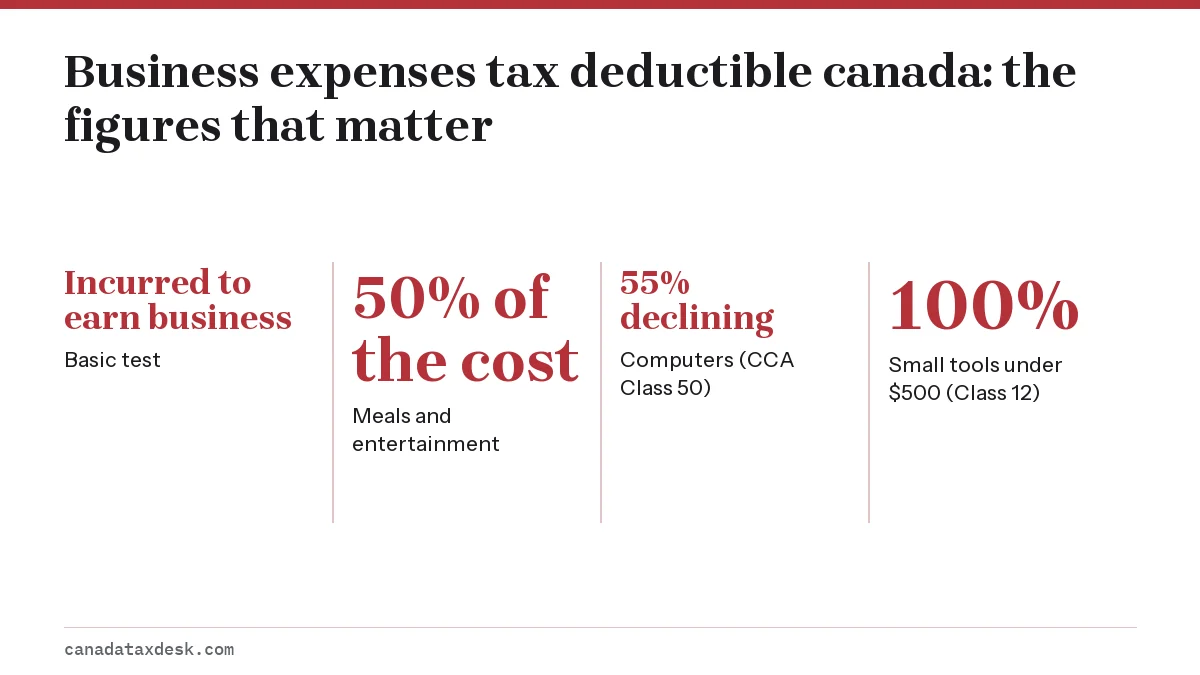
- 01Basic test
- Incurred to earn business income and reasonable in amount
- 02Meals and entertainment
- 50% of the cost
- 03Computers (CCA Class 50)
- 55% declining balance
- 04Small tools under $500 (Class 12)
- 100%
- 05Keep records for
- 6 years from the end of the tax year
What makes business expenses tax deductible in Canada?
A cost is a deductible business expense in Canada when it passes three checks: you spent it to earn income from your business, the amount is reasonable in the circumstances, and it is a current expense rather than a capital purchase or a personal cost. If all three are met, you deduct it on Form T2125 and it reduces both your income tax and your self-employed CPP.
The CRA does not publish a closed list of allowed items. It publishes categories, and the question is always whether the specific cost served the business. A tax write-off is simply a deduction that lowers taxable profit; a $100 expense saves $100 multiplied by your combined tax and CPP rate, not $100 in tax.
Expenses you cannot deduct
- Money you pay yourself (drawings) as a sole proprietor.
- Most fines and penalties imposed under Canadian, provincial or foreign law.
- The personal share of anything used both at work and at home.
- Goods from your own inventory that you or your family consumed.
- Everyday clothing, even if worn only for work, unless it is a uniform or protective gear.
Business expenses list for Canada: common deductions
Most self-employed tax deductions in Canada fall into a short set of categories. The checklist shows the ones sole proprietors claim most often, and the table below gives the T2125 line where each one goes; the T2125 guide walks through the rest of the form.
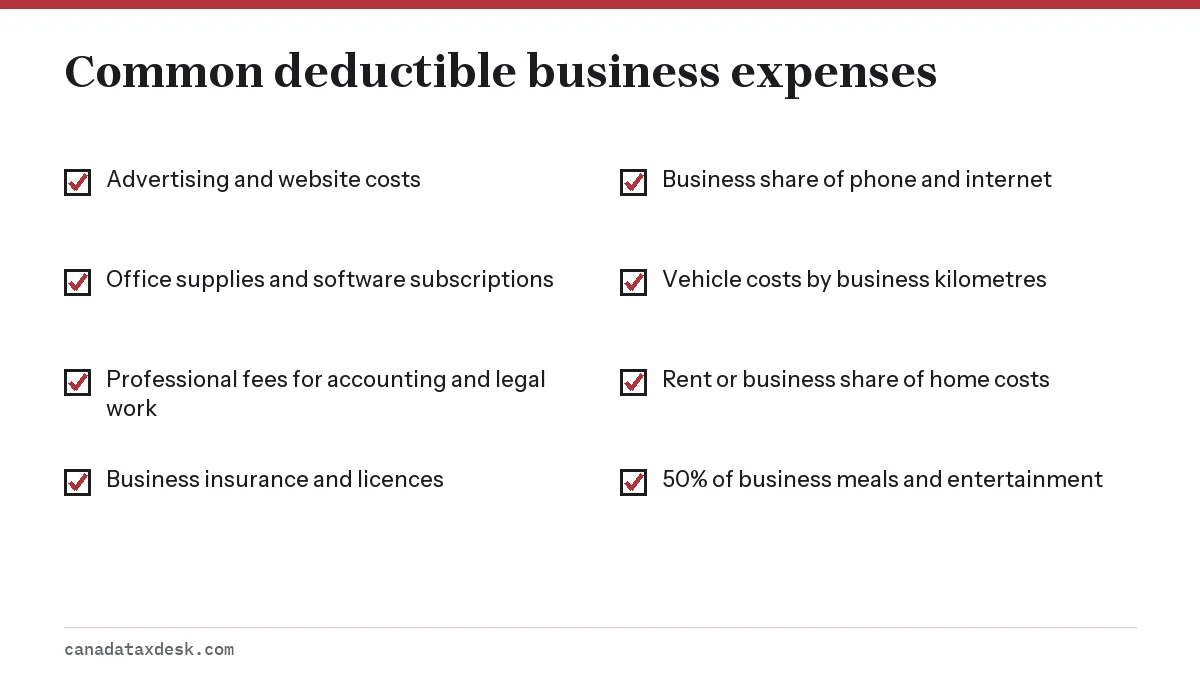
Less obvious deductions include bank charges on a business account, interest on money borrowed for the business, bad debts you previously included in income, subcontractor payments, wages paid to a spouse or child for real work at a reasonable rate, and delivery and freight costs.
| Expense | T2125 line | What to know |
|---|---|---|
| Advertising | 8521 | Ads, website and promotion costs |
| Meals and entertainment | 8523 | 50% of the cost; 80% for long-haul truck drivers on eligible trips |
| Insurance | 8690 | Business insurance; home insurance goes on line 9945 and vehicle insurance on line 9281 |
| Interest and bank charges | 8710 | Business loans and business account fees |
| Business taxes, licences and memberships | 8760 | Annual licence fees; not dues for dining, recreation or sports clubs |
| Office expenses | 8810 | Small items such as pens, paper and stamps; desks and chairs are capital |
| Office stationery and supplies | 8811 | Items used to provide your goods or services, such as a plumber's cleaning supplies |
| Professional fees | 8860 | Accounting and legal fees |
| Rent | 8910 | Business premises; rent for your home goes on line 9945 |
| Salaries, wages and benefits | 9060 | Staff pay plus your employer share of CPP or QPP and EI; never your own drawings |
| Telephone and utilities | 9220 | Business share only; not the basic monthly rate of a home phone |
| Motor vehicle expenses (not CCA) | 9281 | Business-kilometre share of fuel, insurance, repairs, licence, and interest or lease |
| Capital cost allowance (CCA) | 9936 | Equipment, computers and vehicles, claimed over time (classes below) |
| Business-use-of-home expenses | 9945 | Home share of utilities, insurance, rent or mortgage interest and property taxes |
Can I deduct my phone and internet?
Yes, for the business share. A cell phone used 60% for clients and 40% personally gives a 60% deduction of the plan cost; keep a sample month of call and data use to support the percentage. The CRA does not allow the basic monthly rate of a home landline, but business long-distance calls on it are deductible.
Home internet follows the same logic. If you work from home 40 hours a week and the household uses the connection heavily for streaming, a 50% claim is easier to defend than 100%.
Home office and vehicle deductions
A home office qualifies only when the space is your principal place of business, or you use it exclusively for business and regularly meet clients there. You then deduct a share of heat, electricity, insurance, maintenance, rent or mortgage interest and property taxes, based on floor area. The claim cannot push the business into a loss, and unused amounts carry forward to the next year.
Employees working from home use a different set of rules and Form T2200 from their employer; those are covered in work from home expenses. Do not mix the two on one return for the same space.
Vehicle expenses
For a vehicle used partly for business, total the year's fuel, insurance, repairs, licence, and lease payments or loan interest, then deduct the business-kilometre share. Driving between home and a regular work location is personal. A logbook recording date, destination, purpose and kilometres for each trip is the evidence the CRA asks for; after a full base year, a three-month sample log can be used if results stay within 10%.
There is no flat mileage rate for the self-employed. Form T2125 asks for your actual vehicle costs, entered on line 9281, with vehicle CCA claimed separately. The 2026 rates of 73 cents per kilometre for the first 5,000 km and 67 cents after that (77 and 71 cents in the territories) are Finance Canada's limits on tax-exempt allowances that employers pay employees, not a rate you multiply by your business kilometres. For a passenger vehicle bought, financed or leased in 2026, the CCA cost ceiling is $39,000 before tax, deductible loan interest is capped at $350 a month and lease payments at $1,100 a month before tax.
Can I deduct meals as a business expense?
Yes, but only 50% of the cost of food, drinks and entertainment, and only when there is a business reason, such as a meeting with a client or meals while travelling away from your home area for work. A $120 client dinner gives a $60 deduction. Your own lunch on an ordinary workday is personal and not deductible.
- Long-haul truck drivers: 80% of meal costs during eligible trips of at least 24 continuous hours.
- Staff events: up to six events a year open to all employees can be fully deductible.
- Tips and taxes on the bill: included in the cost before the 50% limit is applied.
Current expenses vs capital purchases
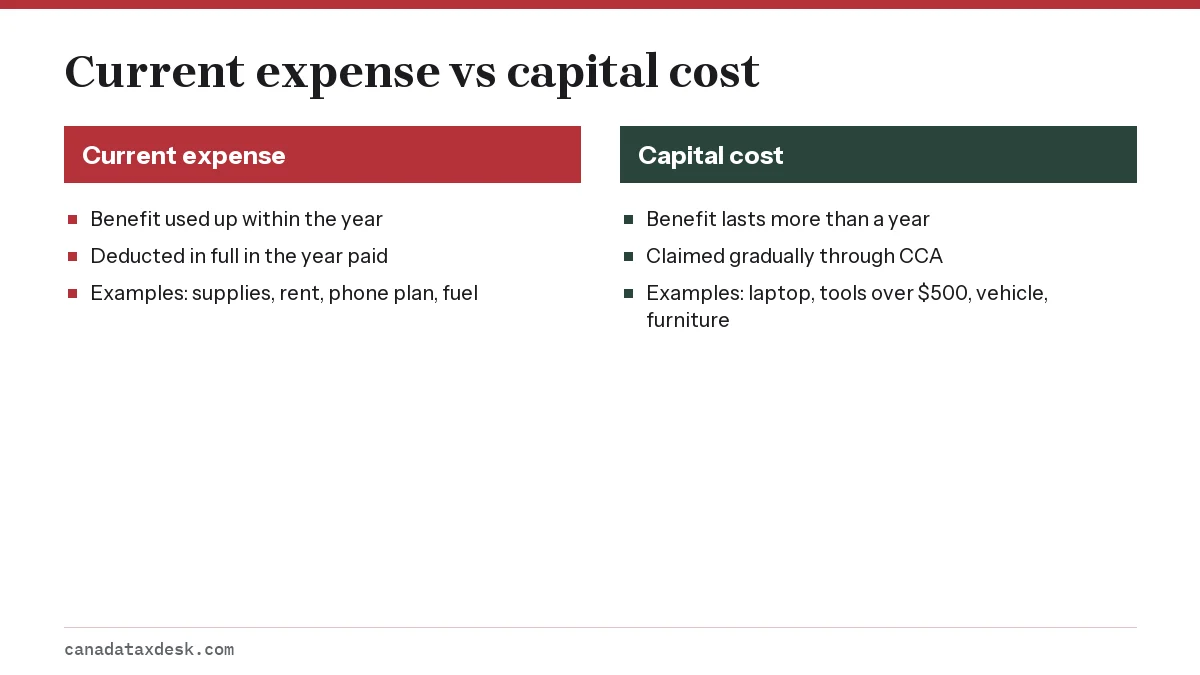
A purchase that gives a lasting benefit, such as a computer, camera, tools, furniture or a vehicle, is a capital cost. You claim part of it each year through capital cost allowance (CCA) at the rate for its class. How much you can claim in the first year depends on the half-year rule and the Accelerated Investment Incentive rules for the year the asset became available for use, which tax software applies for you.
| Class | Examples | Rate |
|---|---|---|
| 8 | Furniture, equipment and tools costing $500 or more | 20% |
| 10 / 10.1 | Vehicles; passenger vehicles over the cost limit go in 10.1 | 30% |
| 12 | Tools and kitchen utensils under $500 | 100% |
| 50 | Computers and systems software | 55% |
Example: a $2,000 laptop used only for business goes into Class 50 at 55%. Only part of the $2,000 is deducted in the year of purchase, and the undepreciated balance carries into later years until it is fully claimed or the laptop is sold. A $300 drill, by contrast, goes into Class 12 and is written off at 100%.
What records do I need for business expenses?
Keep a receipt or invoice that shows who you paid, the date, the amount and what you bought, plus proof of payment. A bank or card statement alone often does not show what was purchased. Records must be kept for six years from the end of the tax year they relate to, and digital copies are acceptable if they are legible and complete.
- Use one bank account and card for business only.
- Photograph paper receipts the day you get them and note the business purpose.
- Keep a running vehicle log and a note of your home workspace measurements.
- Reconcile monthly so the year-end T2125 is a matter of adding up categories.
Drivers and couriers have a few extra record rules for fuel and platform fees, covered in Uber driver taxes in Canada. For how expenses fit into the full picture, start at self-employed taxes in Canada.
Common questions
What expenses are tax deductible in Canada for a small business?
Reasonable costs incurred to earn business income, such as advertising, supplies, rent, insurance, professional fees, business phone use, vehicle costs by business kilometres, and 50% of business meals. Equipment is deducted through capital cost allowance.
Can I write off gym memberships or clothing as a business expense?
Generally no. Gym memberships and everyday clothing are personal even if they help your work. Uniforms, protective equipment and costumes used only for performances are the usual exceptions.
Can I deduct expenses without receipts?
You can claim them, but if the CRA reviews the return and you cannot support the amount, the deduction is usually denied. Bank statements help but rarely show what was bought, so keep the receipt or invoice.
Can I claim business expenses without income in Canada?
Yes, if the business had actually started, for example you were actively marketing or setting up operations. The expenses then produce a business loss that reduces your other income for the year, such as employment income, and a loss larger than your other income becomes a non-capital loss you can generally carry back 3 years or forward 20 years. Costs of investigating whether to start a business at all are harder to deduct.
Are GST/HST amounts part of my business expenses?
If you are registered for GST/HST, you claim the GST/HST paid as input tax credits on your GST/HST return and deduct only the pre-tax cost. If you are not registered, the GST/HST paid is part of the expense.
Sources
- Business expenses canada.ca
- T2125 Statement of Business or Professional Activities canada.ca
- Business-use-of-home expenses canada.ca
- T4002, Chapter 3: Expenses canada.ca
- Motor vehicle records canada.ca
We check figures against these official pages. Rules change; confirm anything that affects a deadline or payment with the agency before you act.
Tell us what happened
Describe your situation and our editors will use it to improve this guide. If you leave your email, we may reply with a pointer to the right page or official contact. We never share your details.
Related guides
 Self-Employed Taxes in Canada: Income, CPP and Deadlines
Self-employed taxes in Canada are paid on business profit, not on gross sales: you report income and expenses on Form T2125, pay…
T2125 Form: How to Report Self-Employment Income in Canada
The T2125, Statement of Business or Professional Activities, is the CRA form a sole proprietor or partner files with the T1 retur…
Work From Home Expenses Canada: T2200 and What to Claim
Employees in Canada can claim work from home expenses for 2023 and later only with the detailed method: your employer must sign F…
Uber Driver Taxes Canada: Income, Expenses and GST/HST
Uber drivers in Canada are self-employed: you report all fares and tips as business income on Form T2125, deduct platform fees an…
CPP for Self-Employed People: 2026 Rates and Maximums
For 2026, CPP for self-employed people is 11.9% of net self-employment earnings between $3,500 and $74,600, up to $8,460.90, plus…