
CPP for self-employed people: 2026 rates, maximums and tax relief
Short answer
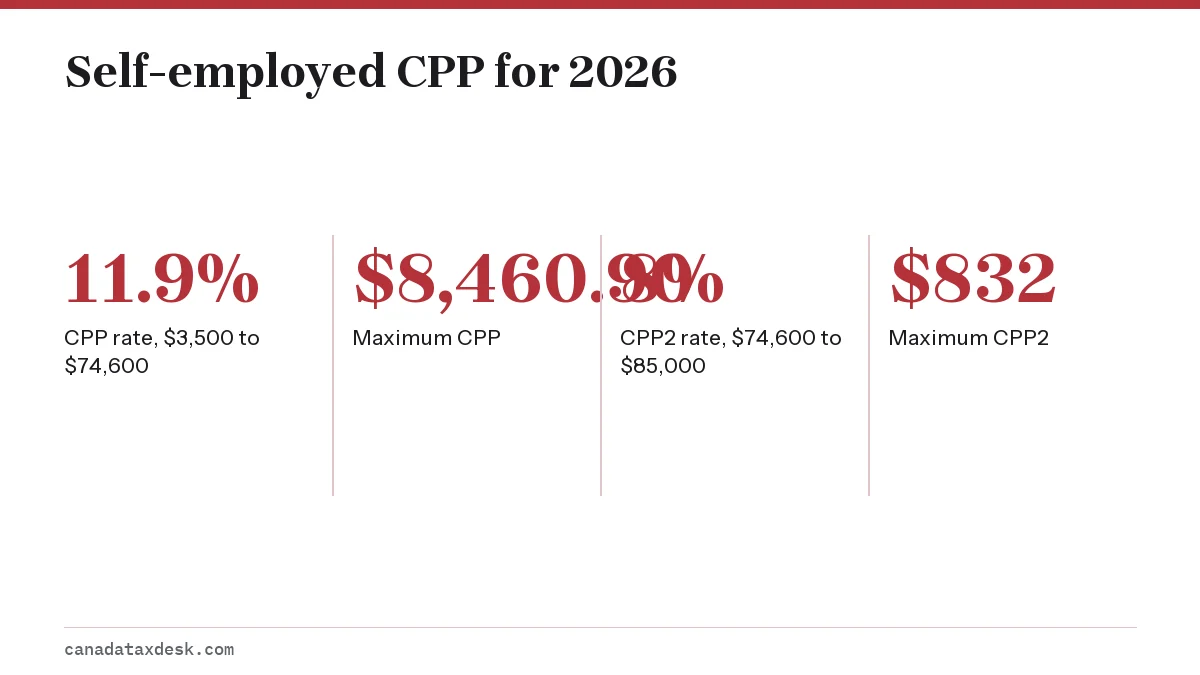
For 2026, CPP for self-employed people is 11.9% of net self-employment earnings between $3,500 and $74,600, up to $8,460.90, plus an 8% CPP2 contribution on earnings from $74,600 to $85,000, up to $832. You pay both the employee and employer shares, and part of the cost comes back as a deduction and a tax credit.
- 012026 CPP rate, self-employed
- 11.9% (9.9% base plus 2% first additional)
- 022026 basic exemption
- $3,500
- 032026 maximum pensionable earnings (YMPE)
- $74,600
- 042026 maximum CPP
- $8,460.90
- 052026 CPP2
- 8% from $74,600 to $85,000, maximum $832
- 062027 YMPE
- Not yet announced as of October 22, 2026 (usually early November)
How much CPP do self-employed people pay?
A self-employed person pays 11.9% CPP on net self-employment earnings above the $3,500 basic exemption and up to the 2026 year's maximum pensionable earnings of $74,600. The most anyone pays in 2026 at that rate is $8,460.90. Earnings from $74,600 to $85,000 attract a further 8% second additional contribution, CPP2, capped at $832.
The contribution is based on net income from Form T2125, not on gross sales. It is calculated on Schedule 8 of your T1 return and added to your balance owing on line 42100, so it is due April 30, 2027 along with your income tax. Residents of Quebec contribute to the QPP instead: for 2026, Retraite Québec sets the self-employed rate at 12.6% on earnings from $3,500 to $74,600, plus the same 8% second additional contribution up to $85,000, for a maximum of about $9,791.
Why self-employed CPP contributions cover both shares
An employee pays 5.95% of pensionable earnings in 2026 and the employer pays a matching 5.95%. When you work for yourself, you are both parties, so you pay the combined 11.9%. The same doubling applies to CPP2: 4% for an employee plus 4% from the employer becomes 8% for you.
The benefit side mirrors this. Your contributions build your own CPP retirement, disability and survivor entitlements in the same way an employee's combined contributions do. Paying less CPP by under-reporting income also means a smaller pension later.
CPP self-employed 2026 rates and limits
| Item | Employee | Self-employed |
|---|---|---|
| Basic exemption | $3,500 | $3,500 |
| Year's maximum pensionable earnings | $74,600 | $74,600 |
| CPP rate | 5.95% | 11.9% |
| Maximum CPP | $4,230.45 | $8,460.90 |
| CPP2 earnings range | $74,600 to $85,000 | $74,600 to $85,000 |
| CPP2 rate and maximum | 4%, $416 | 8%, $832 |
For comparison, the 2025 limits were $71,300 for maximum pensionable earnings and $81,200 for the CPP2 ceiling. The 2027 limits are not yet announced; the government usually publishes them in early November.
What is CPP2 for self-employed earners?
CPP2 is the second additional CPP contribution, introduced in 2024 as the last stage of the CPP enhancement. It applies only to the slice of earnings between the year's maximum pensionable earnings ($74,600) and the year's additional maximum pensionable earnings ($85,000 for 2026). If your net self-employment income is $74,600 or less, you pay no CPP2 at all.
At the top of the range the extra cost is $832 for 2026, but all of it is tax deductible, which lowers the after-tax cost to well under that figure for anyone in the second federal bracket or higher.
Is CPP deductible for self-employed people?
Partly deductible and partly a credit. The CRA splits self-employed contributions this way: half of the 9.9% base contribution is claimed as a non-refundable tax credit, and the other half of the base, the 2% first additional contribution, and all CPP2 are deducted from income. Schedule 8 carries the credit amount to line 31000 and the deduction to line 22200.
- Credit (line 31000): 4.95% of pensionable earnings, worth 14% federally in 2026 plus your provincial lowest rate.
- Deduction (line 22200): the other 4.95%, the 2% enhancement and all CPP2, which lowers taxable income at your marginal rate.
- Not on the T2125: CPP is a personal contribution, so it is never entered as a business expense.
Worked example: CPP at three self-employed income levels
The table applies the 2026 rates to three levels of net self-employment income for someone with no employment income. Figures are calculated by the editorial team from the CRA's published rates and limits.
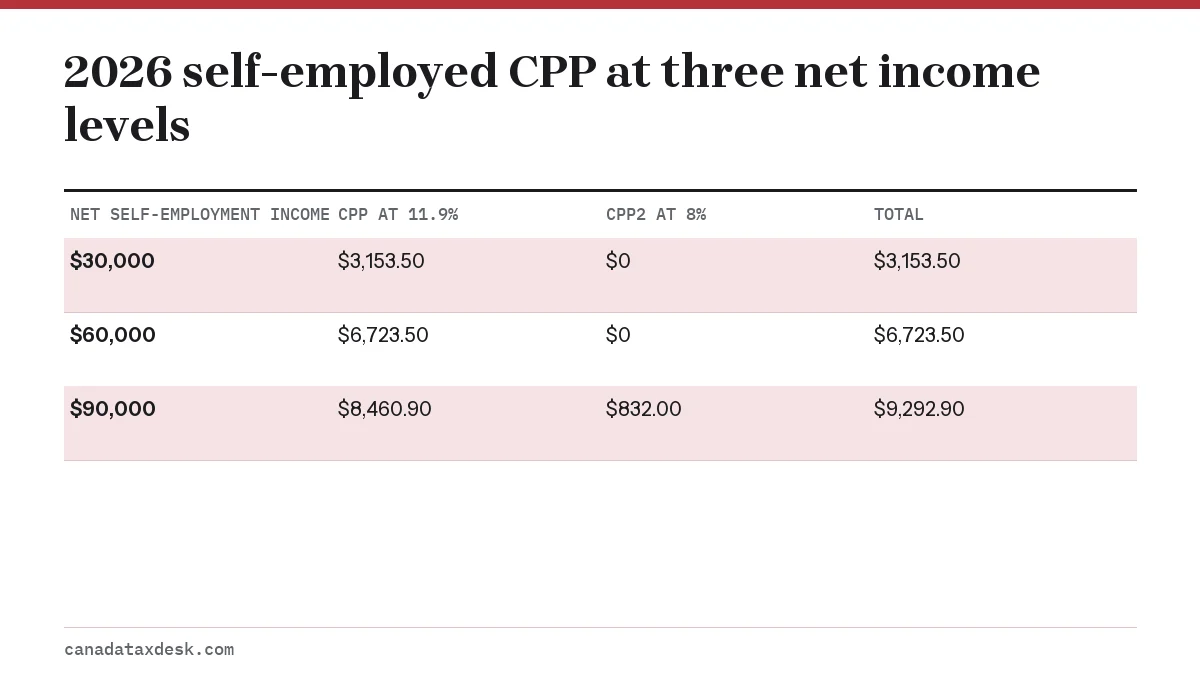
Take the $60,000 case. Pensionable earnings are $60,000 minus $3,500, or $56,500. CPP is 11.9% of $56,500, which is $6,723.50. Of that, $2,796.75 is claimed as a credit, saving about $391.55 in federal tax at 14%, and $3,926.75 is deducted from income. No CPP2 applies because income is below $74,600.
At $90,000 the CPP portion is capped at $8,460.90 and CPP2 is capped at $832, for a total of $9,292.90. Any profit above $85,000 attracts no further CPP. To see these contributions alongside income tax, use the self-employed tax calculator.
Special situations that change your CPP
- You also have a T4 job. Employee CPP already deducted counts toward the annual maximum, so Schedule 8 reduces what you owe on self-employment earnings.
- You are 65 to 70 and receiving a CPP pension. You can elect to stop contributing; for self-employment earnings the election is made on Schedule 8.
- You turned 18, turned 70 or died during the year. The exemption and maximums are prorated by month.
- You live in Quebec. You contribute to the QPP, not the CPP. On the federal return, a Quebec resident with only QPP contributions uses the Quebec version of Schedule 8, and one who also has CPP contributions, for example from a job outside Quebec, uses Form RC381.
- Your net income is $3,500 or less. No CPP is payable on it.
Gig workers often have both a T4 job and platform income, so the first point matters to them; see taxes for Uber and delivery drivers. Expenses reduce CPP as well as income tax, because they lower net earnings, which is one more reason to claim every deductible business expense.
Paying self-employed CPP contributions on time
Nobody withholds CPP from self-employment income, so it is part of your net tax owing when the CRA decides whether you must pay quarterly instalments. If your combined income tax and CPP owing exceeds $3,000 ($1,800 in Quebec), plan for instalments. The overview of self-employed taxes in Canada shows where CPP fits with the other deadlines.
Common questions
What is the maximum CPP for self-employed in 2026?
The maximum is $8,460.90 of CPP at 11.9%, plus up to $832 of CPP2 at 8%, for a combined $9,292.90 on net self-employment earnings of $85,000 or more.
How do I calculate CPP on self-employment income?
Subtract $3,500 from net self-employment income, cap the result at $71,100 (the $74,600 maximum minus the exemption), and multiply by 11.9%. If net income is above $74,600, add 8% of the amount up to $85,000.
Can I opt out of CPP if I am self-employed?
No, not before age 65. People aged 65 to 70 who already receive a CPP retirement pension can elect to stop contributing. Everyone else with net self-employment earnings above $3,500 must contribute.
Do I pay EI as a self-employed person?
No, EI premiums are not required on self-employment income. You can opt in to EI special benefits (such as maternity, parental and sickness) through an agreement with the Canada Employment Insurance Commission, and then premiums are added to your return.
Why is my self-employed CPP higher than last year?
The maximum pensionable earnings rose from $71,300 in 2025 to $74,600 in 2026, and the CPP2 ceiling from $81,200 to $85,000. Higher profit also raises contributions up to those caps.
When do self-employed people pay taxes and CPP for 2026?
With the 2026 tax return. Self-employed people have until June 15, 2027 to file, but the balance owing, including CPP, must be paid by April 30, 2027 to avoid interest. If you have to pay quarterly instalments, the 2027 dates are March 15, June 15, September 15 and December 15, and those payments cover CPP on 2027 earnings as well as income tax.
Sources
- T4127 Payroll Deductions Formulas, January 2026 canada.ca
- MP, DB, RRSP, DPSP, ALDA, TFSA limits, YMPE and YAMPE canada.ca
- The Canada Pension Plan enhancement: what it means for you canada.ca
- Line 22200, Deduction for CPP or QPP contributions on self-employment income canada.ca
- Line 31000, Base CPP or QPP contributions on self-employment income canada.ca
- Retraite Québec, Contributions to the Québec Pension Plan retraitequebec.gouv.qc.ca
We check figures against these official pages. Rules change; confirm anything that affects a deadline or payment with the agency before you act.
Tell us what happened
Describe your situation and our editors will use it to improve this guide. If you leave your email, we may reply with a pointer to the right page or official contact. We never share your details.
Related guides
 Self-Employed Taxes in Canada: Income, CPP and Deadlines
Self-employed taxes in Canada are paid on business profit, not on gross sales: you report income and expenses on Form T2125, pay…
Self-Employed Tax Calculator Canada: Tax and CPP Estimate
This self-employed tax calculator for Canada estimates your 2026 federal and provincial income tax plus CPP and CPP2 on net busin…
Business Expenses List Canada: Self-Employed Deductions
Business expenses are tax deductible in Canada when you incur them to earn business income, they are reasonable, and they are not…
Uber Driver Taxes Canada: Income, Expenses and GST/HST
Uber drivers in Canada are self-employed: you report all fares and tips as business income on Form T2125, deduct platform fees an…
T2125 Form: How to Report Self-Employment Income in Canada
The T2125, Statement of Business or Professional Activities, is the CRA form a sole proprietor or partner files with the T1 retur…