
Newcomers, Students and Seniors
Student tax return in Canada: what to report and claim
Short answer
A student tax return in Canada is the regular T1 return, and most students should file one every year even with low income. Scholarships are usually tax-free for full-time students, tuition from the T2202 becomes a 14% federal credit for 2026, and a student earning less than the $16,452 basic personal amount can get back all federal tax withheld from a part-time job.
- 012026 federal basic personal amount
- $16,452
- 02Federal tuition credit rate, 2026
- 14% of eligible fees
- 03Maximum tuition transfer
- $5,000 of the current-year amount, minus what the student used
- 04Student loan interest carryforward
- Up to 5 years (line 31900)
- 05Scholarships for full-time students
- Generally not taxable
Should students file a tax return in Canada?
Yes. Students should file a return every year, even with no income, because the CRA says filing annually is a condition for continuing to get benefit and credit payments. A student tax return in Canada also records tuition for later and returns tax withheld from part-time work. Students 19 or older who file can also receive the Canada Groceries and Essentials Benefit, the quarterly payment that replaced the GST/HST credit in July 2026; after the October 5 payment, the next one is January 5, 2027.
There is no separate student tax form in Canada. Students file the same T1 Income Tax and Benefit Return as everyone else, with Schedule 11 for tuition and the slips issued by their school and employers. If this is your very first return, start with our first tax return in Canada page for the setup steps.
First time tax filing in Canada at 18
An 18-year-old with a first job files mainly to get a refund and start building RRSP room. Every dollar of earned income reported creates room equal to 18% of it the next year, up to the annual limit, and that room carries forward until it is used.
Which slips go on a student income tax return?
Most students deal with four slips. Enter each exactly as issued; the CRA already has a copy and compares them with your return.
| Slip | What it shows | Where it goes |
|---|---|---|
| T4 | Wages from a part-time, summer or co-op job; tax, CPP and EI deducted | Line 10100 for income; deductions become credits |
| T4A | Scholarships, bursaries and fellowships in box 105 | Only the taxable part goes on line 13010 |
| T2202 | Eligible tuition and months of full-time or part-time study | Schedule 11 and line 32300 |
| T4E | Employment Insurance benefits after a job ends | Line 11900 |
Box 105 amounts confuse many students, since the slip shows the full award even when none of it is taxable. The T4A slip guide walks through the other boxes, and the T4 slip explained page covers job income.
Do scholarships count as income for students?
Post-secondary scholarships, fellowships and bursaries are not taxable when you receive them for a program in which you are a full-time qualifying student, according to the CRA's guide P105, Students and Income Tax. The exemption also covers awards received in one year for full-time study in the year before or the year after.
- Full-time students: the award is usually fully exempt, so nothing goes on line 13010.
- Part-time students: the exemption is limited to the tuition paid plus the cost of program-related materials.
- Basic exemption: when an award is not fully covered by the other exemptions, the first $500 is still exempt.
- Elementary and secondary school awards: not taxable.
Research grants are handled differently from scholarships, and apprenticeship grants have their own rules, so check the description on the slip before assuming an amount is exempt.
What can students claim? Tuition and transfers
The biggest claim for most students is tuition. Fees on the T2202 give a federal credit of 14% for 2026, and the student claims it even when a parent paid the bill. Because a student with part-time income often owes no tax, the choice is between transferring part of the amount and carrying it forward.
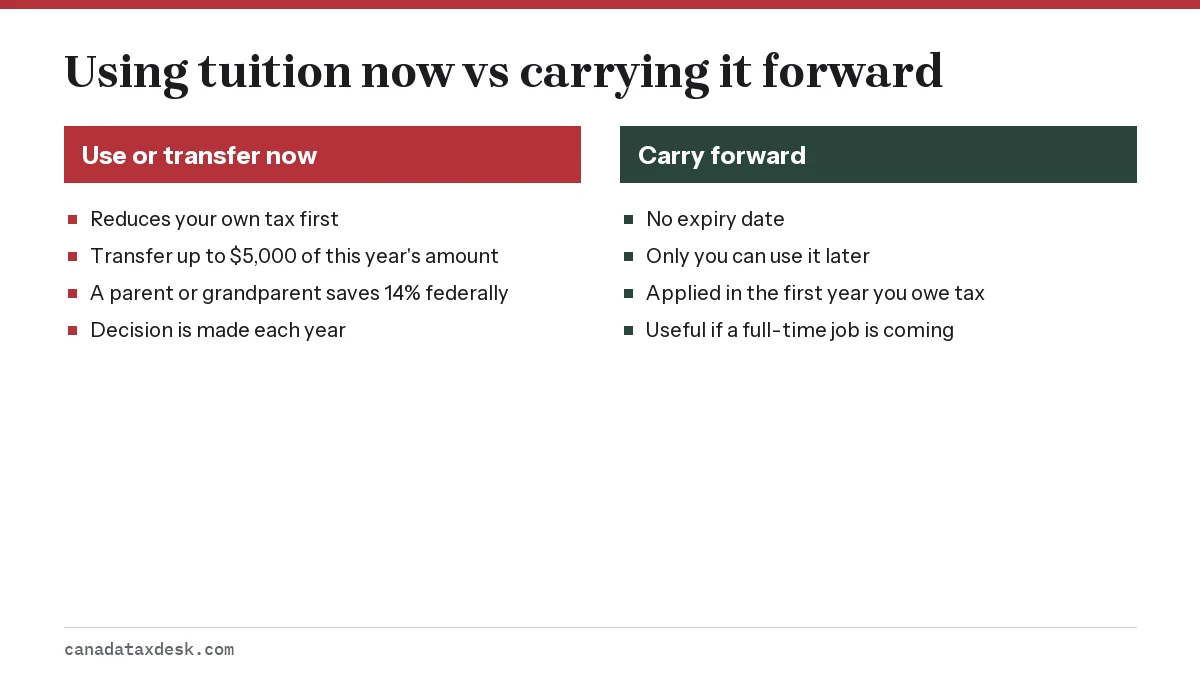
Up to $5,000 of the current year's amount, minus what the student needs to reduce their own tax, can go to a spouse, parent or grandparent. Whatever is carried forward can only be used by the student, in the first year they owe tax. The full rules are on our tuition tax credit page.
Worked example: a 19-year-old with a part-time job
Jordan works at a grocery store during the 2026 school year and earns $14,000 on a T4. His T2202 shows $6,500 of tuition. His income is below the $16,452 basic personal amount, so he owes no federal tax, and all federal income tax withheld from his pay is refunded.
He uses none of the tuition, so he can transfer up to $5,000 to a parent, worth $700 in federal tax to that parent ($5,000 x 14%). The remaining $1,500 is carried forward for Jordan to use when he starts working full time.
Can students claim moving expenses and student loan interest?
Yes to both, with limits. Moving costs count if a full-time post-secondary student moves to a new home at least 40 km closer to the school, but the deduction on line 21900 is limited to the taxable part of scholarship and award income, plus employment income earned at the new location. Since scholarships are often tax-free, many students have little to deduct against; the moving expenses deduction page shows which costs qualify and how to use Form T1-M.
Interest paid on a government student loan is claimed on line 31900. Only loans under the Canada Student Loans Act, the Canada Student Financial Assistance Act, the Apprentice Loans Act or similar provincial laws qualify. Interest on a bank line of credit or a loan that was combined or renegotiated with another loan does not count.
The borrower claims it even if a parent paid the interest. There is no federal maximum, and an unused amount can be carried forward and claimed in any of the next five years, which suits graduates whose income is still low in the first year of repayment.
Canada tax filing for students: a checklist of claims
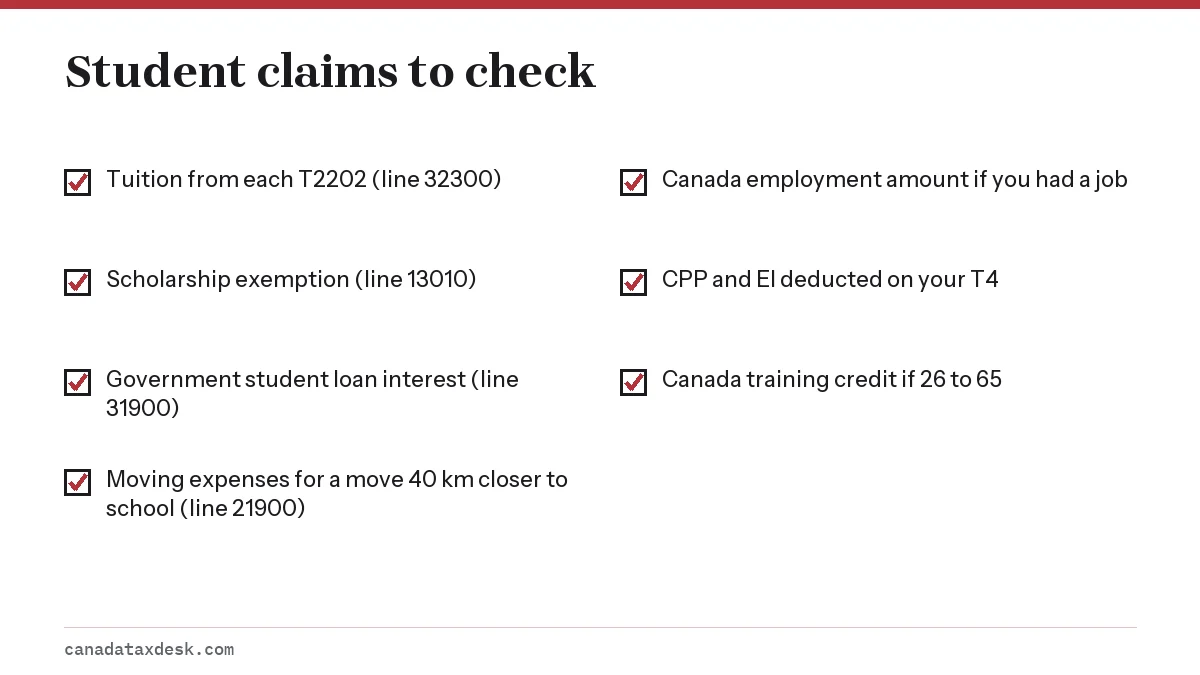
Older students aged 26 to 65 may also be able to claim the Canada training credit, a refundable credit worth up to 50% of eligible tuition, limited by a training credit amount that accumulates at $250 a year and is shown on the notice of assessment. The CRA's students page lists it alongside tuition.
If you do file, the notice of assessment you receive afterwards shows your unused tuition, your RRSP deduction limit and any training credit limit. Keep it with your school records.
What if you had two jobs or worked in two provinces?
Each employer deducts CPP contributions and EI premiums as if it were your only employer, so students who switch jobs mid-year, or hold a campus job and a weekend job, can end up paying more than the yearly maximum. The return catches this: software compares the totals on all your T4 slips with the maximums and claims the extra back as a CPP overpayment on line 44800 and an EI overpayment on line 45000.
The same applies when the jobs are in different provinces. Your province of residence on December 31 sets provincial tax for the whole year, no matter where each employer was located. Tax deducted for another province is still credited in full, because all income tax withheld is claimed together on line 43700. Enter every T4 even if one shows only a few hundred dollars; the CRA already has a copy.
Student tax return mistakes that cost money
- Reporting a tax-free scholarship as income. Entering all of box 105 on line 13010 raises your income for nothing.
- Transferring tuition you needed yourself. Schedule 11 applies your own tax first; you cannot skip it to transfer more.
- Claiming interest on a private loan. Only government student loans qualify for line 31900.
- Not filing because a parent claims you. Your parent's return does not cover your slips, refunds or tuition carryforward.
- Forgetting the T2202 in a year you owe nothing. It still needs to be entered so the carryforward is recorded.
Step by step
Collect slips
Gather your T4, T4A, T2202 and T4E for the year.
Check scholarship exemptions
Report only the taxable part of box 105 on line 13010.
Enter tuition on Schedule 11
Apply what you need, then decide on a transfer of up to $5,000 or carry forward.
Add loan interest and moving costs
Claim government student loan interest on line 31900 and eligible moves on line 21900.
File by April 30
Send the return and keep the notice of assessment showing your carryforwards.
Common questions
Do students have to pay tax on part-time job income?
Only if total income is high enough. For 2026, federal tax does not start until taxable income exceeds the $16,452 basic personal amount, so many part-time students get back everything withheld when they file.
Can I file my own taxes as a student living at home?
Yes. Living with parents does not change anything; each person files their own return with their own slips.
Can a student claim rent on a tax return?
Not federally. Some provinces offer a credit or grant tied to rent or property tax, claimed on the provincial part of the return.
Where do I find my T2202?
Colleges and universities post it on the student portal, usually by the end of February. Some mail it on request.
What happens if I forget to claim tuition one year?
You can ask the CRA to change that year's return through Change my return in your CRA account or with Form T1-ADJ. The amount then joins your carryforward.
What's the deadline to file taxes in Canada for students?
April 30, 2027 for the 2026 tax year, the same date as everyone else. If you are owed a refund there is no late-filing penalty, but the refund, the record of your tuition and any benefit payments wait until you file. A student with self-employment income has until June 15, 2027 to file, although any balance owing is still due April 30.
Is there a T4 for a student loan?
No. A student loan is not income, so it never appears on a T4. What you need at tax time is in your National Student Loans Service Centre (NSLSC) account, which posts your T4A documents and statements at the start of each calendar year. Use the interest paid shown there for line 31900, and enter any T4A slip the same way as your other slips.
Sources
- CRA, Students and income tax canada.ca
- CRA, P105 Students and Income Tax canada.ca
- CRA, Line 32300, your tuition, education and textbook amounts canada.ca
- CRA, Line 31900, interest paid on your student loans canada.ca
- CRA, Line 21900, moving expenses canada.ca
- Government of Canada, Student loans: tax information canada.ca
- CRA, Canada Groceries and Essentials Benefit canada.ca
We check figures against these official pages. Rules change; confirm anything that affects a deadline or payment with the agency before you act.
Tell us what happened
Describe your situation and our editors will use it to improve this guide. If you leave your email, we may reply with a pointer to the right page or official contact. We never share your details.