
Moving expenses and Canadian taxes: the 40 km rule, what counts and how to claim
Short answer
You claim the moving expenses deduction for Canadian taxes on Form T1-M and line 21900 when you move for a new job, a business or full-time post-secondary studies and your new home is at least 40 km closer to that work or school by the shortest public route. The deduction is limited to income earned at the new location, and unused amounts carry forward.
- 01Distance test
- New home at least 40 km closer to the new work or school, by the shortest public route
- 02Where to claim
- Form T1-M, then line 21900 of the T1 return
- 03Temporary living costs
- Up to 15 days of meals and lodging
- 04Vacant old home costs
- Up to $5,000
- 052025 simplified meal rate
- $23 per meal, up to $69 per day per person
Can you deduct moving expenses on your Canadian taxes?
Yes. The moving expenses deduction lets you subtract eligible relocation costs from income on line 21900 of your return, provided the move was to start work, run a business or study full time at a new location, and the new home is at least 40 km closer to it (CRA, line 21900).
Because it is a deduction and not a credit, it lowers taxable income at your top marginal rate. That makes moving expenses one of the more valuable claims for someone who relocated mid-year for a well-paid job. For the full list of what else you can claim, see our tax credits and deductions guide.
What is the 40 km rule for moving expenses?
The 40 km rule means your new home must be at least 40 kilometres closer to your new work location or school than your old home was, measured along the shortest normal public route, not in a straight line. If the move fails this test, none of the costs are deductible.
Compare two distances: old home to the new workplace, and new home to the new workplace. Subtract the second from the first. The result must be 40 km or more.
| Situation | Old home to new work | New home to new work | Difference | Eligible? |
|---|---|---|---|---|
| Transfer from Ottawa to a Toronto office | 450 km | 8 km | 442 km | Yes |
| New job across the same city | 52 km | 15 km | 37 km | No |
| Student moving to a university campus | 120 km | 2 km | 118 km | Yes, against taxable award income |
The CRA also expects you to establish the new home as your ordinary residence and to leave the old one behind, for example by selling, renting out or advertising it. A person who keeps living in the old home and commutes does not qualify.
Who can claim moving expenses with the CRA?
Three groups can claim moving expenses with the CRA, each against a different kind of income. What you can deduct in a year is capped by the income from that source at the new location.
- Employees, including people transferred by the same employer, deduct against employment income earned at the new work location.
- Self-employed people deduct against business income earned at the new location.
- Full-time post-secondary students deduct against the taxable part of scholarships, fellowships, bursaries, certain prizes and research grants, and against any job income earned at the new location.
For a move within Canada, both the old and new homes must be in Canada. Special rules apply to people who remain factual or deemed residents while living abroad, and the CRA handles those moves on a separate page. A move to or from Canada can qualify only if you are a full-time student or a factual or deemed resident of Canada, so newcomers arriving from outside Canada usually cannot claim the cost of moving here. Renting a place abroad while Canada stays your normal home does not count as a move.
Can students claim moving expenses?
Students can claim if they moved to attend a post-secondary program full time and meet the 40 km rule, but only up to the taxable portion of their award income plus job income at the new location. Scholarships are often tax-free for full-time students, so many students have little or nothing to deduct against. Read our student tax return page for how award income is reported.
What moving costs are eligible?
Eligible moving costs are the reasonable amounts you actually paid to move yourself, your household and your belongings. The CRA's list on the line 21900 page is specific.
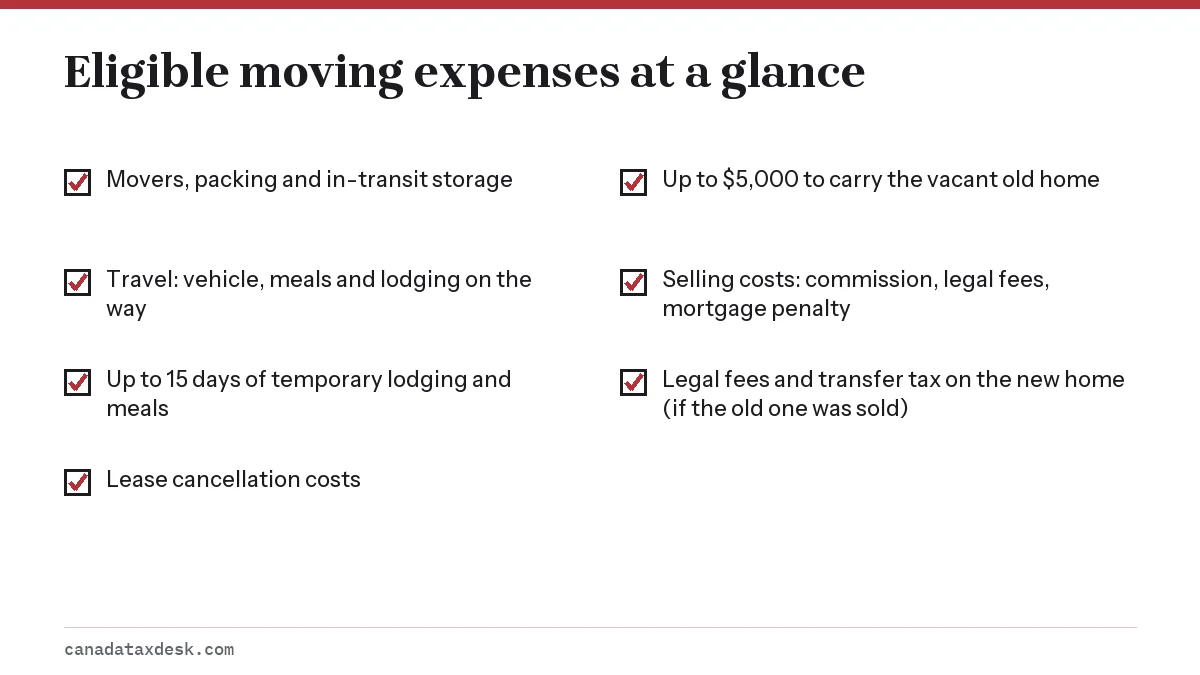
- Movers, packing, hauling, in-transit storage and insurance for household items, including boats and trailers.
- Travel for you and household members: vehicle costs, meals and lodging on the way.
- Temporary lodging and meals near either home for a maximum of 15 days.
- The cost of cancelling a lease on the old home, other than rent for the months you lived there.
- Incidentals such as changing your address on legal documents, replacing driver's licences and vehicle permits, and connecting or disconnecting utilities.
- Up to $5,000 in total of mortgage interest, property taxes, insurance, heating and utilities for the old home while it sat vacant and was listed for sale.
- Selling costs for the old home: advertising, legal or notary fees, real estate commission and a mortgage prepayment penalty.
- Legal or notary fees and land transfer or registration taxes (not GST/HST) on the new home, if you or your spouse sold the old home because of the move.
Costs the CRA does not allow
You cannot deduct house-hunting or job-hunting trips before the move, a loss on the sale of the old home, repairs or improvements made to help it sell, cleaning or repairs on a rental you leave, mail forwarding, mortgage default insurance, replacing personal items, or items movers refuse to carry. Costs of a delayed sale kept for investment reasons are also excluded.
Simplified vs detailed method: how meals and driving are calculated
The simplified method lets you claim meals and vehicle travel at CRA flat rates without keeping every receipt, while the detailed method claims the actual amounts shown on receipts. You can pick either method for meals and either for vehicle costs, and use whichever gives the larger claim.
| Item | 2025 rate |
|---|---|
| Meals | $23 per meal, maximum $69 per day per person |
| Vehicle, travel starting in Ontario | 62.0 cents per km |
| Vehicle, travel starting in Quebec | 60.5 cents per km |
| Vehicle, travel starting in British Columbia | 59.5 cents per km |
| Vehicle, travel starting in Alberta | 56.5 cents per km |
| Vehicle, travel starting in Yukon | 70.5 cents per km |
| Vehicle, travel starting in Manitoba | 56.0 cents per km |
| Vehicle, travel starting in New Brunswick | 59.5 cents per km |
| Vehicle, travel starting in Newfoundland and Labrador | 61.5 cents per km |
| Vehicle, travel starting in Northwest Territories | 70.0 cents per km |
| Vehicle, travel starting in Nova Scotia | 59.5 cents per km |
| Vehicle, travel starting in Nunavut | 70.5 cents per km |
| Vehicle, travel starting in Prince Edward Island | 58.5 cents per km |
| Vehicle, travel starting in Saskatchewan | 55.5 cents per km |
The vehicle rate is set by the province or territory where the trip began (CRA, meal and vehicle rates). Rates for moves made in 2026 have not been posted yet as of October 22, 2026; check that page before filing your 2026 return.
Worked example: claiming moving expenses on a tax return
Priya moved from Ottawa to Toronto in September 2025 for a new job and drove 450 km with one passenger. She sold her Ottawa condo and bought in Toronto. Her Toronto employment income for September to December 2025 was $28,000, and her employer paid nothing toward the move.
| Expense | Amount |
|---|---|
| Movers and packing | $3,200 |
| Vehicle, 450 km x 62.0 cents (simplified, Ontario) | $279 |
| Meals, 2 people x 1 day x $69 (simplified) | $138 |
| Hotel, 6 nights before the Toronto closing | $1,100 |
| Real estate commission and legal fees on the Ottawa sale | $14,500 |
| Legal fees and land transfer tax on the Toronto purchase | $6,300 |
| Total eligible expenses | $25,517 |
Because $25,517 is less than her $28,000 of income at the new location, Priya deducts the full amount on line 21900 of her 2025 return. If her new-location income had been only $18,000, she would deduct $18,000 in 2025 and carry the remaining $7,517 forward to 2026, to use against her Toronto income that year.
How to claim moving expenses with Form T1-M
You claim moving expenses by completing Form T1-M, Moving Expenses Deduction, and carrying its final line to line 21900 of your return. Fill in a separate Form T1-M for each move.
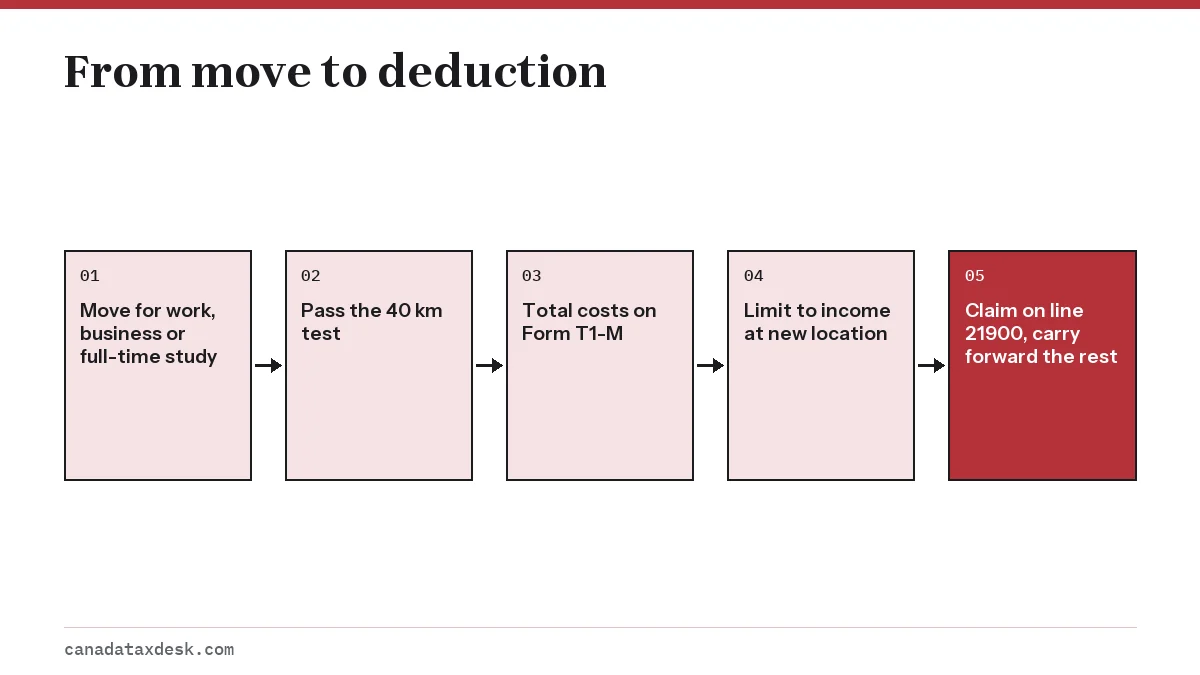
- Confirm the 40 km test using the shortest public route between each home and the new workplace or school.
- Collect receipts for movers, lodging, legal fees and commissions, and a log of kilometres and meals if you use flat rates.
- Subtract any employer reimbursement or allowance you did not include in income.
- Complete Form T1-M in your tax software or on paper and enter the result (line 29 of the form) on line 21900.
- Keep the form and receipts; do not send them unless the CRA asks. Unused amounts carry forward on next year's T1-M.
You can only deduct costs once the move has happened, and only against income from the new location. Moving costs cannot be carried back to an earlier year. If you forgot to claim, you can add the deduction later with Change my return.
What is net eligible income on Form T1-M?
Net eligible income is the income your moving expenses can be deducted from, and it is worked out on Form T1-M. For employees it is the employment income from T4 or T4A slips for the new work location (lines 10100 and 10400), minus related deductions such as those on lines 20700, 21200, 22215, 22900, 23100 and 23200. For self-employed people it is the net self-employment income from the new location reported on lines 13499 to 14300, minus related amounts on lines 21200 and 22200. For students it is the taxable scholarship, fellowship, bursary, prize and research grant income. When net moving expenses (line 26 of the form) are more than net eligible income (line 28), the unused part carries forward.
What if your employer paid for part of the move?
If your employer reimbursed you or paid you a moving allowance, the CRA gives you two choices: reduce your claimed expenses by the amount you received, or include the amount in your income and then claim your full costs. You cannot leave the payment out of income and also deduct the costs it covered.
The CRA may ask your employer to confirm what it paid, so keep the relocation letter or policy. Check whether any part of the payment was already reported as income on your T4 slip; if it was, you can claim the matching costs without reducing them.
Step by step
Check the 40 km rule
Measure the shortest public route from your old home and your new home to the new work location or school; the new home must be at least 40 km closer.
Gather records
Keep receipts for movers, lodging and legal fees, plus a log of kilometres and meals if you use CRA flat rates.
Adjust for reimbursements
Reduce your costs by any employer reimbursement that was not included in your income.
Complete Form T1-M
Fill in one Form T1-M per move and limit the claim to income earned at the new location.
Enter line 21900
Carry the Form T1-M result to line 21900 and keep the form and receipts for six years.
Common questions
Can I claim moving expenses if I moved within the same city?
Only if your new home is at least 40 km closer to your new work or school by the shortest public route. A move across town rarely passes this test, so the costs are usually not deductible.
Can I claim moving expenses if my employer transferred me?
Yes. A transfer to another location of the same employer counts as moving to be employed at a new work location, as long as the 40 km test is met. Reduce the claim by any relocation payment you did not report as income.
Do I need receipts to claim moving expenses in Canada?
Yes for most costs, such as movers, legal fees and hotels. Meals and vehicle costs can be claimed at flat rates under the simplified method, but you still need a record of dates and kilometres.
What is the CRA simplified meal rate for moving expenses?
For the 2025 tax year the simplified meal rate is $23 per meal, up to $69 per day per person, and you do not need meal receipts. Keep basic records of the move anyway, because the CRA can ask for supporting documents. The rate for 2026 moves had not been posted as of October 22, 2026.
Can I claim moving expenses the year after I move?
You claim in the year you paid the costs, once the move has happened. If you pay some costs in the following year, or your income at the new location was too low, the remaining amount is deducted in that later year.
Sources
- Line 21900, Moving expenses canada.ca
- Form T1-M, Moving Expenses Deduction canada.ca
- Meal and vehicle rates used to calculate travel expenses canada.ca
- Income Tax Folio S1-F3-C4, Moving Expenses canada.ca
We check figures against these official pages. Rules change; confirm anything that affects a deadline or payment with the agency before you act.
Tell us what happened
Describe your situation and our editors will use it to improve this guide. If you leave your email, we may reply with a pointer to the right page or official contact. We never share your details.
Related guides
 Tax Credits and Deductions in Canada: What You Can Claim
Tax deductions in Canada reduce the income you are taxed on, so they save tax at your top marginal rate, while most federal tax c…
Student Tax Return Canada: Credits and Tips for Students
A student tax return in Canada is the regular T1 return, and most students should file one every year even with low income. Schol…
Work From Home Expenses Canada: T2200 and What to Claim
Employees in Canada can claim work from home expenses for 2023 and later only with the detailed method: your employer must sign F…
Pension Income Splitting in Canada: Rules and Example
Pension income splitting lets a Canadian resident allocate up to 50% of their eligible pension income to a spouse or common-law p…
T4 Slip Explained: What Each Part of Your T4 Means
A T4, the Statement of Remuneration Paid, is the slip every employer gives each employee for the calendar year. It shows your gro…