
Home accessibility tax credit (HATC): who qualifies, what counts and the 2026 change
Short answer
The home accessibility tax credit (HATC) is a federal non-refundable credit on up to $20,000 a year of permanent renovations that make a home safer or easier to use for a person 65 or older or eligible for the disability tax credit. Starting with 2026 returns, an expense claimed as a medical expense can no longer also be claimed for the HATC.
- 01Annual expense limit
- $20,000 per eligible dwelling (since 2022)
- 02Maximum federal credit
- $2,900 for 2025 (14.5%); $2,800 for 2026 (14%)
- 03Where to claim
- Line 31285, using Federal Worksheet 5000-D1
- 04Who it helps
- People 65 or older at year end, or eligible for the DTC
- 052026 change
- No claiming the same expense under both the HATC and the medical expense credit
What is the home accessibility tax credit?
The home accessibility tax credit (HATC) is a federal credit claimed on line 31285 for renovation costs that let a senior or a person with a disability get into, move around or function in their home, or that reduce their risk of harm there. You can claim up to $20,000 of eligible expenses per year (CRA, line 31285).
The credit is non-refundable and is calculated at the lowest federal rate. That makes the maximum federal value $2,900 for 2025 (14.5% of $20,000) and $2,800 for 2026 (14%). It reduces tax you owe but is not paid out if you owe nothing. The limit was $10,000 for 2015 to 2021 and doubled to $20,000 from 2022.
The HATC sits in the same group of claims as the medical expense tax credit and the Canada caregiver credit. All of them are listed in our credits and deductions guide. If the work creates a self-contained suite so a senior or an adult relative eligible for the DTC can live with family, also look at the refundable multigenerational home renovation tax credit; the same expense cannot go on both.
Who can claim the HATC?
The CRA uses two terms. A qualifying individual is the person the renovation is for. An eligible individual is someone else allowed to claim the cost for them.
| Role | Who fits |
|---|---|
| Qualifying individual | Age 65 or older at the end of the year, or eligible for the disability tax credit at any time in the year |
| Eligible individual | The qualifying individual's spouse or common-law partner |
| Eligible individual | A parent, grandparent, child, grandchild, brother, sister, aunt, uncle, niece or nephew who claimed, or could have claimed, the eligible dependant, caregiver or disability amount for the qualifying individual |
| Eligible dwelling | A housing unit in Canada owned by one of the above (co-op shares count) that the qualifying individual ordinarily lives in, or is expected to within the year |
A person under 65 qualifies only through the DTC. If an application is still pending, keep the receipts: once the disability tax credit is approved for that year, the HATC can be added to the return. Only one dwelling can be the eligible dwelling at a time, though a person who moves during the year can have two in that year.
When more than one person claims for the same qualifying individual, the combined claim cannot exceed $20,000. If claimants cannot agree on the split, the CRA decides it.
Which renovations qualify? HATC eligible expenses
A renovation qualifies when it is of an enduring nature, becomes part of the home, and either improves access, mobility or function for the qualifying individual, or reduces their risk of harm. Temporary or portable items do not qualify.
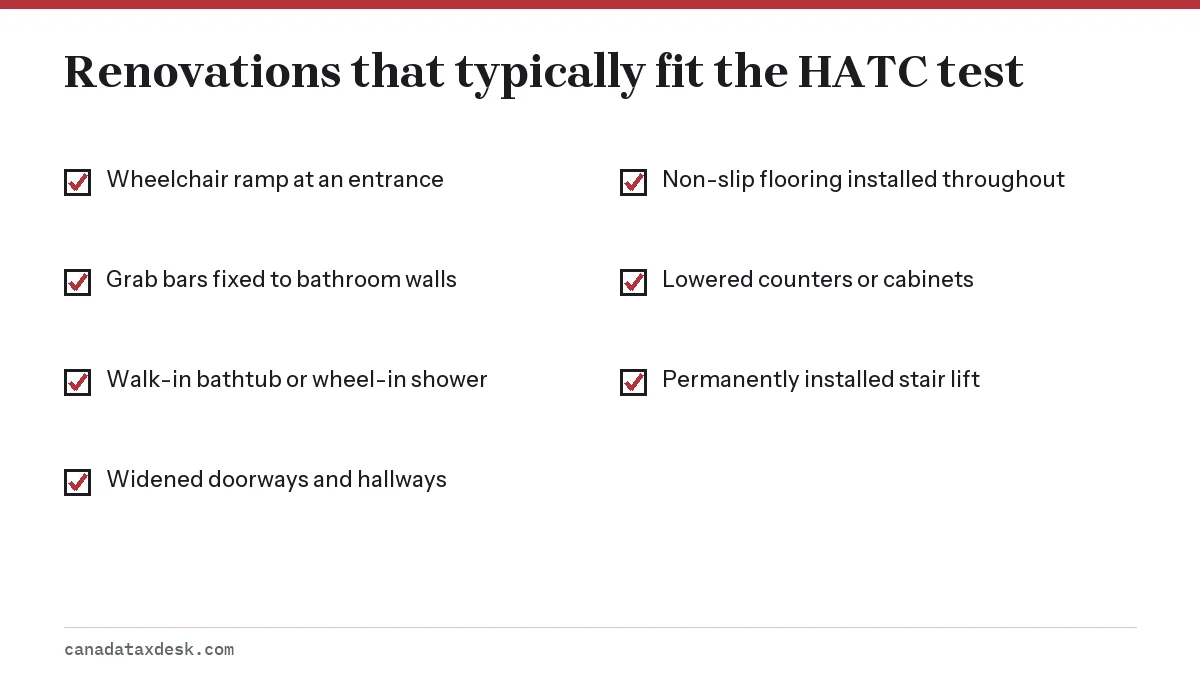
The examples in the checklist are the kinds of permanent changes that meet this two-part test; whether a specific project qualifies depends on the facts. Costs you can count include building materials, fixtures, equipment rentals, building plans and permits, and the work of electricians, plumbers, carpenters and architects. Work by a family member counts only if that person is registered for GST/HST.
What does not qualify
- The value of your own labour, and tools you buy for a do-it-yourself job.
- Items usable on their own, apart from the renovation, and household appliances or electronic entertainment devices.
- Annual, recurring or routine repairs and maintenance.
- Housekeeping, security monitoring, gardening and outdoor maintenance services.
- Financing costs, and renovations done mainly to raise the home's value.
Condominium and co-op owners can claim their share of qualifying work on common areas, supported by a signed statement from the corporation or co-op.
The 2026 rule change: no double claim with medical expenses
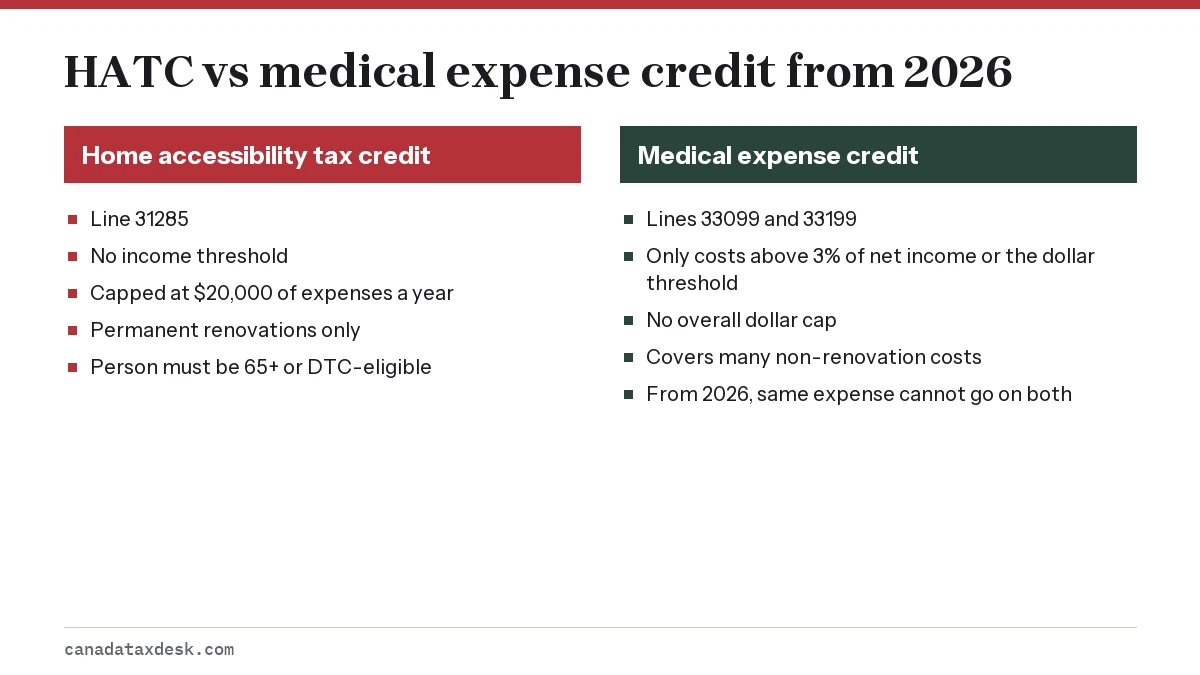
From the 2026 tax year, an expense claimed under the medical expense tax credit cannot also be claimed under the home accessibility tax credit. Up to and including 2025 returns, the CRA allowed the same cost to be claimed under both credits.
Budget 2025 announced the change, and it became law in the Budget 2025 Implementation Act, No. 1 (Bill C-15), which received Royal Assent on March 26, 2026 (Parliament of Canada, LEGISinfo). The Library of Parliament summary says the provision repeals the rule that allowed the double claim and applies from January 1, 2026. The CRA's line 31285 page still shows 2025 rules as of September 2026.
Which credit to choose when an expense qualifies for both
The medical expense credit only counts costs above a threshold: the lower of 3% of net income or a dollar amount ($2,834 for 2025 and $2,890 for 2026). The HATC has no threshold but stops at $20,000. The better choice depends on the size of the project and your other medical costs.
| Project cost | Medical expense credit | HATC | Better choice |
|---|---|---|---|
| $12,000 | ($12,000 - $1,800) x 14% = $1,428 | $12,000 x 14% = $1,680 | HATC |
| $32,000 | ($32,000 - $1,800) x 14% = $4,228 | $20,000 cap x 14% = $2,800 | Medical expense credit |
If your other medical expenses already exceed the threshold, the threshold no longer reduces a renovation claim, which tilts the answer toward the medical expense credit. The two credits also have different rules on who can claim, so check both before filing your 2026 return.
Is there a home accessibility tax credit in Ontario?
Ontario residents claim the federal home accessibility tax credit on line 31285 like everyone else in Canada. Ontario's own Seniors' Home Safety Tax Credit, a refundable credit of 25% on up to $10,000 of home safety renovations, was a temporary measure for the 2021 and 2022 tax years only.
If you have an unfiled or unclaimed 2021 or 2022 Ontario claim, it would be made on Schedule ON(S12) for that year through an adjustment request, such as Change my return. For current years, there is no separate Ontario version of the HATC.
How to claim and what records to keep
- Confirm the qualifying individual is 65 or older at December 31, or DTC-eligible for the year.
- Collect every invoice as the work is done, with the contractor's GST/HST number.
- For 2026 and later, decide whether each cost goes on the HATC or the medical expense credit, not both.
- Complete the line 31285 chart on Federal Worksheet 5000-D1, capping the total at $20,000.
- Enter the result on line 31285. Do not send receipts unless the CRA asks.
The CRA expects each receipt to show the vendor or contractor, their GST/HST registration number, a description of the goods or services and quantity, the date of purchase or completed work, the address of the work, and proof of full payment. A delivery slip helps for materials you installed yourself.
Families who pay for in-home help rather than renovations should also read about the personal support workers tax credit, which is claimed by the worker, not the family.
Common questions
Is the home accessibility tax credit refundable?
No. It is a non-refundable credit that can reduce federal tax to zero but is not paid out as cash. A spouse or eligible relative with more tax to reduce can claim it instead, within the $20,000 combined limit.
Can I claim a walk-in tub under both the HATC and medical expenses in 2026?
No. For the 2026 tax year and later, an expense claimed as a medical expense cannot also be claimed for the HATC. You pick the credit that gives the larger saving for that cost.
Do I need the disability tax credit to claim the HATC?
Only if the person the renovation is for is under 65. A person who is 65 or older at the end of the year qualifies on age alone.
Can a renter claim the home accessibility tax credit?
Generally no. The dwelling must be owned by the qualifying individual or an eligible individual, or held through a co-op share. A tenant who pays for changes to a landlord's unit does not meet the ownership test.
What is the maximum home accessibility tax credit for 2026?
The expense limit is $20,000, so the federal credit is worth up to $2,800 at the 14% rate for 2026. The CRA's 2026 line 31285 page will confirm this when it publishes the 2026 tax package.
Sources
- Line 31285, Home accessibility expenses canada.ca
- Budget 2025: CRA information on select measures canada.ca
- LEGISinfo, Bill C-15 (45-1), Budget 2025 Implementation Act, No. 1 parl.ca
- Library of Parliament, Legislative summary of Bill C-15 lop.parl.ca
- Lines 33099 and 33199, Eligible medical expenses canada.ca
- Schedule ON(S12), Ontario Seniors' Home Safety Tax Credit (2021, archived) canada.ca
We check figures against these official pages. Rules change; confirm anything that affects a deadline or payment with the agency before you act.
Tell us what happened
Describe your situation and our editors will use it to improve this guide. If you leave your email, we may reply with a pointer to the right page or official contact. We never share your details.
Related guides
 Tax Credits and Deductions in Canada: What You Can Claim
Tax deductions in Canada reduce the income you are taxed on, so they save tax at your top marginal rate, while most federal tax c…
Multigenerational Home Renovation Tax Credit: Who Qualifies
The multigenerational home renovation tax credit (MHRTC) is a refundable federal credit for building a self-contained secondary u…
Medical Expenses Tax Credit Canada: What You Can Claim
The medical expenses tax credit lets you claim eligible health costs above the lesser of 3% of your net income or $2,890 for 2026…
Disability Tax Credit Canada: Eligibility, Amount, Applying
The disability tax credit (DTC) is a non-refundable federal credit worth a disability amount of $10,138 for 2025 (line 31600), pl…
Personal Support Workers Tax Credit: 2026 Amount and Rules
The personal support workers tax credit (PSWTC) is a refundable federal credit equal to 5% of an eligible personal support worker…
Canada Caregiver Credit: Amounts, Eligibility, How to Claim
The Canada caregiver credit is a non-refundable federal credit for supporting a spouse, child or relative who depends on you beca…