
Child care expenses deduction: the limit per child, who claims it and how to fill in Form T778
Short answer
The child care expenses deduction lets you deduct what you paid for daycare, a babysitter, day camps and similar care on line 21400, so that you could work, run a business or study. The yearly limit is $8,000 for each child under 7, $5,000 for each child aged 7 to 16 and $11,000 for a child eligible for the disability tax credit, and it cannot exceed two-thirds of your earned income. In a couple, the spouse with the lower net income usually claims.
- 01Where to claim
- Line 21400, calculated on Form T778
- 02Child under 7 at year end
- Up to $8,000 a year
- 03Child aged 7 to 16
- Up to $5,000 a year
- 04Child eligible for the DTC
- Up to $11,000 a year, at any age
- 05Overall cap
- Two-thirds of the claimant's earned income
- 06Who claims in a couple
- The spouse or partner with the lower net income, even if it is zero
What is the child care expenses deduction?
Child care expenses are amounts you or another person paid to have someone else look after an eligible child so that you, or the other person, could earn employment income, carry on a business alone or as an active partner, do research under a grant, or attend school (CRA, line 21400). The amount you can deduct is worked out on Form T778, Child Care Expenses Deduction, and entered on line 21400.
Because it is a deduction, it comes off your income before tax is calculated. It also lowers your net income on line 23600, the figure that income-tested benefits are based on, so the saving can be larger than the tax alone.
Which children count
- The child was under 16 at any time in the year, or had a mental or physical infirmity and depended on you or your spouse or common-law partner.
- The child is yours or your spouse's or common-law partner's, or depended on you or your partner and had net income of $16,129 or less in 2025.
- The child lived with you, or with the other person claiming, when the expenses were paid.
- The care was provided in Canada by a Canadian resident, with limited exceptions for people who lived outside Canada.
How much can you claim for child care expenses?
Your deduction is the lowest of three figures: what you actually paid, the total of the annual limits for all your eligible children, and two-thirds of your earned income for the year. The annual limits come from the CRA's Income Tax Folio S1-F3-C1.
| Child | Annual limit | Weekly limit at overnight camps and boarding schools |
|---|---|---|
| Under 7 at the end of the year | $8,000 | $200 |
| Aged 7 to 16 (under 16 at some time in the year) | $5,000 | $125 |
| Over 15 with an infirmity, not eligible for the DTC | $5,000 | $125 |
| Eligible for the disability tax credit, any age | $11,000 | $275 |
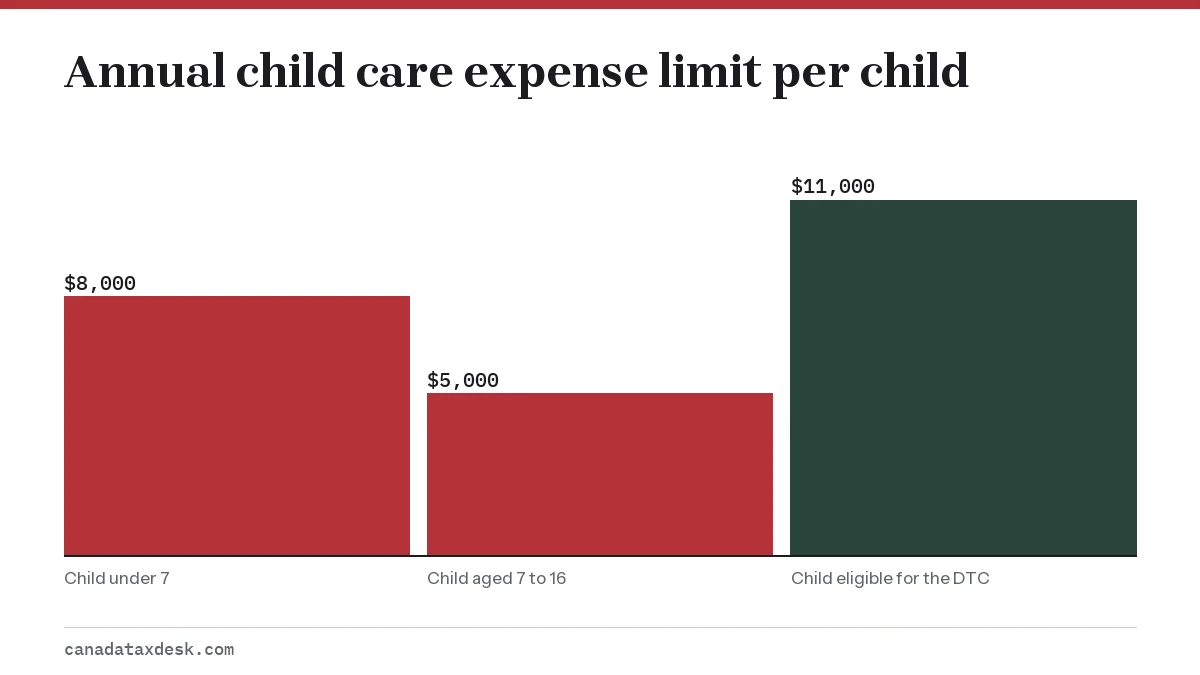
The weekly figures are 1/40 of the annual limit, which is how the folio caps lodging costs at overnight camps, boarding schools and overnight sports schools. Day camps and daycare fall under the annual limits only.
The limits are added together for all eligible children, so you can claim more for one child than that child's own limit as long as the family total stays inside the combined figure. For example, a parent with three children under 7 has a combined limit of $24,000, but with $30,000 of earned income the two-thirds cap of $20,000 applies.
Earned income includes salaries, wages, tips and other employment pay, and income, not losses, from a business you carry on alone or as an active partner.
Who claims child care expenses in a couple?
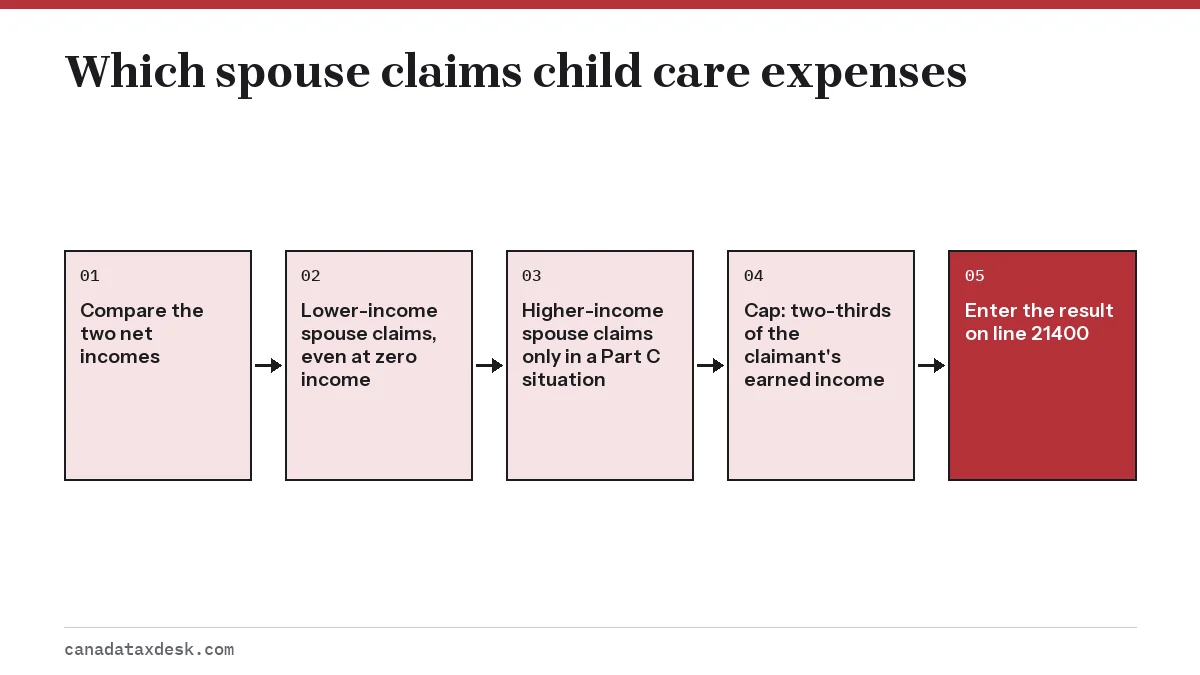
If you lived with a spouse, common-law partner or another supporting person of the child, the person with the lower net income, including zero income, must generally make the claim. If your net incomes are exactly equal, you agree on which of you claims.
The higher-income person can claim instead, for the weeks the situation applied, only when the lower-income person was in one of the situations listed in Part C of Form T778:
- Enrolled in a secondary school, college, university or other designated educational program lasting at least three consecutive weeks: full time means at least 10 hours a week, part time at least 12 hours a month.
- Unable to care for children because of a mental or physical infirmity, with a physician's statement.
- Confined to a bed or wheelchair, or a patient in a hospital or similar institution, for at least two weeks.
- Confined to a prison or similar institution for at least two weeks.
- Living separate and apart at year end and for at least 90 days beginning in the year because of a breakdown in the relationship, then reconciled within the first 60 days of the next year.
Which child care costs count, and which do not?
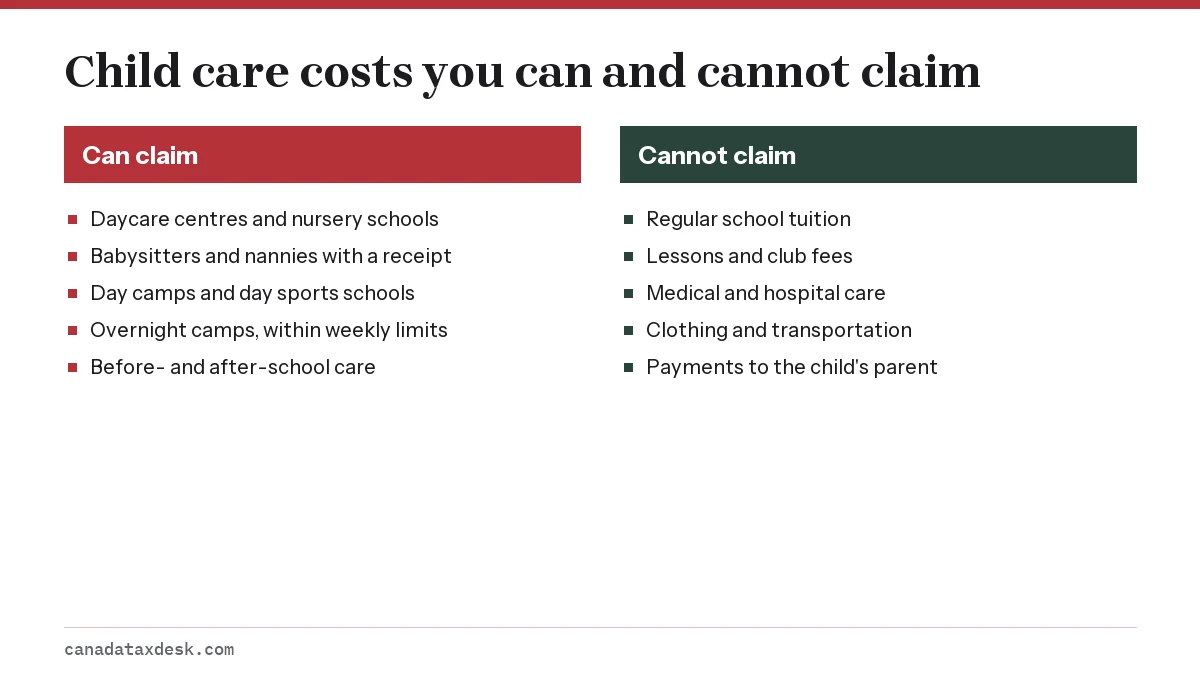
The CRA accepts payments to caregivers providing child care, day nursery schools and daycare centres, the child care part of school fees, day camps and day sports schools whose main goal is to care for children, and boarding schools, overnight sports schools or camps with lodging, within the weekly limits.
Who you pay matters too. Under the folio, an individual caregiver cannot be the child's father or mother, a person under 18 who is related to you, or someone for whom you or another supporting person of the child claims a tax credit. A grandparent who is 18 or older and is not your dependant can therefore be paid for care, with a receipt that shows their social insurance number.
Costs that were reimbursed, or that you received financial help for, cannot be claimed. Medical and hospital care, clothing, transportation, regular tuition and sports study programs, and leisure fees such as lessons or Scouts are also excluded.
How do you claim the deduction on Form T778?
- Collect a receipt from every daycare, camp or caregiver. A receipt from an individual must show that person's social insurance number. It can be in your name or your spouse's or common-law partner's name.
- Fill in Parts A and B of Form T778 with each child and each payment.
- Complete Part C only if you have the higher net income and one of the listed situations applied, and Part D if you were enrolled in an educational program.
- Enter the allowable amount on line 21400. Certified software does the calculation if you enter the receipts.
- Keep the receipts. Online filers send nothing unless the CRA asks; paper filers attach Form T778 but not the receipts.
You can only claim expenses for care provided in the tax year, and unused amounts cannot be carried forward. A missed claim from an earlier year can still be added with Change my return.
Worked example: two working parents with a 4-year-old and a 9-year-old
Priya earns $48,000 of employment income and her partner earns $70,000. In 2026 they paid $9,600 of daycare for their 4-year-old and $4,200 of after-school care and day camp for their 9-year-old, $13,800 in total.
- Priya has the lower net income, so she claims.
- Combined annual limit: $8,000 + $5,000 = $13,000.
- Two-thirds of her earned income: $32,000.
- Deduction: the lowest of $13,800, $13,000 and $32,000, which is $13,000.
Priya's taxable income is in the lowest federal bracket, taxed at 14% for 2026, so the deduction saves her about $1,820 of federal tax ($13,000 x 14%), plus provincial tax. Other family claims are covered in our tax credits and deductions guide, and parents of a child with a disability should also read about the disability tax credit for a child.
Common questions
Can I claim child care expenses if my spouse stays home?
Usually not. The lower-income spouse must claim, and with no earned income the two-thirds cap is zero. The exceptions are the Part C situations, such as the stay-at-home spouse being in school, infirm or hospitalized.
Can I pay a grandparent for babysitting and deduct it?
Yes, if the grandparent is 18 or older, is not someone you or another supporting person claims a tax credit for, and gives you a receipt with their social insurance number.
Are summer day camps a child care expense?
Yes, when the camp's main goal is to care for children. Overnight camps also count, but only up to $200 a week for a child under 7, $125 for an older child and $275 for a child eligible for the DTC.
What age does the child care deduction stop?
The child must be under 16 at some time in the year. After that, care only counts if the child has a mental or physical infirmity and depends on you.
Can I deduct private school tuition as child care?
No. Regular tuition and sports study fees are excluded. Only the part of school fees that pays for child care services, such as supervised before- or after-school care, can be claimed.
Can I carry forward unused child care expenses?
No. Child care expenses can only be claimed for care provided in that tax year, and unclaimed amounts cannot be carried forward.
Sources
- Line 21400, Child care expenses canada.ca
- Line 21400: Who is eligible canada.ca
- Line 21400: Expenses you can claim canada.ca
- Line 21400: Determine who can claim the deduction canada.ca
- Line 21400: How to claim canada.ca
- Income Tax Folio S1-F3-C1, Child Care Expense Deduction canada.ca
- Form T778, Child Care Expenses Deduction canada.ca
We check figures against these official pages. Rules change; confirm anything that affects a deadline or payment with the agency before you act.
Tell us what happened
Describe your situation and our editors will use it to improve this guide. If you leave your email, we may reply with a pointer to the right page or official contact. We never share your details.
Related guides
 Tax Credits and Deductions in Canada: What You Can Claim
Tax deductions in Canada reduce the income you are taxed on, so they save tax at your top marginal rate, while most federal tax c…
Line 23600 (Line 236): Net Income on Your Tax Return and NOA
Line 23600 on your tax return, called line 236 before the 2019 tax year, is your net income: total income on line 15000 minus the…
Disability Tax Credit Eligibility for a Child: Who Claims
Disability tax credit eligibility for a child is decided on Form T2201 by comparing the child with other children of the same age…
Canada Caregiver Credit: Amounts, Eligibility, How to Claim
The Canada caregiver credit is a non-refundable federal credit for supporting a spouse, child or relative who depends on you beca…
Student Tax Return Canada: Credits and Tips for Students
A student tax return in Canada is the regular T1 return, and most students should file one every year even with low income. Schol…