
Home buyers' amount: the $10,000 claim for a first home
Short answer
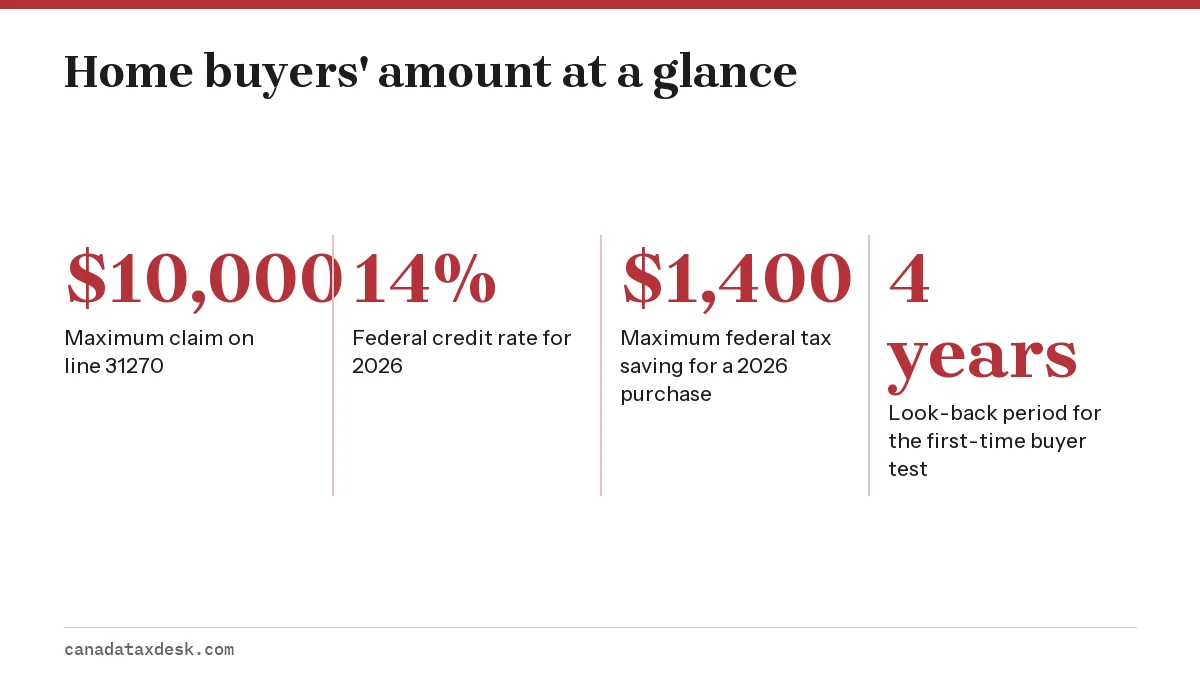
The home buyers' amount is a non-refundable federal credit that lets you claim up to $10,000 on line 31270 in the year you buy a qualifying home in Canada, which cuts federal tax by up to $1,400 for 2026 purchases ($1,450 for 2025). You must be a first-time buyer, or qualify for the disability tax credit or buy for a related person who does.
- 01Maximum claim
- $10,000 per home (since 2022; $5,000 for 2015 to 2021)
- 02Federal value, 2026
- Up to $1,400 at 14%
- 03Federal value, 2025
- Up to $1,450 at 14.5%
- 04First-time buyer test
- No owner-occupied home in the year of purchase or the 4 years before
- 05Return line
- Line 31270; no documents sent with the return
What is the home buyers' amount?
The home buyers' amount is a federal tax credit of up to $10,000 that you enter on line 31270 of your return for the year you acquire a qualifying home (CRA, line 31270). Because it is a non-refundable credit, it is worth the amount multiplied by the lowest federal rate: $1,400 for a 2026 purchase at 14%, and $1,450 for a 2025 purchase at 14.5%. It is sometimes called the first-time home buyers' tax credit.
It is separate from the savings programs for a first home. The Home Buyers' Plan lets you borrow up to $60,000 from your RRSP, and the FHSA gives a deduction for contributions. You can use all three for the same purchase if you meet each program's rules.
Who is a first-time home buyer for this credit?
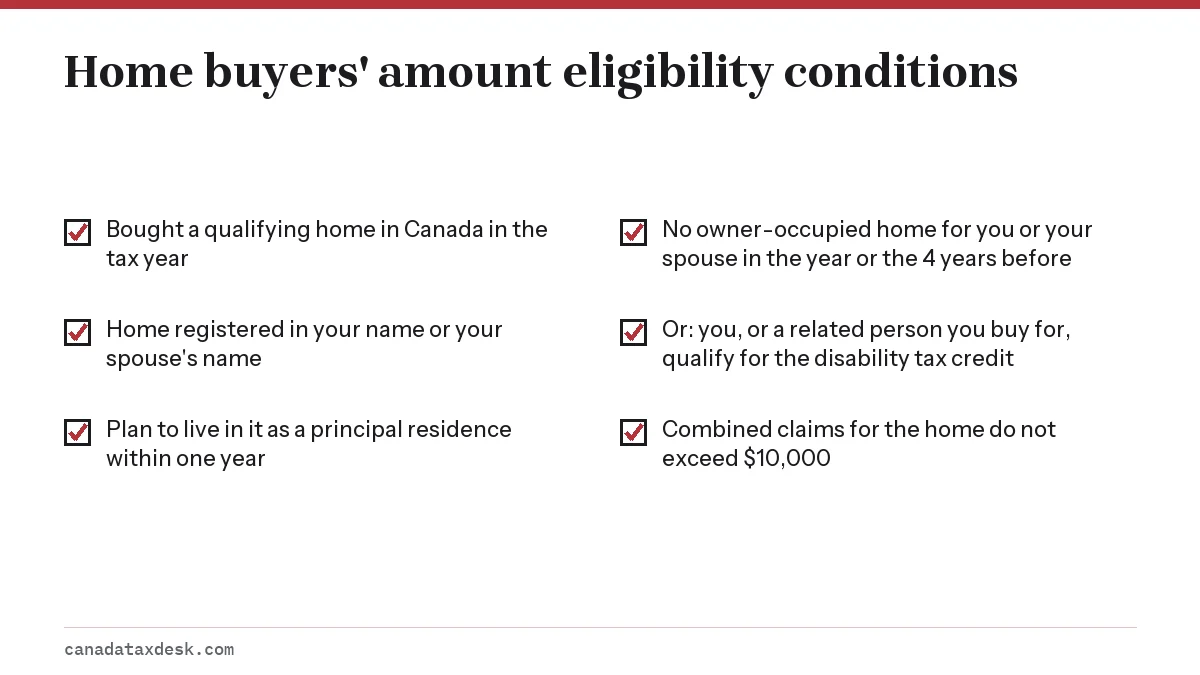
For the home buyers' amount, you are a first-time buyer if you did not live in another home, in Canada or abroad, that you or your spouse or common-law partner owned in the year of purchase or any of the four preceding years. For a 2026 purchase, that means no owner-occupied home in 2022, 2023, 2024, 2025 or 2026 before the purchase.
The test looks at living in a home you owned, not at owning property in general. A rental property you owned but never lived in does not by itself disqualify you, while a condo you owned and lived in during 2023 does. Your partner's history counts as well: if your spouse lived in a home they owned three years ago, you do not qualify, even if you never owned anything.
Home buyers' amount eligibility with a disability
You do not have to be a first-time buyer if you are eligible for the disability tax credit, or if you buy the home for a related person who is eligible. The purchase must let the person with the disability live in a home that is more accessible or better suited to their needs (CRA, line 31270). This home buyers' amount disability rule is often missed by families who move a parent or adult child into an adapted home, and it pairs with the Canada caregiver credit when the same person depends on you.
Which homes qualify for line 31270?
A qualifying home is a housing unit in Canada registered in your name or your spouse's or common-law partner's name under the applicable land registration system. You, or the related person with a disability, must intend to live in it as a principal residence no later than one year after the purchase. Homes outside Canada never qualify.
| Type of home | Qualifies? |
|---|---|
| Single-family, semi-detached house or townhouse | Yes |
| Condominium unit or a unit in a duplex, triplex or other multiplex | Yes |
| Mobile home | Yes |
| Share in a co-operative housing corporation that gives an equity interest | Yes |
| Co-op share that only gives the right to rent the unit | No |
| Existing home or one under construction | Both can qualify |
Keep the statement of adjustments, the deed or transfer from the land registry, and anything showing when you moved in. You do not send these with the return, but the CRA can ask for them in a review.
Can two buyers split the home buyers' amount?
Yes. When two or more eligible people buy a home together, each can claim part of the amount, but the combined claims for the same home cannot exceed $10,000. The split does not have to follow ownership shares; spouses can divide it however they choose. If only one spouse or common-law partner is eligible, that person can claim the full amount: the CRA says the credit cannot be split between spouses or partners unless both are eligible.
The best split is usually the one that uses the whole credit. Suppose Amir and Jo bought a townhouse in 2026. Jo was on parental leave and owes little federal tax, so Amir claims the full $10,000 and saves $1,400. If each of them owes more than $700 in federal tax, a $5,000 and $5,000 split gives the same result. What you should avoid is both claiming $10,000: the CRA will reduce the total when it matches the property.
What is the home buyers' amount worth in 2026?
For a home bought in 2026, the full $10,000 claim reduces federal tax by $1,400, because non-refundable credits are calculated at the lowest federal rate of 14% (CRA, current-year rates). The claim was $5,000 for 2015 to 2021 and has been $10,000 since the 2022 tax year. As of October 22, 2026, no change for 2027 has been announced.
| Purchase year | Lowest federal rate | Maximum federal saving |
|---|---|---|
| 2015 to 2021 | 15% | $750 (claim capped at $5,000) |
| 2022 to 2024 | 15% | $1,500 |
| 2025 | 14.5% | $1,450 |
| 2026 | 14% | $1,400 |
The credit only helps if you owe that much federal tax after your other credits. A buyer with $30,000 of income and the $16,452 basic personal amount may not use all of it, and the unused part cannot be carried forward. Graduates with unused tuition lose nothing by claiming both: the home buyers' amount is applied first, and only the part of the tuition tax credit carryforward still needed to reach zero tax is used, with the rest kept for later years.
How to claim the home buyers' amount tax credit
- Confirm the purchase closed in the tax year you are filing for; the closing date on the statement of adjustments is the usual reference.
- Check the four-year history for you and your spouse or common-law partner, or confirm disability tax credit eligibility.
- Agree with any co-buyer how to divide the $10,000.
- Enter your share in your tax software's home buyers' amount section; it goes on line 31270.
- Keep the land registry document and closing papers for at least six years.
If you bought in an earlier year and never claimed the credit, you can ask the CRA to reassess that year through Change my return in My Account. Other credits families combine with a first home are listed in the tax credits and deductions guide.
Common questions
Is the home buyers' amount a refund?
No. It reduces federal tax you owe by up to $1,400 for 2026, but it cannot create a refund on its own if your tax is already zero.
Is line 31270 the same as the first-time home buyers' tax credit?
Yes. Line 31270 is the home buyers' amount, which many people and tax programs call the first-time home buyers' tax credit. It is one credit, not two: up to $10,000 claimed on line 31270, worth up to $1,400 federally for a 2026 purchase. The Home Buyers' Plan is a different program that lets you withdraw from your RRSP.
Can I claim the home buyers' amount and use the FHSA for the same home?
Yes. The FHSA, the Home Buyers' Plan and the home buyers' amount are separate programs, and one purchase can use all three if you meet each set of rules.
I sold my home five years ago. Am I a first-time buyer again?
Possibly. If neither you nor your spouse lived in a home either of you owned during the year of purchase or the four years before it, you meet the test again.
Can I claim the home buyers' amount for a cottage?
Only if it becomes your principal residence within one year of purchase. A secondary or vacation property does not qualify.
Do I claim the home buyers' amount in the year I sign the offer or the year I close?
Claim it for the year you acquire the home, which is normally the year the purchase closes and title is registered.
Sources
- CRA, Line 31270, home buyers' amount canada.ca
- CRA, Tax rates and income brackets, current year canada.ca
- CRA, What is the Home Buyers' Plan canada.ca
We check figures against these official pages. Rules change; confirm anything that affects a deadline or payment with the agency before you act.
Tell us what happened
Describe your situation and our editors will use it to improve this guide. If you leave your email, we may reply with a pointer to the right page or official contact. We never share your details.
Related guides
 Tax Credits and Deductions in Canada: What You Can Claim
Tax deductions in Canada reduce the income you are taxed on, so they save tax at your top marginal rate, while most federal tax c…
Home Buyers' Plan: $60,000 RRSP Withdrawal and Repayment
The Home Buyers' Plan (HBP) lets a first-time home buyer withdraw up to $60,000 from their own RRSPs to buy or build a qualifying…
FHSA Rules Canada: Eligibility, Limits and Withdrawals
The main FHSA rules: you must be a Canadian resident, at least 18 and no older than 71, and a first-time home buyer to open one.…
Canada Caregiver Credit: Amounts, Eligibility, How to Claim
The Canada caregiver credit is a non-refundable federal credit for supporting a spouse, child or relative who depends on you beca…
Home Buyers' Plan vs FHSA: Which to Use for a First Home
In the Home Buyers' Plan vs FHSA choice, the main difference is repayment: the HBP lets you borrow up to $60,000 from your RRSPs…