
Home Buyers' Plan (HBP): how to take up to $60,000 from your RRSP for a first home
Short answer
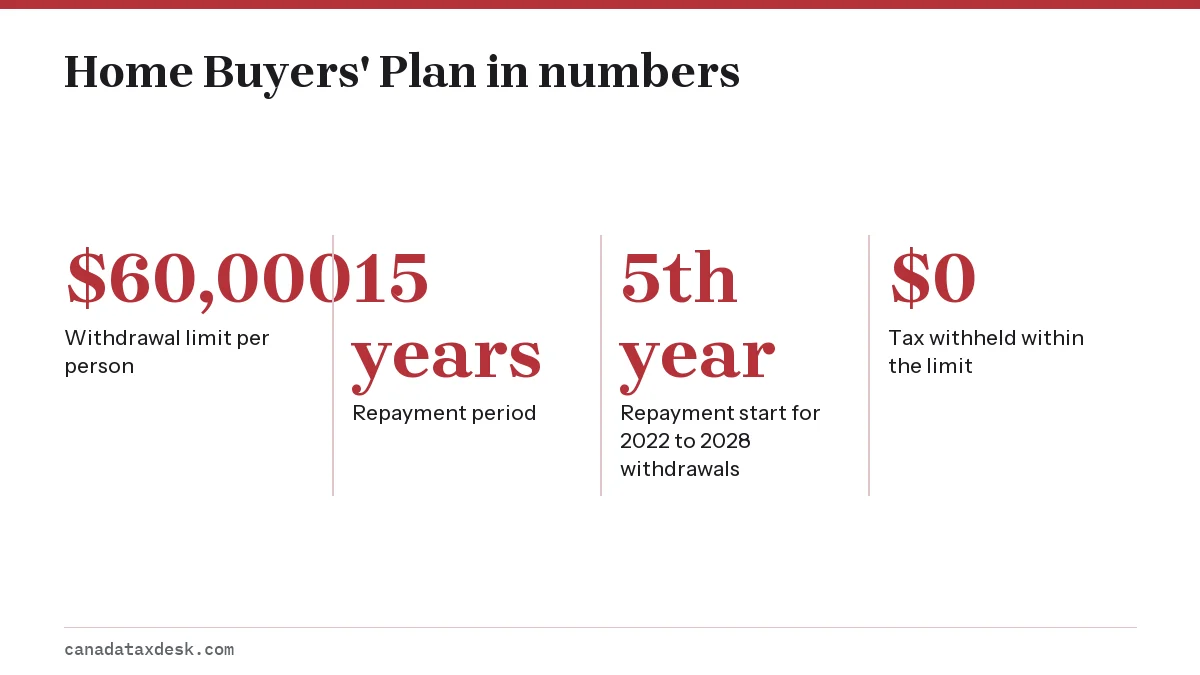
The Home Buyers' Plan (HBP) lets a first-time home buyer withdraw up to $60,000 from their own RRSPs to buy or build a qualifying home in Canada, with no tax withheld, as long as the money is repaid over 15 years (CRA). For a first withdrawal made from 2022 to 2028, repayments start in the fifth year after the withdrawal year.
- 01HBP withdrawal limit
- $60,000 per person
- 02Form to withdraw
- T1036, Home Buyers' Plan (HBP) Request to Withdraw Funds from an RRSP
- 03Repayment period
- 15 years
- 04First repayment year for a 2026 withdrawal
- 2031
- 05Deadline to buy or build
- Before October 1 of the year after the first withdrawal
What is the Home Buyers' Plan?
The Home Buyers' Plan is a federal program that lets you borrow from your own registered retirement savings plans (RRSPs) to buy or build a first home, then pay yourself back. Money withdrawn under the home buyers plan is not added to your income and your RRSP issuer does not withhold tax, which is the main difference from an ordinary RRSP withdrawal.
The catch is that the HBP is a loan, not a gift. Every dollar you take out has to go back into an RRSP over 15 years, and any required amount you skip is added to your taxable income for that year.
Who qualifies for the Home Buyers' Plan in Canada?
You qualify for the home buyers plan in Canada if you are a first-time home buyer, you have a written agreement to buy or build a qualifying home, you intend to live in it as your principal residence, and you are a resident of Canada. All four conditions must be met, and the CRA checks them at the time of each withdrawal. A pre-approved mortgage is not a written agreement. If you have not acquired the home yet, you must also stay a resident of Canada from your first withdrawal until you acquire it.
The first-time home buyer test
The CRA treats you as a first-time buyer if you did not live in a home that you owned or jointly owned as your principal residence at any time in the preceding four calendar years, or in the current year before the withdrawal. The 30 days immediately before the withdrawal are ignored. The same test applies to a home owned by your current spouse or common-law partner that you lived in.
For a withdrawal in 2026, the look-back covers 2022, 2023, 2024, 2025 and 2026 up to 30 days before the money comes out. Someone who sold a condo they lived in during 2021 and has rented since then passes the test.
Exceptions to the first-time buyer rule
- Disability: the first-time buyer condition does not apply when the withdrawal is for a specified disabled person, including buying a more accessible home for a related person who qualifies for the disability tax credit.
- Relationship breakdown: the condition is waived if you separated from your spouse or common-law partner in the withdrawal year or the four years before, subject to the CRA's rules on selling the previous home.
- Returning participants: you can use the HBP more than once, but your HBP balance must be zero on January 1 of the year you withdraw again.
What counts as a qualifying home
A qualifying home is a housing unit located in Canada, existing or under construction. Detached and semi-detached houses, townhouses, condominium units, mobile homes, apartments in duplexes or apartment buildings, and shares in a co-operative housing corporation that give you an equity interest all qualify. A home outside Canada does not.
What is the Home Buyers' Plan limit?
The home buyers plan limit is $60,000 per person per participation period. It applies to your own RRSPs only: you cannot withdraw from a spouse's RRSP under your HBP. Each qualifying buyer of the same home participates separately, so two eligible spouses buying together can each withdraw up to $60,000 from their own plans.
- Any amount above $60,000 is treated as a regular RRSP withdrawal: the issuer withholds tax and you report it as income.
- Locked-in RRSPs and group RRSPs normally do not allow HBP withdrawals, so check with your plan administrator early.
- You can make several withdrawals, but only in the calendar year of your first withdrawal and in January of the following year.
How do I make a Home Buyers' Plan withdrawal?
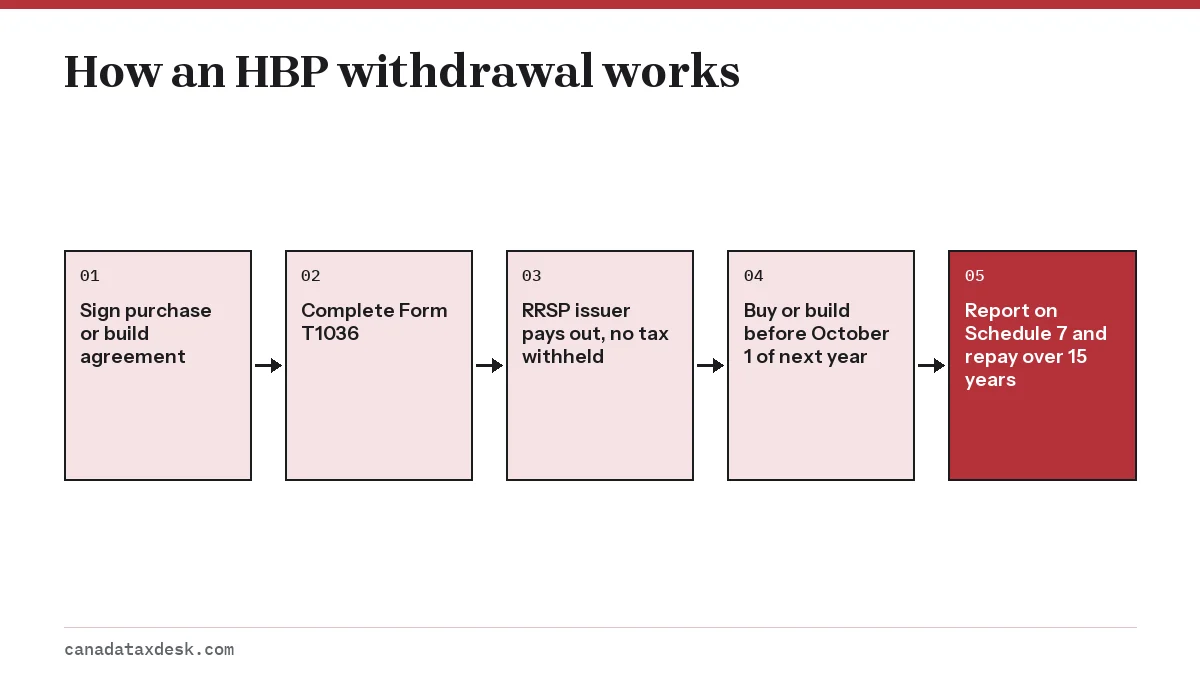
You make a home buyers plan withdrawal by filling out Form T1036 and giving it to the financial institution that holds your RRSP. The steps below follow the order the CRA expects.
- Sign a written agreement to buy or build a qualifying home. The purchase must close, or construction be completed, before October 1 of the year after the year of your first withdrawal.
- Check the 89-day rule. Contributions made to an RRSP in the 89 days before the withdrawal can only be fully deducted if the plan's value after the withdrawal is at least equal to those contributions. Money that has sat in the RRSP longer is not affected.
- Fill out Area 1 of Form T1036 with your details and the address of the home. Use a separate form for each withdrawal.
- Give the form to your RRSP issuer, which completes Area 2 and pays out the money without withholding tax.
- Close on the home and move in, or intend to move in, within one year of buying or building it.
- Report the withdrawal on Schedule 7, RRSP, PRPP and SPP Unused Contributions, Transfers, and HBP or LLP Activities, when you file your return for the withdrawal year.
Do I pay tax on a Home Buyers' Plan withdrawal?
No tax is payable on a Home Buyers' Plan withdrawal of up to $60,000, as long as you meet the conditions and repay on schedule. The issuer does not withhold tax, and you do not include the amount in income. You do, however, show it on Schedule 7 so the CRA can set up your repayment balance.
Tax only enters the picture in three situations: you withdraw more than $60,000, you skip a required repayment, or you cancel the plan and fail to put the money back by the deadline. In each case the amount becomes RRSP income on line 12900 of your return.
| Situation | Tax withheld when paid out? | Added to income? |
|---|---|---|
| Withdrawal up to $60,000 with valid T1036 | No | No |
| Portion above $60,000 | Yes | Yes, in the withdrawal year |
| Required repayment not made | Not applicable | Yes, the shortfall on line 12900 |
| Cancelled HBP not repaid in time | Not applicable | Yes, the unpaid amount on line 12900 for the withdrawal year |
Home Buyers' Plan rules for repayment
You repay the HBP by contributing to your RRSP and designating the contribution as an HBP repayment on Schedule 7. The repayment period is 15 years, and the minimum each year is your balance divided by the years left. On a $60,000 withdrawal that works out to $4,000 a year.
For a first withdrawal made from January 1, 2022 to December 31, 2028, the first repayment year is the fifth year after the withdrawal year, so a 2026 withdrawal has its first repayment due for 2031. Withdrawals before 2022 follow the older rule, where repayment starts in the second year. Our HBP repayment page covers the schedule, missed payments and how to find your balance.
What if the purchase falls through?
If you do not buy or build a qualifying home, or you become a non-resident before you do, you can cancel your HBP participation. You return the money to your RRSP and file Form RC471, Home Buyers' Plan (HBP) Cancellation, or a letter with your receipts and social insurance number.
- The cancellation amount is due by December 31 of the year after your first withdrawal, or one year later if you obtained the one-year extension.
- Anything not returned by that date is included in your income on line 12900 for the year of the withdrawal.
- A cancellation payment is not an RRSP contribution: you do not enter it on Schedule 7 and you cannot deduct it. Send Form RC471 or your letter, with the payment receipts, so the CRA receives it no later than 60 days after the payment due date.
- Once you have met all the conditions and bought the home, you cannot cancel: the regular 15-year repayment applies instead.
Using the Home Buyers' Plan with an FHSA
You can combine the HBP with a First Home Savings Account for the same home. The CRA allows an HBP withdrawal and a qualifying FHSA withdrawal toward one qualifying home, as long as you meet the conditions of each program when you take each withdrawal. For one eligible buyer that can mean up to $60,000 from RRSPs plus the full FHSA balance.
The difference is that FHSA money does not have to be repaid. Our Home Buyers' Plan vs FHSA comparison walks through which to use first, and the FHSA contribution limit page explains how fast you can build that account. Buyers who qualify can also claim the home buyers' amount of up to $10,000 on the return for the purchase year.
Common Home Buyers' Plan mistakes
- Forgetting that a spouse's or partner's owned home counts in the four-year look-back.
- Starting a new HBP while an old balance is still unpaid on January 1 of the withdrawal year.
- Contributing to an RRSP a few weeks before the withdrawal and losing the deduction under the 89-day rule.
- Leaving Schedule 7 off the return, so the withdrawal is not recorded correctly.
- Treating the October 1 deadline as a suggestion when a closing date slips.
- Giving false or incomplete information on Form T1036. If a condition was not met, the CRA can treat the withdrawal as ineligible and include it in your income for the year you received it.
For a broader view of how RRSP, TFSA and FHSA money fit together when saving for a home, see our RRSP, TFSA and FHSA guide.
Step by step
Sign a written agreement
Sign an agreement to buy or build a qualifying home in Canada that you will live in within one year.
Check timing of recent RRSP contributions
Contributions made in the 89 days before the withdrawal may not be deductible unless the RRSP value afterwards covers them.
Complete Form T1036
Fill out Area 1 of Form T1036 for each withdrawal and give it to your RRSP issuer.
Receive the funds
Your issuer completes Area 2 and pays out up to $60,000 without withholding tax.
Buy or build the home
Acquire the home before October 1 of the year after your first withdrawal.
Report on Schedule 7
Record the withdrawal on Schedule 7 with your return and start repaying in your first repayment year.
Common questions
Can I use the Home Buyers' Plan if I owned a home 10 years ago?
Yes, as long as you did not live in a home you or your current spouse owned during the four calendar years before the withdrawal year or in the withdrawal year itself, apart from the 30 days just before the withdrawal.
Can I use the Home Buyers' Plan for a second home?
Only if you count as a first-time home buyer again. You can take part in the HBP more than once, but your HBP balance must be zero on January 1 of the withdrawal year, and you must not have lived in a home that you or your current spouse or common-law partner owned in the four previous calendar years or in the current year before the withdrawal, apart from the 30 days just before it. If you still own and live in your first home, buying a second one does not qualify unless the disability or relationship breakdown exception applies.
Can my spouse and I both use the HBP for the same house?
Yes. Each eligible buyer participates separately and can withdraw up to $60,000 from their own RRSPs. You cannot withdraw from your spouse's RRSP under your own HBP.
Is the Home Buyers' Plan only for buying, or also for building?
Both. The home can be an existing unit or one under construction, provided construction is completed before October 1 of the year after your first withdrawal, or the second year with the extension.
Can I use the HBP for a cottage or rental property?
Only if you intend to occupy it as your principal residence within one year of buying or building it. A property bought purely as a rental or a second home does not qualify.
Where do I get Form T1036?
Form T1036 is on the CRA forms page and most RRSP issuers also provide it. You complete Area 1 and your issuer completes Area 2.
Do HBP repayments give me an RRSP tax deduction?
No. Contributions you designate as HBP repayments on Schedule 7 are not deductible, because you already deducted that money when it first went into your RRSP. Only contributions above your required repayment can be claimed as a regular RRSP deduction.
Sources
- What is the Home Buyers' Plan canada.ca
- Participate in the Home Buyers' Plan canada.ca
- Make withdrawals from RRSPs under the HBP canada.ca
- Cancel your participation in the HBP canada.ca
- HBP definitions canada.ca
- Withdrawals and transfers out of your FHSAs canada.ca
We check figures against these official pages. Rules change; confirm anything that affects a deadline or payment with the agency before you act.
Tell us what happened
Describe your situation and our editors will use it to improve this guide. If you leave your email, we may reply with a pointer to the right page or official contact. We never share your details.
Related guides
 RRSP, TFSA and FHSA Rules: Limits, Deadlines, Penalties
For 2026, the RRSP dollar limit is $33,810, the TFSA annual limit is $7,000 and the FHSA annual limit is $8,000 (CRA). RRSP and F…
Home Buyers' Plan Repayment: New 5-Year Deferral Explained
Home Buyers' Plan repayment for a first withdrawal made from January 1, 2022 to December 31, 2028 starts in the fifth year after…
Home Buyers' Plan vs FHSA: Which to Use for a First Home
In the Home Buyers' Plan vs FHSA choice, the main difference is repayment: the HBP lets you borrow up to $60,000 from your RRSPs…
RRSP Withdrawal Tax: Withholding Rates and What You Owe
RRSP withdrawal tax works in two stages: your financial institution withholds 10% on withdrawals up to $5,000, 20% on $5,000.01 t…
Home Buyers' Amount: Claim Up to $10,000 on Line 31270
The home buyers' amount is a non-refundable federal credit that lets you claim up to $10,000 on line 31270 in the year you buy a…
FHSA Contribution Limit: $8,000 a Year and Carry-Forward
The FHSA contribution limit is $8,000 of participation room per year and $40,000 over your lifetime, according to the CRA. Up to…