
RRSP withdrawal tax: what is withheld and what you really owe
Short answer
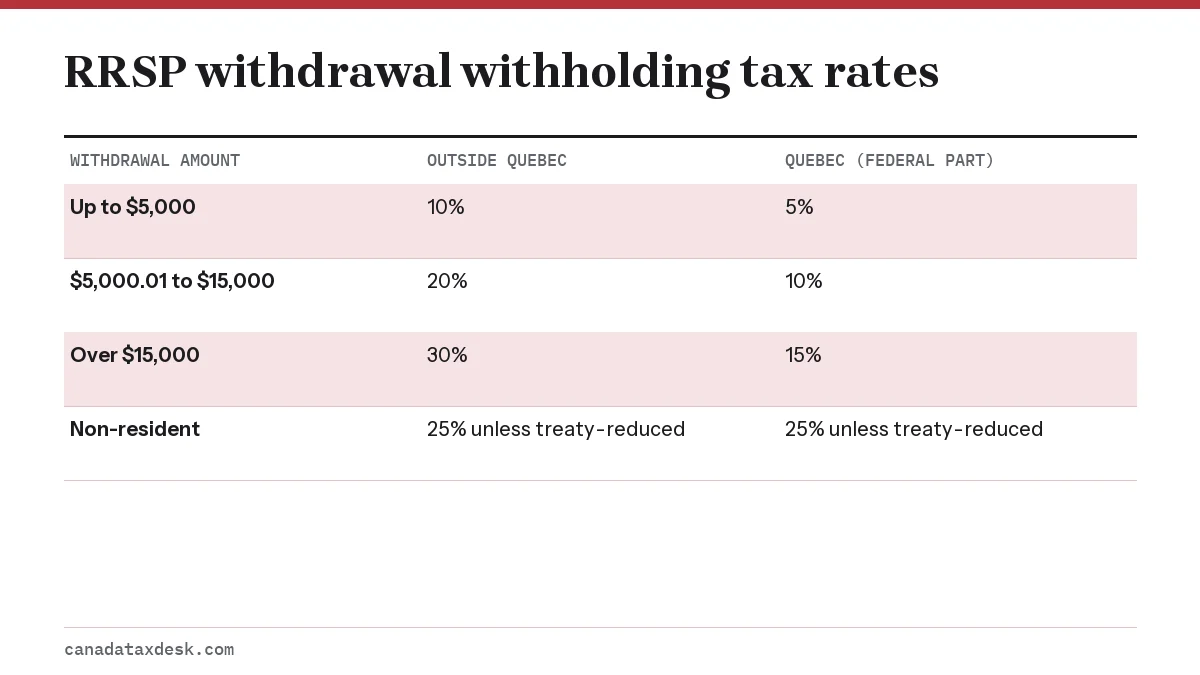
RRSP withdrawal tax works in two stages: your financial institution withholds 10% on withdrawals up to $5,000, 20% on $5,000.01 to $15,000 and 30% above $15,000 (5%, 10% and 15% federally in Quebec), then the whole withdrawal is added to your income on line 12900 and taxed at your marginal rate when you file (CRA).
- 01Withholding outside Quebec
- 10% up to $5,000; 20% over $5,000 to $15,000; 30% over $15,000
- 02Federal withholding in Quebec
- 5%, 10% or 15%, plus Quebec provincial withholding
- 03Where the withdrawal is reported
- Line 12900, from the T4RSP slip
- 04Where the withheld tax is claimed
- Line 43700, from T4RSP box 30
- 05Non-resident withholding
- 25% unless a tax treaty reduces it
How much tax is withheld on an RRSP withdrawal?
The tax withheld on an RRSP withdrawal depends on the size of the withdrawal and where you live. For a Canadian resident outside Quebec, the CRA's RRSP withdrawal tax rates are 10% on amounts up to $5,000, 20% on amounts over $5,000 up to $15,000, and 30% on amounts over $15,000. The issuer sends that money straight to the CRA on your behalf.
Quebec residents have lower federal withholding (5%, 10% and 15% in the same bands) because Revenu Quebec also requires provincial tax to be withheld by the financial institution. People who are not resident in Canada face 25% withholding unless a tax treaty sets a lower rate.
An RRSP withdrawal is any amount you cash out of a registered retirement savings plan that is not a direct transfer to another registered plan. Moving money from one RRSP to another RRSP, or into a registered retirement income fund, is a transfer and is not taxed at the time it happens.
Is the withholding tax the final RRSP withdrawal tax?
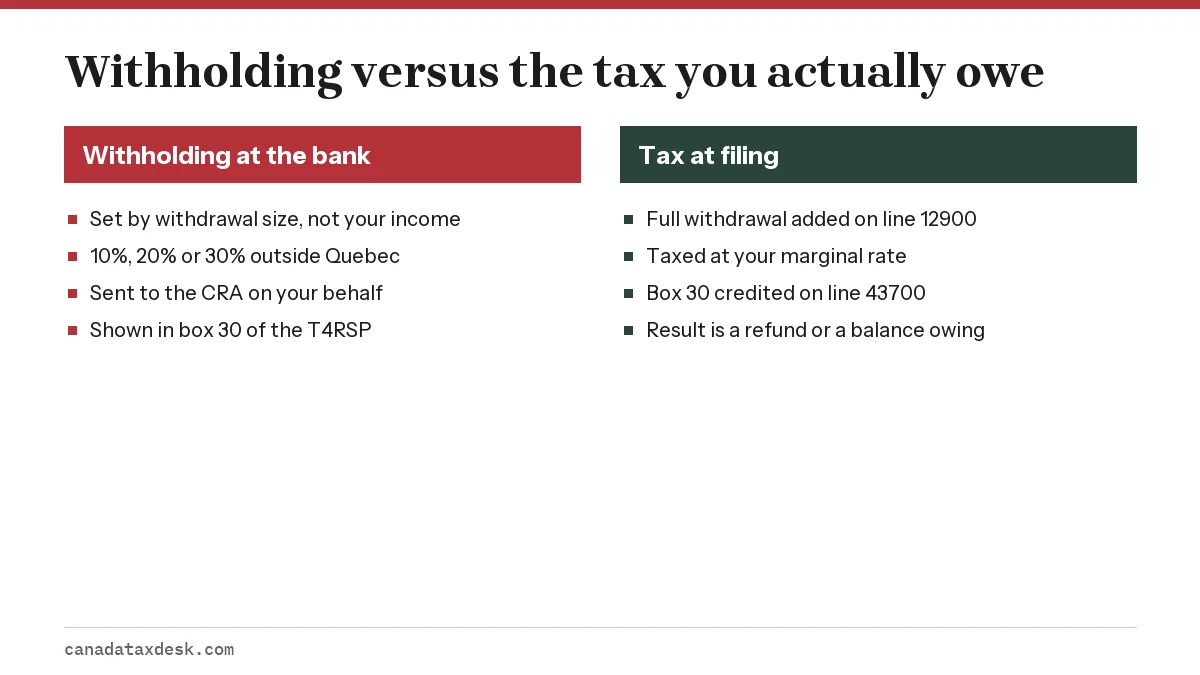
No. RRSP withdrawal withholding tax is a prepayment, not the final bill. When you file, you report the full withdrawal from your T4RSP slip, Statement of RRSP Income, on line 12900 of your return, and you claim the tax shown in box 30 of that slip on line 43700 as tax already deducted (CRA, Withdrawing from your own RRSPs).
The CRA then taxes the withdrawal at your marginal rate, the combined federal and provincial rate that applies to the last dollars of your income. If that rate is higher than the withholding rate, you owe the difference. If it is lower, the extra withholding comes back as part of your refund. The CRA itself warns that the amount withheld may not cover the tax you end up owing.
Worked example: what an RRSP withdrawal really costs
Take an Alberta resident with $70,000 of 2026 employment income who withdraws $20,000 from an RRSP. The bank withholds 30%, or $6,000. At filing, their taxable income becomes $90,000. That extra $20,000 falls entirely in the 20.5% federal bracket ($58,523.01 to $117,045) and the 10% Alberta bracket ($61,200.01 to $154,259), for a combined 30.5%. These are the CRA's 2026 brackets; the 2027 brackets, which will apply to withdrawals made next year, had not been published as of October 22, 2026 and are expected in November 2026.
| Situation | Withheld at source | Tax at filing on the withdrawal | Balance at filing |
|---|---|---|---|
| $70,000 salary, one $20,000 withdrawal | $6,000 (30%) | $6,100 (30.5%) | $100 owing |
| $70,000 salary, one $4,000 withdrawal | $400 (10%) | $1,220 (30.5%) | $820 owing |
| $120,000 salary, one $20,000 withdrawal | $6,000 (30%) | $7,200 (26% federal + 10% Alberta) | $1,200 owing |
The second row shows why splitting a withdrawal into several small pieces does not save tax. Each $4,000 piece is only withheld at 10%, but every dollar is still taxed at 30.5% when you file, so the shortfall simply arrives in April instead of at the bank.
Why you may owe more at filing
Besides a marginal rate above the withholding rate, an RRSP withdrawal raises your net income on line 23600. Net income drives income-tested payments such as the Canada Child Benefit and the GST/HST credit, and the recovery of Old Age Security, so a large withdrawal can cut those amounts in the following benefit year.
- A withdrawal pushed into a higher bracket is taxed above the 30% maximum withholding: 26% federal plus provincial tax already exceeds it in most provinces.
- Small withdrawals of $5,000 or less are withheld at 10%, which is below the lowest combined federal and provincial rate in every province.
- If you expect to owe more than a few hundred dollars, you can ask your issuer to withhold more, or set the difference aside for April 30.
Do I lose RRSP contribution room when I withdraw?
Yes. A regular RRSP withdrawal does not give back the contribution room you used to make the original deposit. Your RRSP deduction limit is built from 18% of earned income up to the annual dollar limit ($33,810 for 2026), plus unused room, minus pension adjustments, and there is no add-back for money taken out. See our RRSP contribution limit page for the full formula.
This is the key difference from a TFSA, where withdrawals are added back to your room on January 1 of the following year, as our TFSA contribution limit page explains. If you want money back into an RRSP after a withdrawal, it has to come out of new room.
RRSP withdrawal rules: which withdrawals are tax-free?
Two government programs let you take money out of your own RRSP without withholding and without adding it to income, as long as you repay it on schedule. A third situation lets you recover an over-contribution without withholding.
| Withdrawal | Limit | Form | Condition |
|---|---|---|---|
| Home Buyers' Plan (HBP) | $60,000 | T1036 | Repay over 15 years |
| Lifelong Learning Plan (LLP) | $10,000 a year, $20,000 total | RC96 | Repay over a period that is generally 10 years |
| Unused contributions | The undeducted amount | T3012A approved by the CRA | Contributions you never deducted |
Anything withdrawn under the Home Buyers' Plan above $60,000 is an ordinary taxable withdrawal. Any HBP or LLP repayment you skip is added to income on line 12900 for that year. The T3012A route is how people usually fix an RRSP over-contribution without paying withholding tax on the refund of the excess.
Spousal RRSP withdrawals and the three-year rule
If you contributed to a spousal or common-law partner RRSP, a withdrawal by your partner can be taxed in your hands instead. The CRA attributes the income to the contributor if they paid into any spousal RRSP in the year of withdrawal or either of the two years before it. The annuitant calculates the split on Form T2205, Amounts from a Spousal or Common-law Partner RRSP, RRIF or SPP to Include in Income.
The withholding tax on the T4RSP is always claimed by the person named on the slip, normally the annuitant, even when some of the income is reported by the contributing spouse.
Steps before you cash out an RRSP
- Check whether the account is locked-in. Locked-in RRSPs generally cannot be withdrawn, so ask the issuer first.
- Decide whether the HBP or LLP applies. If it does, file Form T1036 or RC96 with the issuer before the money is paid out.
- Estimate the tax at your marginal rate and compare it with the withholding rate for the amount you plan to take.
- Consider timing. A withdrawal in a low-income year, such as a year of parental leave or study, is taxed at a lower marginal rate.
- Keep the T4RSP slip, which the issuer sends early the next year, and report it on line 12900 with box 30 on line 43700.
For how RRSP withdrawals compare with taking money from a TFSA or FHSA, see our RRSP, TFSA and FHSA guide.
Common questions
How much tax do I pay on a $10,000 RRSP withdrawal?
Outside Quebec, the issuer withholds 20%, or $2,000. The final tax depends on your marginal rate: at a combined 30%, the $10,000 costs $3,000, so you would owe about $1,000 more when you file.
Can I avoid withholding tax by taking out $5,000 at a time?
You can lower the amount withheld at source, because each withdrawal of $5,000 or less is withheld at 10%. You do not lower the tax itself: all withdrawals in a year are added together on line 12900 and taxed at your marginal rate.
Do I get the RRSP withholding tax back?
You get back any part of it that exceeds your actual tax. The box 30 amount on your T4RSP is credited on line 43700, and if your total tax is lower than everything withheld, the difference is refunded.
When do I get a T4RSP slip for my withdrawal?
Your RRSP issuer sends the T4RSP after the end of the year of the withdrawal, in time for you to file. It is also usually available in CRA My Account once the issuer files it.
Is an RRSP withdrawal taxed at a lower rate after retirement?
It is taxed at whatever your marginal rate is in the year you withdraw. If your income is lower in retirement, that rate is usually lower, which is the main reason people defer RRSP withdrawals.
How can I withdraw from my RRSP without paying tax?
Only a few routes avoid tax when the money comes out: a Home Buyers' Plan or Lifelong Learning Plan withdrawal, which you must repay; a refund of contributions you never deducted, using Form T3012A; or a direct transfer to another RRSP, a RRIF or, within your FHSA room, an FHSA. An ordinary withdrawal is always added to your income, so what you can control is the rate, by withdrawing in a year when your income is low.
Is there an age limit or a penalty on RRSP withdrawals?
There is no separate penalty and no minimum age: unless the plan is locked-in, you can withdraw at any age and simply pay income tax on the amount. In the year you turn 71, you must withdraw your RRSPs, transfer them to a RRIF or use them to buy an annuity, and amounts transferred directly to a RRIF or used for an annuity are not subject to withholding.
Does a withdrawal from a Quebec RRSP have two withholding amounts?
Yes. A Quebec resident sees federal withholding of 5%, 10% or 15% plus separate Quebec provincial withholding taken by the financial institution.
Sources
- Tax rates on withdrawals canada.ca
- Withdrawing from your own RRSPs canada.ca
- Withdrawing from spousal or common-law partner RRSPs canada.ca
- Lifelong Learning Plan withdrawals canada.ca
- Tax rates and income brackets for individuals, current year canada.ca
We check figures against these official pages. Rules change; confirm anything that affects a deadline or payment with the agency before you act.
Tell us what happened
Describe your situation and our editors will use it to improve this guide. If you leave your email, we may reply with a pointer to the right page or official contact. We never share your details.
Related guides
 RRSP, TFSA and FHSA Rules: Limits, Deadlines, Penalties
For 2026, the RRSP dollar limit is $33,810, the TFSA annual limit is $7,000 and the FHSA annual limit is $8,000 (CRA). RRSP and F…
Home Buyers' Plan: $60,000 RRSP Withdrawal and Repayment
The Home Buyers' Plan (HBP) lets a first-time home buyer withdraw up to $60,000 from their own RRSPs to buy or build a qualifying…
Income Tax Calculator Canada: Estimate Your 2026 Tax
This income tax calculator for Canada estimates 2026 federal and provincial tax from your taxable income, using the CRA's 2026 br…
TFSA Contribution Limit 2026 & 2027: $7,000, $109,000 Total
The TFSA contribution limit is $7,000 for 2026, the same as in 2024 and 2025. The 2027 limit has not been announced as of October…
RRSP Contribution Limit 2026: How Your Room Is Calculated
The RRSP contribution limit for 2026 is 18% of your 2025 earned income, to a maximum of $33,810, plus any unused room from earlie…
RRSP Over-Contribution Penalty: The $2,000 Buffer and T1-OVP
An RRSP over contribution is only penalized when your unused contributions exceed your RRSP deduction limit by more than $2,000.…