
RRSP over-contribution: the 1% penalty, the $2,000 buffer and how to fix it
Short answer
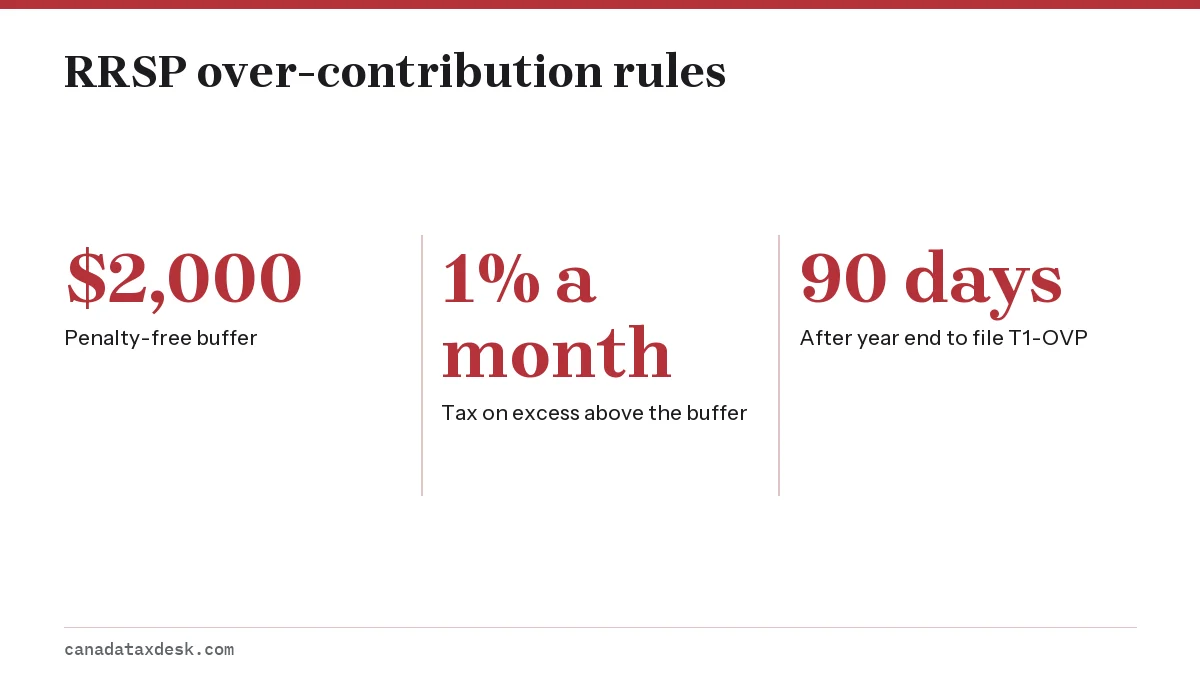
An RRSP over contribution is only penalized when your unused contributions exceed your RRSP deduction limit by more than $2,000. The excess above that buffer is taxed at 1% per month, reported on Form T1-OVP, which must be filed and paid within 90 days after the end of the year (CRA). Withdrawing the excess with Form T3012A stops the tax.
- 01Penalty-free buffer
- $2,000 (if you were 18 or older in the prior year)
- 02Tax on excess above the buffer
- 1% per month
- 03Form to report the tax
- T1-OVP
- 04T1-OVP deadline for 2026 excess
- March 31, 2027 (90 days after year end)
- 05Waiver request form
- RC2503
How the RRSP over-contribution penalty works
The RRSP over contribution penalty is a tax of 1% per month on the part of your unused contributions that is more than $2,000 above your RRSP deduction limit. It is charged for every month-end the excess exists. It is not a one-time fine, so a mistake left alone for a year costs 12%.
Unused contributions are amounts you put into your RRSP but have not deducted. Your deduction limit is the room printed on your notice of assessment. The CRA compares the two each month, and only the gap above $2,000 is taxed.
Worked example
- Leila's 2026 RRSP deduction limit is $16,400. In April 2026 she contributes $22,000 after misreading her notice of assessment.
- Her unused contributions exceed her limit by $5,600. The first $2,000 is covered by the buffer, leaving $3,600 subject to tax.
- The tax is 1% of $3,600, or $36 for each month from April to December: 9 months, $324 in total for 2026.
- If she withdraws $3,600 in June instead, only April and May are taxed, for $72.
There is one narrow exception: if you withdraw the excess before the end of the same month you contributed it, no tax applies for that month. Taking the excess out as a Home Buyers' Plan or Lifelong Learning Plan withdrawal does not stop the tax: the CRA warns that excess amounts withdrawn under those plans may still be taxed.
What is the $2,000 RRSP buffer?
The $2,000 buffer is a cushion that lets you go over your RRSP deduction limit by up to $2,000 without paying the 1% tax. It is available only if you were 18 or older at any time in the previous year. It is a lifetime cushion, not an extra $2,000 each year.
Money inside the buffer still cannot be deducted until you earn new room. Using the cushion on purpose can make sense for someone with steady earned income, because the extra $2,000 grows tax-sheltered and becomes deductible in a later year. Our RRSP contribution limit page shows how new room is calculated.
RRSP over-contribution: what to do first
Stop the monthly tax, then report what already built up. The order matters, because every month-end you wait adds another 1% charge.
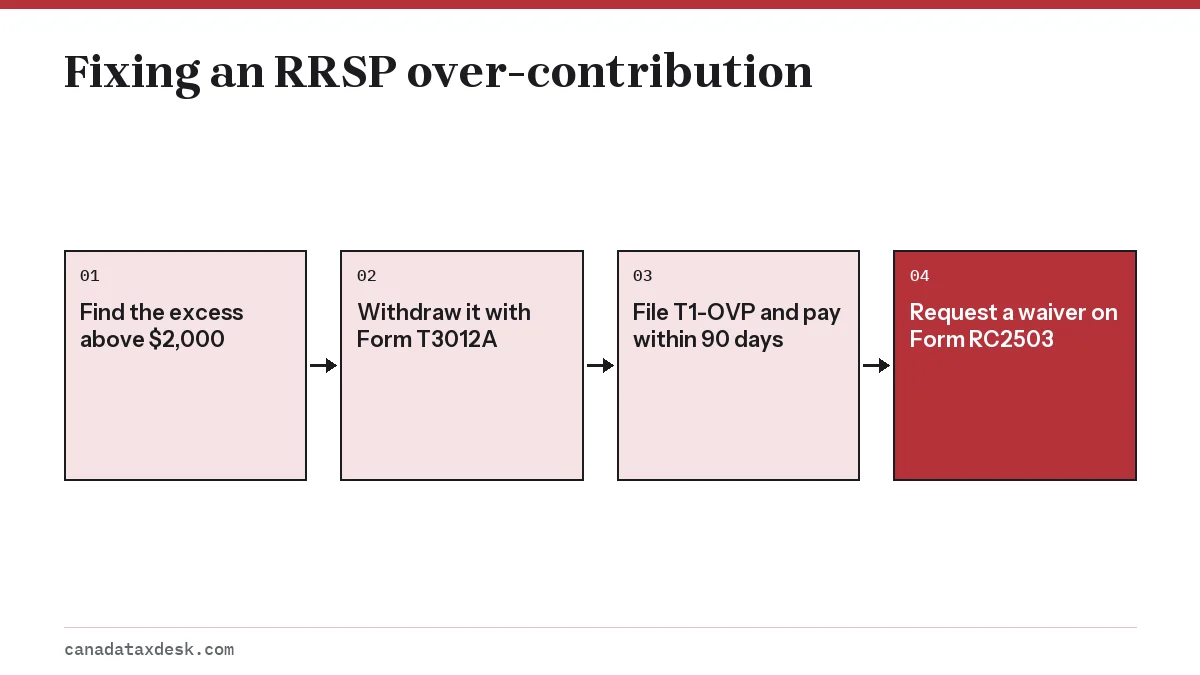
- Confirm your room. Check the RRSP deduction limit on your latest notice of assessment, reassessment or Form T1028, or in CRA My Account. Subtract contributions made since then that are not yet reported.
- Work out the excess. Unused contributions minus your deduction limit, minus $2,000.
- Withdraw the excess using Form T3012A so no tax is withheld (see below).
- File Form T1-OVP and pay any tax owing within 90 days after the end of the year.
- If it was an honest error, ask the CRA to waive the tax with Form RC2503.
RRSP over-contribution withdrawal with Form T3012A
The cleanest RRSP over contribution withdrawal uses Form T3012A, Tax Deduction Waiver on the Refund of Your Unused RRSP, PRPP, or SPP Contributions. You send the form to the CRA, it approves the amount, and you give the approved form to your RRSP issuer. The issuer then pays out the excess without withholding tax.
The withdrawal still appears on a T4RSP slip and is included in income, but you claim an offsetting deduction on line 23200 of your return, so the net tax effect is zero. Attach or keep copies of the approved T3012A and the slip.
How to send Form T3012A, step by step
- Fill in Parts 1 and 2. Part 1 works out how much of the year's contributions you have not deducted; attach proof of your contributions. Use a separate form for each plan you want to withdraw from.
- Send four copies to your tax centre, the one shown on your notice of assessment (the form lists the Pension Workflow Team addresses in Jonquière, Sudbury and Winnipeg). Do not send it with your income tax return.
- Wait for the CRA's approval. The CRA fills in Part 3 with the amount your issuer can pay without withholding tax and returns three copies to you.
- Fill in Part 4 and send all three copies to your RRSP issuer, who pays the refund, completes Part 5 and returns two copies to you.
- Report it when you file. Include the T4RSP amount on line 12900 and claim the same amount on line 23200.
If you already withdrew without the form
If you took the money out before getting T3012A approved, your issuer will have withheld tax. You can still claim the deduction by completing Form T746, Calculating Your Deduction for Refund of Unused RRSP, PRPP, and SPP Contributions. The withheld tax is credited when you file, so you get it back as part of your refund or balance.
Timing and conditions
- The unused contributions must never have been deducted for any year.
- The refund must be received in the year you contributed, the year after, or the year you got a notice of assessment for the contribution year or the year after that.
- The CRA must accept that you either expected to deduct the contributions fully or did not contribute intending to withdraw and deduct them.
Do I need to file a T1-OVP form?
You need to file the RRSP over contribution form, T1-OVP, Individual Tax Return for RRSP, PRPP and SPP Excess Contributions, for any year in which you owe the 1% tax. It is a separate return from your T1, due within 90 days after the end of the year the excess existed. For a 2026 excess, that is March 31, 2027.
There is also a shorter version, Form T1-OVP-S, the simplified return, which the CRA offers to people who made their contributions after February 27, 1995 and did not make mandatory contributions to a group RRSP. File the version for the year the excess existed: in October 2026 the newest one on canada.ca is the 2025 form, and a 2026 excess goes on the 2026 version, due March 31, 2027.
Missing the T1-OVP deadline adds a late-filing penalty of 5% of the balance owing plus 1% per full month late, up to 12 months, and daily compound interest starting on the 91st day of the following year. Those are the same penalty rates as on a late income tax return, described on our late-filing penalty page.
| Year of the excess | File T1-OVP and pay by |
|---|---|
| 2025 | March 31, 2026 |
| 2026 | March 31, 2027 |
| 2027 | March 30, 2028 (2028 is a leap year) |
Asking the CRA to waive the RRSP over-contribution penalty
The CRA can waive or cancel the 1% tax if you show that the excess arose from a reasonable error and that you are taking reasonable steps to remove it. The request goes on Form RC2503, Request for Waiver or Cancellation of Part X.1 Tax, sent with supporting documents to the tax centre shown on your notice of assessment.
- Explain how the error happened, for example a pension adjustment you did not know about or a transfer counted twice.
- Include proof of when you contributed and when you withdrew the excess. The documents must show the exact months; the CRA does not accept official RRSP receipts or T4RSP slips as proof for this request.
- Show that you acted quickly once you found out, ideally by withdrawing with T3012A right away.
Late-filing penalties and interest on a T1-OVP are a different matter. Relief for those is requested through the taxpayer relief program on Form RC4288.
Can I just leave the excess in my RRSP?
You can, but the 1% monthly tax keeps running until new deduction room absorbs the excess. New room arrives on January 1, based on the previous year's earned income. If Leila earns enough in 2026 to create about $15,000 of room for 2027, her $3,600 excess disappears on January 1, 2027, but she still owes the 2026 tax.
Leaving it only works when the excess is small and new room is certain. People near retirement, on leave or with a large pension adjustment should withdraw instead. If you are sorting out several accounts at once, the TFSA over-contribution penalty works on similar 1% logic but without a $2,000 buffer, and our RRSP, TFSA and FHSA guide compares all three.
Step by step
Confirm your deduction limit
Check your notice of assessment or CRA My Account and subtract unreported contributions.
Calculate the excess
Subtract your deduction limit and the $2,000 buffer from your unused contributions.
Withdraw with Form T3012A
Get T3012A approved by the CRA and give it to your issuer to withdraw the excess without withholding.
File Form T1-OVP
Report and pay the 1% monthly tax within 90 days after the end of the year.
Request a waiver if it was an error
Send Form RC2503 with supporting documents to your tax centre.
Common questions
How much is the penalty for over-contributing to an RRSP?
It is 1% per month on the amount more than $2,000 above your RRSP deduction limit. A $5,000 excess over the buffer costs $50 a month until it is removed or absorbed by new room.
Does the CRA notify you of an RRSP over-contribution?
The CRA may send a letter once it matches your contribution receipts to your deduction limit, but that can take months. You are responsible for filing the T1-OVP yourself within 90 days after year end.
Can I deduct an over-contribution in a later year?
Yes. Undeducted contributions carry forward on Schedule 7 and can be deducted in any later year when you have enough new RRSP deduction room.
Does a spousal RRSP contribution count toward my over-contribution?
Yes. Contributions to a spousal or common-law partner RRSP use the contributor's deduction limit, so they count toward the contributor's excess, not the spouse's.
Is the $2,000 buffer per year?
No. It is a single cushion of $2,000 of cumulative excess, not a new $2,000 each year.
Where do I send Form T3012A?
Send four copies to the tax centre shown on your notice of assessment, not to your bank and not with your tax return. The CRA approves the amount, returns three copies, and you then send those to your RRSP issuer to release the excess without withholding tax.
Sources
- What happens if you go over your RRSP deduction limit canada.ca
- Withdrawing unused contributions canada.ca
- RRSPs and related plans canada.ca
- Form RC4288, Request for Taxpayer Relief canada.ca
We check figures against these official pages. Rules change; confirm anything that affects a deadline or payment with the agency before you act.
Tell us what happened
Describe your situation and our editors will use it to improve this guide. If you leave your email, we may reply with a pointer to the right page or official contact. We never share your details.
Related guides
 RRSP, TFSA and FHSA Rules: Limits, Deadlines, Penalties
For 2026, the RRSP dollar limit is $33,810, the TFSA annual limit is $7,000 and the FHSA annual limit is $8,000 (CRA). RRSP and F…
RRSP Withdrawal Tax: Withholding Rates and What You Owe
RRSP withdrawal tax works in two stages: your financial institution withholds 10% on withdrawals up to $5,000, 20% on $5,000.01 t…
RC4288 Taxpayer Relief Request: Cancel CRA Penalties
An RC4288 taxpayer relief request asks the CRA to cancel or waive penalties and interest, not the tax itself. The CRA considers e…
TFSA Over-Contribution Penalty: How to Fix It and Get Relief
The TFSA over-contribution penalty is a tax of 1% per month on the highest excess amount in your TFSA in each month, for as long…