
TFSA over-contribution penalty: stop the 1% tax and ask for a waiver
Short answer
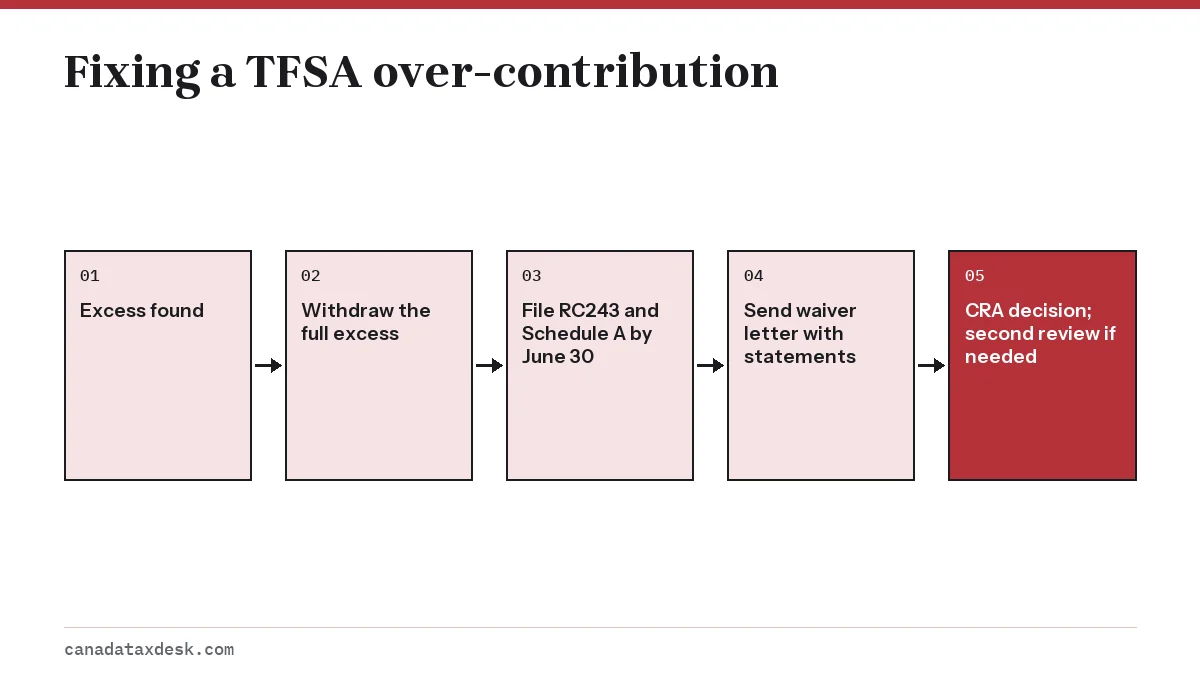
The TFSA over-contribution penalty is a tax of 1% per month on the highest excess amount in your TFSA in each month, for as long as the excess stays in (CRA). Withdraw the excess right away, then file Form RC243 with Schedule A by June 30 of the next year. You can ask the CRA in writing to waive the tax if the excess came from a reasonable error.
- 01Penalty rate
- 1% per month on the highest excess in the month
- 02Return to file
- Form RC243 and RC243-SCH-A
- 03Deadline for 2026 excess
- June 30, 2027
- 04Waiver request
- Letter via My Account (Submit documents) or mail
- 05Objection deadline
- 90 days from the notice of assessment
How does the TFSA over-contribution penalty work?
The TFSA over-contribution penalty is a 1% tax on the highest excess TFSA amount in your account in each month. An excess TFSA amount is any contribution above your available room at that moment. There is no grace amount: even $100 over is taxed, and the tax repeats every month until the excess is gone or new room absorbs it. A deliberate over-contribution is treated more harshly: income reasonably attributable to it counts as a TFSA advantage, which is taxed at 100%.
Timing matters more than size. At 1% a month, a $2,000 excess costs $20 if it is removed in the month it happened, and $80 if it stays for four months. A month counts in full even if the excess was only there for one day.
| Excess amount | 1 month | 4 months | 8 months |
|---|---|---|---|
| $1,000 | $10 | $40 | $80 |
| $2,000 | $20 | $80 | $160 |
| $5,000 | $50 | $200 | $400 |
| $10,000 | $100 | $400 | $800 |
To estimate your own tax, multiply the largest excess in each month by 1% and add the months together, starting with the month the excess began and ending with the month you removed it.
Why did I over-contribute after a withdrawal?
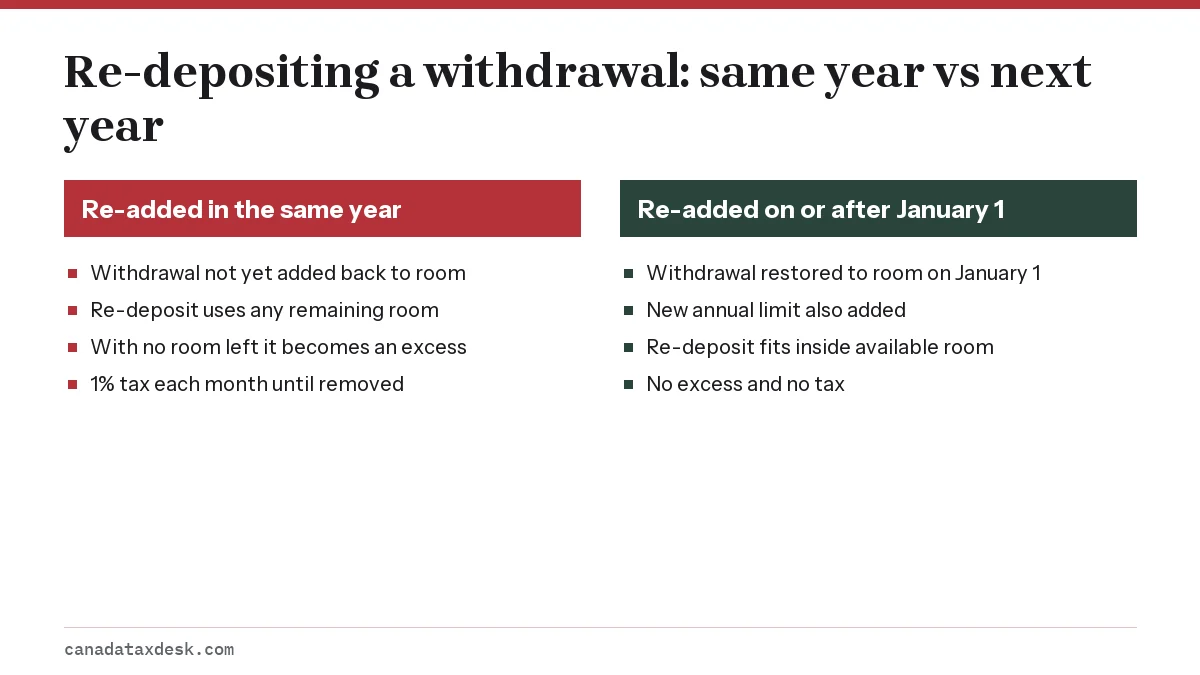
Most TFSA excess contribution penalties come from putting money back in the same year it was taken out. A withdrawal is added back to your room only on January 1 of the following year. Until then, re-depositing it uses whatever room you have left, and if that is zero, the re-deposit is an excess.
Worked example
- On January 5, 2026 Marc contributes $7,000, using all his room.
- On March 10, 2026 he withdraws $5,000 to pay a bill.
- On May 15, 2026 he puts the $5,000 back. He has no room, so he now has a $5,000 excess.
- If he withdraws the $5,000 on August 20, he owes 1% for May, June, July and August: $200.
- If he leaves it until year end, he owes 1% for May through December: $400. On January 1, 2027 the March withdrawal plus the 2027 limit restore enough room to end the excess.
How do I remove an excess TFSA amount?
Withdraw the full excess as soon as you notice it. The CRA says to take out the whole amount, because a partial withdrawal only lowers the tax base for the following month and the 1% still applies to whatever remains.
- Work out your room: January 1 room from CRA My Account, minus contributions made since January 1. Form RC343 helps with the math.
- Compare that with what you have contributed this year to find the excess.
- Ask your issuer for a withdrawal of at least the excess, in cash, from the TFSA.
- Keep the withdrawal confirmation. You will need the date and amount for Schedule A.
- Do not re-contribute the withdrawn excess later in the year.
The part of a withdrawal that removes an excess is called the qualifying portion of the withdrawal. Unlike an ordinary withdrawal, it is not added back to your room the next January. For how room is rebuilt each year, see our TFSA contribution limit page.
How do I file the TFSA return, Form RC243?
Anyone who owes tax on an excess TFSA amount must file Form RC243, Tax-Free Savings Account (TFSA) Return, with Form RC243-SCH-A, Schedule A: Excess TFSA Amounts. Both are due, along with payment, by June 30 of the year after the excess arose. For an excess in 2026, that is Wednesday, June 30, 2027.
- List each month's highest excess amount on Schedule A.
- Total the 1% tax for each month and carry it to RC243.
- Send the forms through the Submit documents service in CRA My Account, or by mail to the TFSA Processing Unit at the Sudbury or Winnipeg tax centre listed on the form.
- Pay the balance by June 30 to avoid interest. When you pay, choose TFSA as the payment type under the "Other benefit, tax, fee or amount owing" category.
The RC243 is separate from your T1 income tax return. Filing your T1 on time does not satisfy it, and a missed RC243 can bring late-filing penalties and interest on top of the 1% tax.
What letters does the CRA send about TFSA excess amounts?
The CRA usually contacts you the year after the excess arose, once financial institutions have filed their TFSA records for the prior year by the end of February. It sends either an educational letter or a notice of assessment.
- Educational letter: explains the over-contribution and its effect on your room. If you already removed the excess, no further action is needed; if not, remove it immediately.
- Notice of assessment: shows when the excess began, how long it lasted, and the tax, penalties and interest owed. If you disagree with the figures, you have 90 days from the notice date to file a formal objection with Form T400A or a signed letter. The CRA strongly recommends asking for a waiver or cancellation of the TFSA tax before you file an objection.
Can the CRA waive the TFSA over-contribution penalty?
Yes. The CRA can waive or cancel all or part of the tax when it decides that doing so is fair. It looks at whether the tax arose from a reasonable error, whether the same transaction also created another tax, and whether amounts have been paid out of the TFSA. A TFSA over contribution penalty waiver is requested by letter, not by a dedicated form. The letter should explain why the excess happened and why it would be fair to cancel the tax.
- Write a signed letter with your name, social insurance number, the tax year and the amount of tax you want waived.
- Explain what happened in plain terms: for example, that you re-deposited a withdrawal believing the room was already restored, or that your issuer processed a transfer as a withdrawal.
- Show that you removed the excess promptly, with dates. Attach account statements and the withdrawal confirmation.
- Send it through Submit documents in CRA My Account, or by mail to the TFSA Processing Unit at the Sudbury Tax Centre (Post Office Box 20000, Station A, Sudbury ON P3A 5C1) or the Winnipeg Tax Centre (Post Office Box 14000, Station Main, Winnipeg MB R3C 3M2).
- If you disagree with the decision, you can ask for a second review the same way. You have 30 days from the decision letter to apply to the Federal Court for judicial review.
Relief for penalties and interest in other situations, such as serious illness, goes through the taxpayer relief provisions. Our RC4288 taxpayer relief request page explains that process.
Does the same penalty apply to an FHSA or RRSP?
The First Home Savings Account uses the same 1% monthly tax on the highest excess, but you can remove an FHSA excess tax-free with a designated withdrawal on Form RC727, and the excess shrinks when new room arrives on January 1. The RRSP allows a $2,000 cushion first. Our FHSA rules guide and the RRSP, TFSA and FHSA overview compare all three.
Common questions
How much is the CRA TFSA over-contribution penalty?
It is 1% of the highest excess amount in your TFSA for each month the excess exists. A $3,000 excess left in for six months costs $180, plus any interest and late-filing penalties if Form RC243 is not filed by June 30 of the next year.
Will the CRA waive a TFSA penalty the first time?
There is no automatic first-time waiver. The CRA looks at whether the tax arose from a reasonable error, among other factors, so explain the circumstances, show that you removed the excess promptly, and include dates and statements.
Does the excess go away on January 1?
It can. New room on January 1, including the new annual limit and last year's withdrawals, is applied against any excess still in the account. The 1% tax for the months before that is still owed.
Will the 2027 TFSA limit clear my 2026 over-contribution?
On January 1, 2027 your room grows by the 2027 TFSA dollar limit plus the amounts you withdrew in 2026, except any qualifying portion that removed an excess, and any excess still in the account is set against that new room. As of October 22, 2026 the CRA has not published the 2027 limit (the 2026 limit is $7,000); it is usually confirmed in November with indexation. The 1% tax for the 2026 months is still owed and goes on Form RC243 by June 30, 2027.
Do I have to file RC243 if the CRA already sent a letter?
If you owe tax on an excess, you are required to file RC243 and Schedule A by June 30 of the following year. If the CRA has already assessed the tax on a notice of assessment, review it and pay or object within 90 days.
Can I just leave the excess in and wait for next year's room?
You can, but every month until January 1 costs 1% of the excess. On a $7,000 excess, waiting six months costs $420, so withdrawing right away is almost always cheaper.
Sources
- If you over-contribute to a TFSA canada.ca
- If you owe tax on excess TFSA amounts canada.ca
- If you have to pay tax on a TFSA canada.ca
- TFSA excess amount correspondence explained canada.ca
- Form RC243, Tax-Free Savings Account (TFSA) Return canada.ca
We check figures against these official pages. Rules change; confirm anything that affects a deadline or payment with the agency before you act.
Tell us what happened
Describe your situation and our editors will use it to improve this guide. If you leave your email, we may reply with a pointer to the right page or official contact. We never share your details.
Related guides
 RRSP, TFSA and FHSA Rules: Limits, Deadlines, Penalties
For 2026, the RRSP dollar limit is $33,810, the TFSA annual limit is $7,000 and the FHSA annual limit is $8,000 (CRA). RRSP and F…
RC4288 Taxpayer Relief Request: Cancel CRA Penalties
An RC4288 taxpayer relief request asks the CRA to cancel or waive penalties and interest, not the tax itself. The CRA considers e…
FHSA Rules Canada: Eligibility, Limits and Withdrawals
The main FHSA rules: you must be a Canadian resident, at least 18 and no older than 71, and a first-time home buyer to open one.…