
Home Buyers' Plan vs FHSA: differences, and how to use both
Short answer
In the Home Buyers' Plan vs FHSA choice, the main difference is repayment: the HBP lets you borrow up to $60,000 from your RRSPs and repay it over 15 years, while a qualifying FHSA withdrawal is tax-free and never repaid. The CRA lets an eligible first-time buyer use both for the same home.
- 01HBP withdrawal limit
- $60,000 from your RRSPs
- 02FHSA contribution limits
- $8,000 a year, $40,000 lifetime
- 03HBP repayment
- 15 years; starts in 2031 for a 2026 first withdrawal
- 04FHSA repayment
- None for a qualifying withdrawal
- 05Use both for one home?
- Yes, if you meet each program's conditions
Home Buyers' Plan vs FHSA: the key differences
The Home Buyers' Plan (HBP) and the First Home Savings Account (FHSA) both let a first-time buyer put tax-sheltered savings toward a home in Canada, but they work in opposite ways. The HBP is an interest-free loan from your own RRSP that must be repaid. The FHSA is a separate account whose qualifying withdrawals are yours to keep, with no repayment and no tax.
The HBP's strength is size and speed: if you already have RRSP savings, you can take up to $60,000 at once. The FHSA's strength is cost: contributions are deductible like an RRSP's, but the money comes out tax-free and never has to go back in. The trade-off is that FHSA room builds at only $8,000 a year.
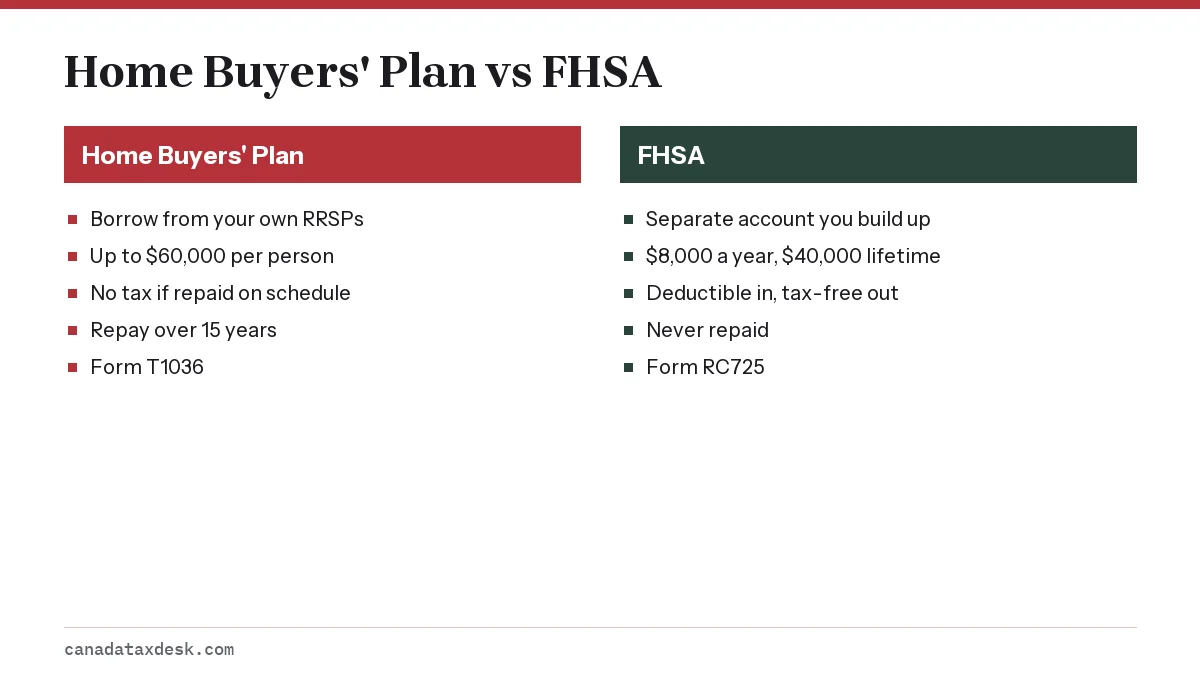
Side-by-side rules: FHSA vs HBP
| Rule | Home Buyers' Plan | First Home Savings Account |
|---|---|---|
| Where the money comes from | Your existing RRSPs | A separate FHSA you open and fund |
| How much you can use | Up to $60,000 per person | Your full FHSA balance: contributions of up to $40,000 plus investment growth |
| Contribution limit | Your RRSP deduction limit | $8,000 a year, carry-forward of up to $8,000, $40,000 lifetime |
| Tax on contributions | Deductible as an RRSP contribution | Deductible by the account holder |
| Tax on the home withdrawal | None, if repaid on schedule | None for a qualifying withdrawal |
| Repayment | 15 years; fifth-year start for 2022 to 2028 first withdrawals | Not required |
| Form to withdraw | T1036 | RC725, Request to Make a Qualifying Withdrawal from your FHSA |
| First-time buyer test at withdrawal | You and your current spouse or common-law partner | Your own ownership only |
| Buy or build deadline | Before October 1 of the year after the first withdrawal | Written agreement with a closing or completion date before October 1 of the year after the withdrawal |
| If you do not buy | Cancel with Form RC471 and repay by December 31 of the year after your first withdrawal | Transfer to an RRSP or RRIF tax-free, or withdraw it as taxable income |
Both first-time buyer tests look back over the same period: the current year before the withdrawal (ignoring the 30 days just before it) and the four previous calendar years. They differ on spouses. For the HBP, you cannot have lived in a home that you or your current spouse or common-law partner owned. For an FHSA qualifying withdrawal, only your own ownership counts: the CRA's example is a buyer who lives in a condo his wife owns and can still make a qualifying withdrawal. A spouse's home does matter when you first open the FHSA. For the full FHSA eligibility list, including the age 18 and age 71 limits, see FHSA rules in Canada.
How each is taxed
Both programs give you a deduction on the way in. RRSP contributions reduce taxable income up to your RRSP deduction limit, and FHSA contributions reduce it up to your FHSA participation room. The difference is on the way out.
- HBP: the withdrawal is not income as long as you repay. Every dollar you fail to repay in a year is added to income on line 12900, so the tax you avoided up front comes back.
- FHSA: a qualifying withdrawal is never taxed. You get the deduction on the way in and pay nothing on the way out.
- FHSA, non-qualifying withdrawal: money taken out for any other purpose is taxable income in the year you receive it, and tax is withheld at source.
- HBP above $60,000: any extra is a regular RRSP withdrawal, with withholding and full tax, as explained on our RRSP withdrawal tax page.
Whichever route you use, a qualifying buyer can also claim the home buyers' amount of up to $10,000 on line 31270 for the purchase year, worth up to $1,400 in federal tax for 2026.
Do I have to repay the FHSA?
No. A qualifying FHSA withdrawal does not have to be repaid, and there is no schedule or balance to track afterwards. The only follow-up is that you must close all your FHSAs by December 31 of the year after your first qualifying withdrawal.
The HBP is the opposite. The CRA sets a minimum each year equal to your balance divided by the years left, and you designate RRSP contributions against it on Schedule 7. On a full $60,000 withdrawal that is $4,000 a year for 15 years. The HBP repayment page covers the schedule and what a missed year costs. You cannot use an FHSA to repay HBP withdrawals.
Can you use the FHSA and HBP together?
Yes. The CRA allows a qualifying FHSA withdrawal and an HBP withdrawal for the same qualifying home, provided you meet the conditions of each program at the time of each withdrawal. You file Form RC725 with your FHSA issuer and Form T1036 with your RRSP issuer.
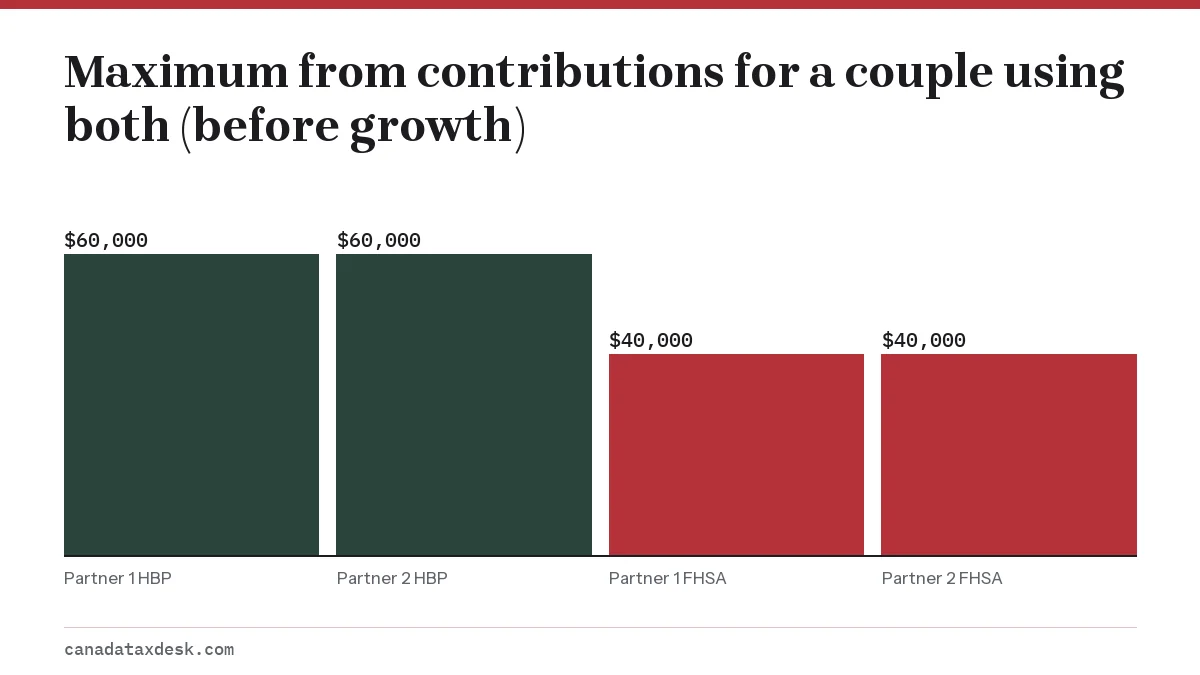
Because both are per person, a couple where each partner qualifies can combine four sources for one purchase: two HBP withdrawals of up to $60,000 each and two FHSA balances. On contributions alone, that is up to $200,000 before any investment growth.
FHSA or RRSP for a first home: which should I use first?
In most cases, fill and use the FHSA first and treat the HBP as the top-up. FHSA money is free once withdrawn, while every HBP dollar is a debt to your future self. If the FHSA covers the down payment, leaving the RRSP alone keeps your retirement savings growing and avoids 15 years of required repayments.
There are exceptions. Someone buying within a year with a large RRSP and no FHSA cannot build $40,000 of FHSA room in time, since room grows at $8,000 a year. In that case the HBP may carry most of the down payment, and opening an FHSA right away still adds the first year's $8,000. The FHSA contribution limit page shows how carry-forward room builds.
Example scenarios
Scenario 1: single buyer, buying in 2028
Take a buyer who opens an FHSA in 2026 and contributes $8,000 in each of 2026, 2027 and 2028, deducting all three. They also have $25,000 in an RRSP. On buying in 2028, they withdraw the $24,000 of FHSA contributions plus any growth tax-free, and take $25,000 under the HBP. The first HBP repayment year is 2033, with a minimum of about $1,667.
Scenario 2: couple buying in six months
Two partners each have $60,000 in RRSPs and no FHSA. They can each withdraw up to $60,000 under the HBP now. If each opens an FHSA and contributes $8,000 before closing, that adds $16,000 of tax-free money, provided each FHSA withdrawal meets the qualifying rules on the date it is made.
Scenario 3: the purchase never happens
A buyer who built a $40,000 FHSA decides not to buy. The balance can go directly to their RRSP with no tax and no effect on their unused RRSP deduction room, so the FHSA still ends up as extra retirement savings. An HBP participant in the same position would cancel with Form RC471 and return the money to the RRSP by the deadline.
Which one should you choose?
- Choose the FHSA first if you have at least a year or two before buying and can contribute, because withdrawals are never repaid.
- Add the HBP if you already have RRSP savings and need more than your FHSA holds.
- Rely mainly on the HBP if you are buying soon, have a large RRSP and little FHSA room, and can afford the repayments from the fifth year on.
- Keep the FHSA even if unsure about buying, since an unused balance can move to your RRSP without tax.
For eligibility and the withdrawal process on the RRSP side, see the full Home Buyers' Plan guide. For how the RRSP, TFSA and FHSA work together, see our RRSP, TFSA and FHSA guide.
Common questions
Is the FHSA better than the Home Buyers' Plan?
For most first-time buyers the FHSA is the better deal per dollar, because a qualifying withdrawal is tax-free and never repaid. The HBP is better for reaching a large amount quickly if you already have RRSP savings.
Can I withdraw from my FHSA and RRSP for the same house?
Yes. The CRA allows a qualifying FHSA withdrawal and an HBP withdrawal for the same qualifying home, as long as you meet each program's conditions when you make each withdrawal.
Can I use the HBP if I already bought a home with my FHSA?
Only for the same home and only if you still meet the HBP conditions at the time of the RRSP withdrawal, including the first-time buyer test and the written agreement.
Should I move RRSP money into an FHSA before buying?
A direct RRSP-to-FHSA transfer uses FHSA room and gives no new deduction, and it does not restore RRSP room. It can let that money come out without any repayment, but it takes FHSA room you could otherwise fill with new, deductible contributions.
What are the FHSA and HBP deadlines?
For the FHSA, contribute by December 31 for that year (there is no 60-day window), have a written agreement with a closing date before October 1 of the year after the withdrawal, and close all your FHSAs by December 31 of the year after your first qualifying withdrawal. For the HBP, buy or build before October 1 of the year after your first withdrawal or cancel and repay by December 31 of that year; repayments then start in the fifth year after a first withdrawal made from 2022 to 2028.
What if I use the HBP and later sell the home?
Selling the home does not cancel your HBP balance. You still owe the remaining annual minimums on Schedule 7, and any shortfall is taxed as income.
Sources
- What is the Home Buyers' Plan canada.ca
- Opening your FHSAs canada.ca
- Contributing to your FHSA canada.ca
- Withdrawals and transfers out of your FHSAs canada.ca
- How to repay amounts withdrawn under the HBP canada.ca
We check figures against these official pages. Rules change; confirm anything that affects a deadline or payment with the agency before you act.
Tell us what happened
Describe your situation and our editors will use it to improve this guide. If you leave your email, we may reply with a pointer to the right page or official contact. We never share your details.
Related guides
 RRSP, TFSA and FHSA Rules: Limits, Deadlines, Penalties
For 2026, the RRSP dollar limit is $33,810, the TFSA annual limit is $7,000 and the FHSA annual limit is $8,000 (CRA). RRSP and F…
FHSA Rules Canada: Eligibility, Limits and Withdrawals
The main FHSA rules: you must be a Canadian resident, at least 18 and no older than 71, and a first-time home buyer to open one.…
Home Buyers' Plan: $60,000 RRSP Withdrawal and Repayment
The Home Buyers' Plan (HBP) lets a first-time home buyer withdraw up to $60,000 from their own RRSPs to buy or build a qualifying…
Home Buyers' Amount: Claim Up to $10,000 on Line 31270
The home buyers' amount is a non-refundable federal credit that lets you claim up to $10,000 on line 31270 in the year you buy a…
FHSA Contribution Limit: $8,000 a Year and Carry-Forward
The FHSA contribution limit is $8,000 of participation room per year and $40,000 over your lifetime, according to the CRA. Up to…
Home Buyers' Plan Repayment: New 5-Year Deferral Explained
Home Buyers' Plan repayment for a first withdrawal made from January 1, 2022 to December 31, 2028 starts in the fifth year after…