
Line 23600 (formerly line 236): net income on your tax return and notice of assessment
Short answer
Line 23600 on your tax return, called line 236 before the 2019 tax year, is your net income: total income on line 15000 minus the deductions on lines 20700 to 23500, such as RRSP contributions, union dues and child care expenses. Your notice of assessment shows the line 23600 amount the CRA accepted. The CRA uses it to calculate the Canada child benefit, the GST/HST credit, the medical expense threshold and other income-tested amounts, so it often matters more than the tax you pay.
- 01Formula
- Line 15000 minus lines 20700 to 23500
- 02Next step
- Line 23600 minus line 25700 = taxable income, line 26000
- 03Medical expense threshold (2025)
- Lesser of 3% of line 23600 or $2,834
- 04EI repayment starts (2025)
- Net income above $82,125
- 05If the result is negative
- Enter zero; the loss may be carried back on Form T1A
What is line 23600 on a tax return?
Line 23600 is net income on the T1 Income Tax and Benefit Return. Net income is what remains after you subtract a specific set of deductions from your total income, and it sits between total income (line 15000) and taxable income (line 26000) on the return. Before the 2019 tax year it was called line 236.
The CRA's own definition is short: line 23600 equals line 15000 minus the total of lines 20700 to 23500 (CRA, Line 23600 Net income, modified January 20, 2026). If you have no deductions at all, your line 23600 net income is the same as your total income.
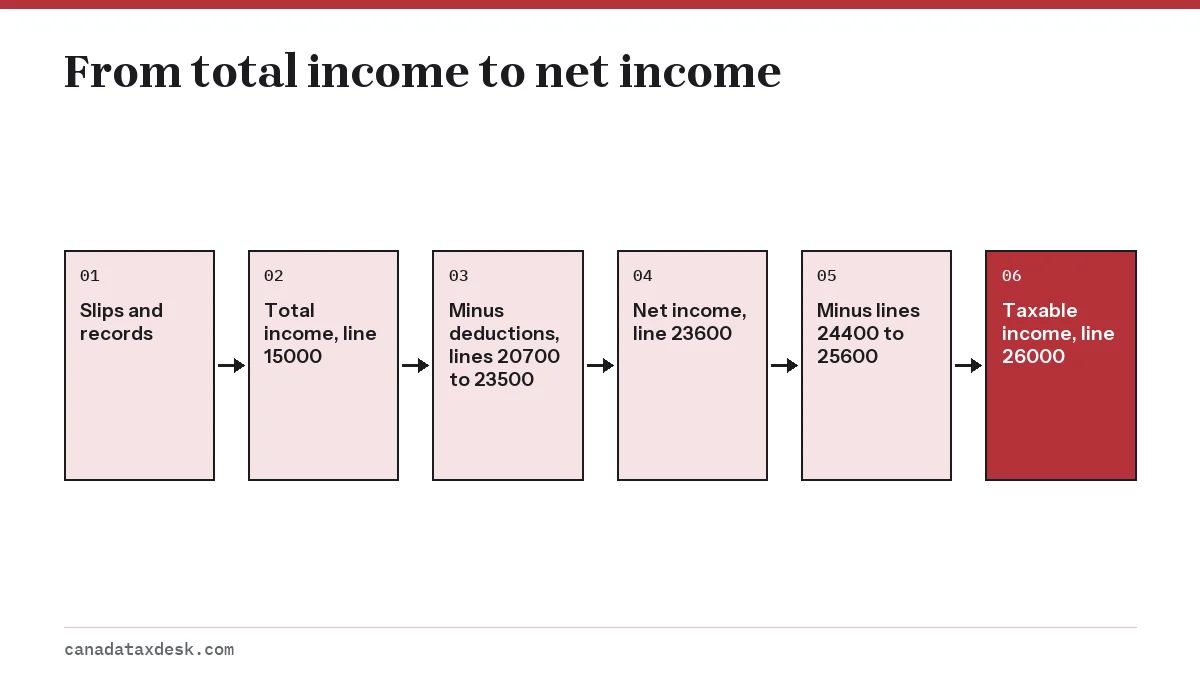
Everything that feeds line 15000 comes from your slips and records, which is why this line belongs with the slips. For the income side, see how line 15000 total income is built and the overview of every common tax slip.
Which deductions lower line 23600 net income?
Only the deductions on lines 20700 to 23500 reduce net income. Credits such as the basic personal amount or tuition do not touch it, because non-refundable credits reduce tax, not income. The deductions most people see are listed below.
| Line | Deduction | Where the number usually comes from |
|---|---|---|
| 20700 | Registered pension plan (RPP) deduction | T4 box 20 or T4A box 32 |
| 20800 | RRSP deduction | RRSP contribution receipts and Schedule 7 |
| 20805 | FHSA deduction | FHSA contribution records |
| 21200 | Annual union, professional or like dues | T4 box 44 or receipts |
| 21400 | Child care expenses | Form T778 and daycare receipts |
| 21900 | Moving expenses | Form T1-M |
| 22000 | Support payments made | Separation agreement or court order |
| 22100 | Carrying charges and interest expenses | Investment loan statements |
| 22215 | Enhanced CPP or QPP contributions on employment income | Calculated by software from T4 box 16A or 17A |
| 23500 | Social benefits repayment | Calculated when EI or OAS must be repaid |
Other lines in the range include 21000 (elected split-pension amount), 21500 (disability supports), 22200 (CPP or QPP on self-employment income), 22900 (other employment expenses) and 23200 (other deductions). Pension splitting is the one to watch for couples: moving pension income to a spouse lowers the transferring spouse's line 23600 and raises the other spouse's by the same amount.
Worked example
Take an employee with $70,000 in T4 box 14 and $500 of interest on a T5. Total income on line 15000 is $70,500. She contributes $5,000 to an RRSP, pays $800 in union dues shown in T4 box 44, and claims $4,000 of daycare on line 21400.
| Line | Item | Amount |
|---|---|---|
| 15000 | Total income | $70,500 |
| 20800 | RRSP deduction | minus $5,000 |
| 21200 | Union dues | minus $800 |
| 21400 | Child care expenses | minus $4,000 |
| 23600 | Net income | $60,700 |
The $9,800 of deductions lowers both her tax and the net income the CRA uses for her family's benefits. An RRSP contribution is the deduction most people can choose to make, within their RRSP contribution limit.
Where do I find line 23600 (line 236) on my notice of assessment?
The quickest place is your notice of assessment. The line 23600 figure on the notice of assessment is the net income the CRA accepted after processing your return, which may differ from what you filed if it made changes. Read how to read a notice of assessment if the figure does not match your copy.
- Sign in to CRA My Account and open the notice of assessment for the year you need, or look at the paper notice mailed to you.
- Find the summary that lists line 15000, line 23600 and line 26000 side by side.
- Compare the assessed line 23600 with your filed return. A difference means the CRA adjusted something, and the explanation section says what.
- If you need an older year, the same notice for that year shows it. Your filed T1 copy or tax software file also shows the amount you claimed.
Why do benefits and credits use line 23600?
The CRA uses net income to calculate the Canada child benefit, the GST/HST credit, the social benefits repayment and several credits, including the refundable medical expense supplement and the Canada workers benefit (CRA, Line 23600). Net income is also why you must enter your spouse's or common-law partner's net income on page 1 of the return, even if it is zero: family benefits are based on combined net income.
| Amount | How net income affects it | 2025 figure |
|---|---|---|
| Medical expense credit | Only expenses above the lesser of 3% of net income or a fixed cap count | Cap $2,834 |
| EI benefits repayment | Part of EI benefits is repaid when net income passes the threshold | Above $82,125 |
| OAS recovery tax | OAS is partly clawed back above the threshold | Above $93,454 |
| Age amount | Reduced as net income rises, eliminated at the upper limit | Starts at $45,522, ends at $105,709 |
In the worked example above, the medical expense threshold is 3% of $60,700, which is $1,821. That is below the $2,834 cap, so only medical costs above $1,821 count. The full method is on the medical expenses tax credit page. For 2026, the CRA's table of indexed amounts puts the medical expense cap at $2,890 and the Old Age Security repayment threshold at $95,323; the EI repayment figure for 2026 normally appears with the 2026 tax package in January 2027.
The social benefits repayment has a circular twist: it is itself a deduction on line 23500, so the repayment reduces the net income that triggered it. The line 23500 social benefits repayment page walks through that calculation, and seniors can see the income test for the age amount.
Line 23600 vs 26000: what is the difference?
Line 26000 is taxable income: line 23600 minus line 25700, where line 25700 is the total of the deductions on lines 24400 to 25600 (CRA, Line 26000). Federal and provincial tax is calculated on line 26000, while benefits and income tests use line 23600. For most employees with no loss carryovers, the two lines are identical.
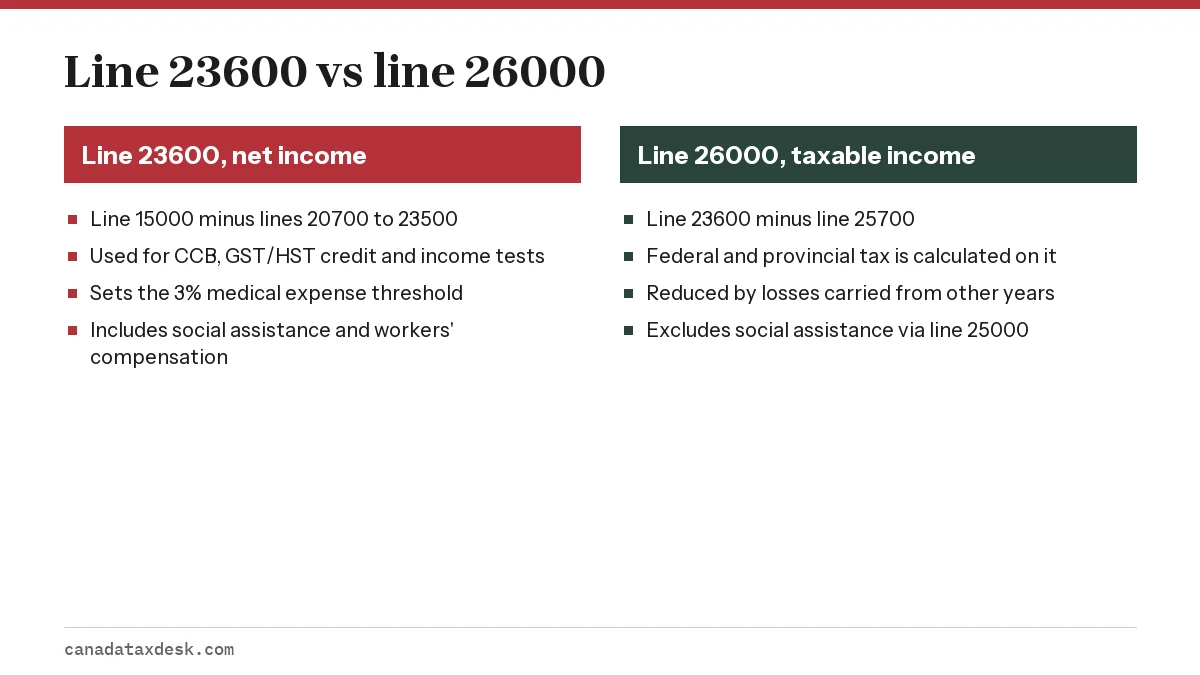
The deductions that separate the two lines are narrower and more specialized: Canadian Armed Forces personnel and police deduction (24400), security options deductions (24900), other payments deduction (25000), limited partnership losses (25100), non-capital losses of other years (25200), net capital losses of other years (25300), the capital gains deduction (25400) and northern residents deductions (25500).
This is why a loss carried forward from another year lowers your tax but does not raise your child benefit. Losses of other years reduce line 26000 only, so line 23600 and the benefits tied to it stay where they were.
What if line 23600 is negative?
Line 23600 cannot go below zero. If deductions exceed total income, enter zero on line 23600 and keep a record of the negative amount, because it may be a non-capital loss. The CRA says you can carry that loss back to the three previous years with Form T1A, Request for Loss Carryback; on a 2025 return, that means 2022, 2023 or 2024.
A loss you do not carry back can be applied in later years on line 25200. Certain negative amounts from line 23600 can also reduce the adjusted net income used for the basic personal amount, the age amount and some benefits, according to the CRA's line 23600 page.
Common questions
Is line 23600 the same as gross income?
No. Gross or total income is line 15000. Line 23600 is net income, which is line 15000 after deductions such as RRSP contributions, union dues and child care expenses.
What was line 236 on a tax return?
Line 236 is the old name for line 23600. The CRA added two zeros to most line numbers starting with the 2019 tax year, but the meaning, net income, did not change.
Does an RRSP contribution lower line 23600?
Yes. The RRSP deduction on line 20800 is subtracted before net income, so it lowers line 23600, line 26000 and any benefit calculated from net income. The contribution must fit within your deduction limit.
Why is my line 23600 on the notice of assessment different from my return?
The CRA changed something while assessing your return, such as removing a deduction it could not verify or adding a slip you missed. The explanation of changes on the notice describes the adjustment. If you disagree, you can request a change or file an objection.
Is net income for the Canada child benefit just my line 23600?
Not exactly. The CCB and GST/HST credit use adjusted family net income, which starts with your line 23600 and your spouse's or common-law partner's line 23600 and makes a few adjustments. Both of you must file for it to be calculated.
Can line 23600 be higher than line 26000?
Yes, and it never goes the other way. Line 26000 is line 23600 minus deductions on lines 24400 to 25600, so taxable income is equal to or lower than net income.
Sources
- Adjustment of personal income tax and benefit amounts (2026) canada.ca
- Line 23600 - Net income canada.ca
- Line 26000 - Taxable income canada.ca
- All deductions, credits and expenses canada.ca
- Lines 33099 and 33199 - Eligible medical expenses canada.ca
- Line 23500 - Social benefits repayment canada.ca
- Notice of assessment and reassessment canada.ca
We check figures against these official pages. Rules change; confirm anything that affects a deadline or payment with the agency before you act.
Tell us what happened
Describe your situation and our editors will use it to improve this guide. If you leave your email, we may reply with a pointer to the right page or official contact. We never share your details.
Related guides
 Canadian Tax Slips Explained: T4, T4A, T5 and More
Tax slips in Canada are information returns that employers, payers, banks, schools and governments send to you and to the CRA. Th…
Canada Workers Benefit 2026: Amounts, Eligibility, Advances
The Canada workers benefit (CWB) is a refundable tax credit for low-income workers, claimed on line 45300 with Schedule 6. For 20…
What Is Line 15000 on a Tax Return? Total Income vs Box 14
What is line 15000? It is your total income for the year on the Canadian T1 return: every type of income added together before an…
Medical Expenses Tax Credit Canada: What You Can Claim
The medical expenses tax credit lets you claim eligible health costs above the lesser of 3% of your net income or $2,890 for 2026…
Line 23500: Social Benefits Repayment on Your Tax Return
Line 23500 social benefits repayment is the deduction for Old Age Security or Employment Insurance benefits you must pay back bec…
T5007 Slip: Social Assistance and Workers' Compensation
A T5007 slip, the Statement of Benefits, reports social assistance (box 11) and workers' compensation (box 10). Neither is taxed,…