
RRSP receipt: which return it belongs on and how to claim it
Short answer
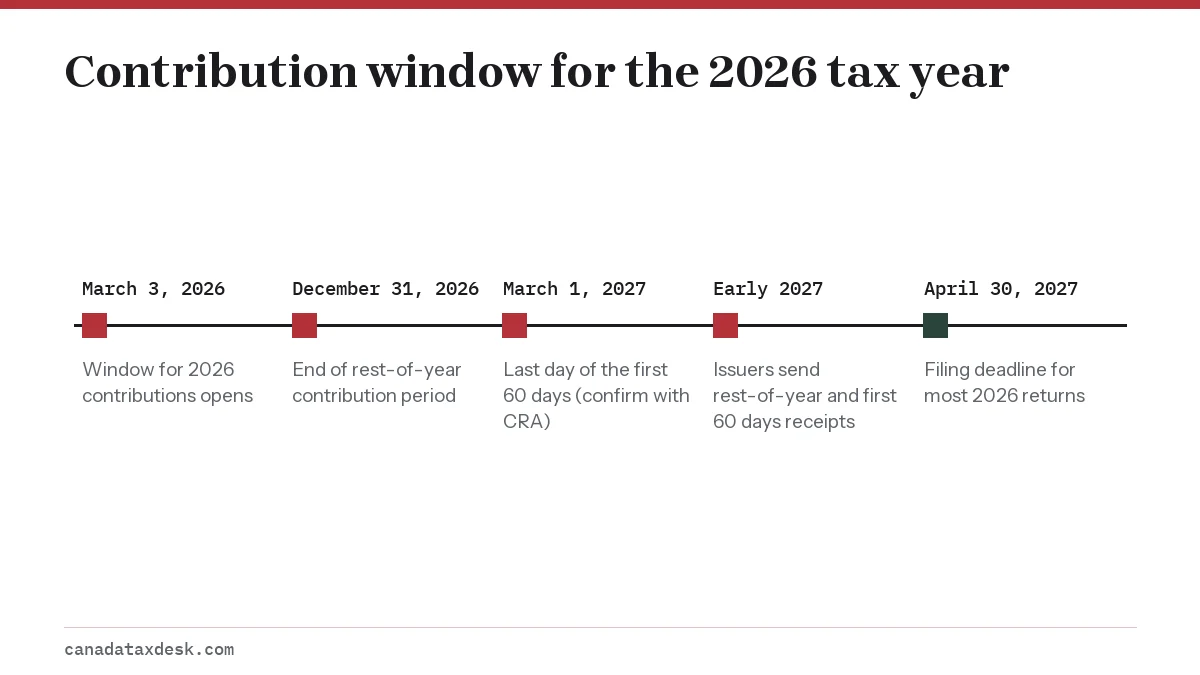
An RRSP receipt is the official contribution receipt your plan issuer gives you. Contributions from early March of one year to the 60-day deadline of the next count for the same tax year: March 3, 2026 to March 1, 2027 for 2026 returns, a date the CRA usually confirms in January. You claim them on line 20800 and list them on Schedule 7 if you do not deduct everything. You keep the receipts; e-filers do not send them.
- 012025 tax year window
- March 4, 2025 to March 2, 2026
- 022026 tax year deadline
- March 1, 2027 (confirm when the CRA publishes it)
- 03Deduction line
- Line 20800
- 042026 RRSP dollar limit
- $33,810 (2027: $35,390)
What an RRSP receipt shows
An RRSP receipt is the official tax receipt from the bank, credit union, trust company, insurer or broker that holds your plan. It shows the contributor, the annuitant (the plan owner), the amount and the contribution period. For a spousal RRSP, you are the contributor and your spouse is the annuitant, and the deduction goes on your return.
Unlike a T4 or T5, the RRSP tax receipt is not an information slip that reports income. It is proof of a deduction. You claim the amount yourself on line 20800, and the CRA can ask to see the receipt during a review.
RRSP receipt first 60 days vs rest of year
The RRSP year does not match the calendar year. Contributions made in the first 60 days of a calendar year can be deducted on the previous year's return. Many issuers send two receipts for this reason: one for contributions from March to December, and a separate first 60 days receipt for January to the deadline.
| Contribution dates | Receipt type | Can be deducted on |
|---|---|---|
| March 4 to December 31, 2025 | Rest-of-year 2025 receipt | 2025 return or later |
| January 1 to March 2, 2026 | First 60 days of 2026 receipt | 2025 return or later |
| March 3 to December 31, 2026 | Rest-of-year 2026 receipt | 2026 return or later |
| January 1 to March 1, 2027 | First 60 days of 2027 receipt | 2026 return or later |
The March 1, 2027 date for the 2026 tax year is the calculated 60th day; the CRA confirms the RRSP receipt deadline on its line 20800 page, usually in January. A contribution made on March 2, 2027 would count toward the 2027 tax year.
How to use an RRSP receipt for taxes
Before claiming, find your deduction limit on your latest notice of assessment or in your CRA account. For 2026 it is the lesser of 18% of 2025 earned income or $33,810, plus unused room from earlier years, minus your pension adjustment. Our RRSP contribution limit page explains each piece.
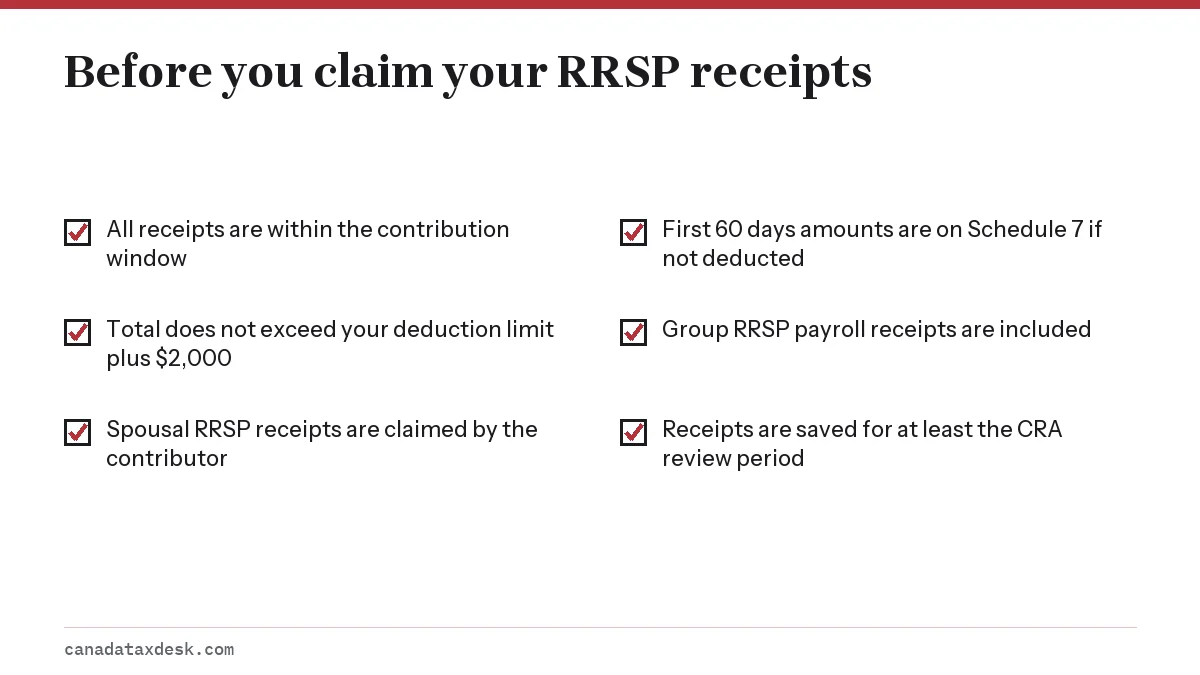
- Gather every receipt dated within the contribution window for the year.
- Add them up and compare the total with your deduction limit.
- Enter the amount you choose to deduct on line 20800.
- Complete Schedule 7 if you are not deducting everything you contributed in the window, or if you are using unused contributions from earlier years.
- Keep the receipts. If you file on paper, attach them.
Worked example
Priya contributed $4,000 in October 2025 and $3,000 in February 2026, and her 2025 limit was $12,000. Both receipts fall in the 2025 window, so she can deduct $7,000 on her 2025 return. If her 2025 income was low and she expects a higher bracket in 2026, she may deduct only $4,000 now and carry the other $3,000 forward. She must then show the full $7,000 on her 2025 Schedule 7.
Undeducted contributions and Schedule 7
You do not have to deduct a contribution in the year you make it. Unused contributions carry forward with no time limit, and your notice of assessment tracks them. What you cannot do is leave the first 60 days receipt off the earlier return entirely. The CRA's rule is that contributions made in the window must be reported on Schedule 7 for that year even if you deduct them later.
Contributions that exceed your deduction limit by more than $2,000 are taxed at 1% per month on the excess. If your receipts add up to more than your room, read RRSP over-contribution before filing.
How do you get a missing RRSP receipt?
Most issuers post receipts in online banking or the investment platform's document centre, and only the issuer can give you a copy of the receipt itself. Issuers also send the receipt information to the CRA: RRSP contribution receipts are on the CRA's list of information that Auto-fill my return downloads into certified software. Most slips are ready by mid-March, but the CRA warns that receipts for first 60 days contributions may not be available in Auto-fill until May.
- Check your online banking or brokerage documents under tax receipts.
- Ask the issuer for a duplicate if you cannot find it.
- If filing online before the receipt arrives, use your transaction confirmation to enter the right amount, then keep the receipt when it comes.
- If you claimed a wrong amount, fix it with Change my return after your notice of assessment.
See missing tax slip for the general process, RRSP contribution deadline for date rules, and the tax slips guide for the other documents you need.
Step by step
Collect receipts
Gather all RRSP receipts dated in the contribution window for the tax year.
Check your limit
Find your RRSP deduction limit on your notice of assessment or in your CRA account.
Deduct on line 20800
Enter the amount you choose to deduct this year.
Complete Schedule 7
List contributions you are not deducting, and any unused amounts from earlier years.
Keep the receipts
E-filers keep receipts for a CRA review; paper filers attach them.
Common questions
When will I get my RRSP receipt?
It depends on the issuer. Many issue the rest-of-year receipt early in the new year and the first 60 days receipt shortly after the deadline. Check the issuer's online documents before asking for a paper copy. If you use Auto-fill, the CRA says first 60 days receipts may not show up there until May.
Do you get a tax slip for RRSP contributions?
No T-slip is issued for contributions. You get an RRSP contribution receipt from the issuer as proof of your line 20800 deduction, and the CRA receives the same information for Auto-fill. The T4RSP is a different slip: it reports money withdrawn from an RRSP, which is income on line 12900.
What is the first 60 days RRSP receipt?
It covers contributions made from January 1 to the 60-day deadline. You can deduct those amounts on the previous year's return, or carry them forward, but they must appear on that year's Schedule 7 if not deducted.
Do I need to send my RRSP receipt to the CRA?
Not if you file electronically. Keep the receipts in case the CRA asks for them. Paper filers attach them to the return.
Can I claim an RRSP contribution without a receipt?
You can enter the amount if you know it exactly, but you must be able to produce the official receipt if the CRA reviews the claim.
Should I deduct my RRSP contribution this year or carry it forward?
Deducting saves tax at your current marginal rate. Carrying it forward can save more if you expect to be in a higher bracket soon, but the contribution still has to be reported on Schedule 7.
Sources
- Line 20800: RRSP deduction canada.ca
- Guide T4040, RRSPs and Other Registered Plans for Retirement canada.ca
- MP, DB, RRSP, DPSP, ALDA, TFSA limits, YMPE and YAMPE canada.ca
We check figures against these official pages. Rules change; confirm anything that affects a deadline or payment with the agency before you act.
Tell us what happened
Describe your situation and our editors will use it to improve this guide. If you leave your email, we may reply with a pointer to the right page or official contact. We never share your details.
Related guides
 Canadian Tax Slips Explained: T4, T4A, T5 and More
Tax slips in Canada are information returns that employers, payers, banks, schools and governments send to you and to the CRA. Th…
RRSP Deadline 2027: Last Day to Contribute for 2026
The RRSP deadline in 2027 for contributions you want to deduct on your 2026 return is Monday, March 1, 2027. That is the 60th day…
RRSP Contribution Limit 2026: How Your Room Is Calculated
The RRSP contribution limit for 2026 is 18% of your 2025 earned income, to a maximum of $33,810, plus any unused room from earlie…
Missing Tax Slip? T4 Slip Download and Other Fixes
If a slip has not arrived, try a T4 slip download from CRA My Account first; every slip the issuer has filed is there. Otherwise,…
RRSP Over-Contribution Penalty: The $2,000 Buffer and T1-OVP
An RRSP over contribution is only penalized when your unused contributions exceed your RRSP deduction limit by more than $2,000.…