
Newcomers, Students and Seniors
Line 23500 social benefits repayment: how OAS and EI clawbacks work on your return
Short answer
Line 23500 social benefits repayment is the deduction for Old Age Security or Employment Insurance benefits you must pay back because your income was too high. The same amount is added to tax on line 42200. For 2025 returns, OAS is repaid at 15% of net income above $93,454 and EI regular benefits at 30% above $82,125.
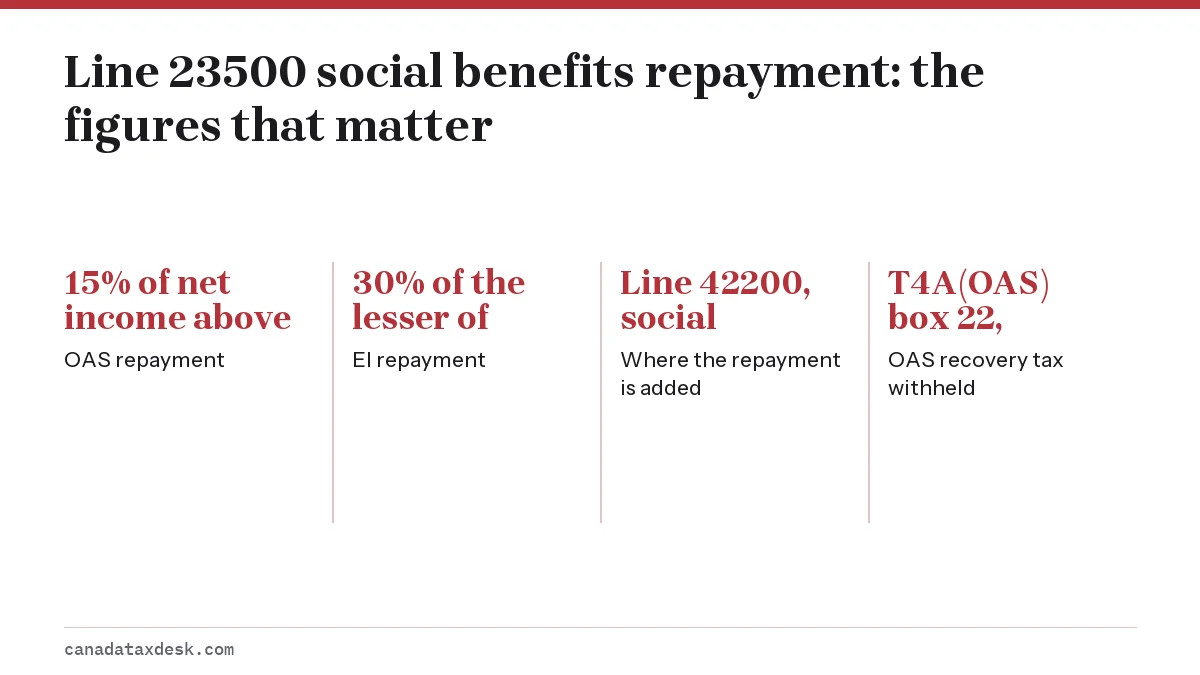
- 01OAS repayment
- 15% of net income above $93,454 (2025) or $95,323 (2026), up to the OAS received
- 02EI repayment
- 30% of the lesser of regular benefits or income above $82,125 (2025) or $86,125 (2026)
- 03Where the repayment is added
- Line 42200, social benefits repayment
- 04OAS recovery tax withheld
- T4A(OAS) box 22, claimed on line 43700
- 05How it is calculated
- Chart for line 23500 on the Federal Worksheet
What is line 23500 on my tax return?
Line 23500 is where you deduct the part of your OAS pension or EI benefits that you have to give back because your net income passed a threshold. It is the last deduction before net income on line 23600, and it only applies to people who received one of those two benefits during the year.
People often call the OAS side the clawback and the CRA calls it the OAS recovery tax. On the EI side it is the EI benefit repayment. Both are calculated on the same chart for line 23500 on the Federal Worksheet, and certified tax software completes that chart for you from your slips.
Why is there a deduction and a repayment for the same amount?
Because the benefit was already added to your income, and you should not pay income tax on money you are handing back. The line 23500 deduction removes the repaid part from net income, and line 42200 then collects the repayment itself as a separate amount on top of your tax.
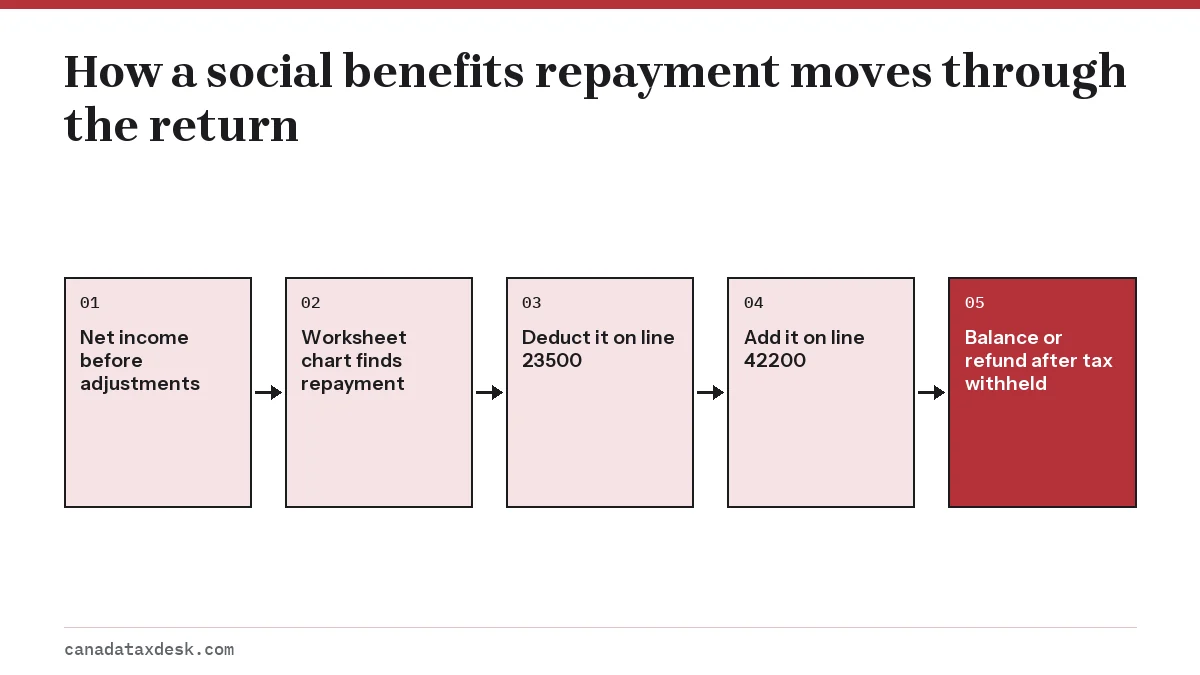
The two entries do not cancel out. Line 23500 lowers net income, which can slightly raise income-tested amounts such as the age amount, while line 42200 adds the full repayment to total payable. Non-refundable credits reduce income tax but cannot reduce the line 42200 amount.
How the OAS recovery tax works on line 23500
If your net world income is above the OAS threshold, you repay 15% of the excess, up to the total OAS you received. The threshold is $93,454 for 2025 income and $95,323 for 2026 income, according to the Government of Canada's recovery tax page. The test uses net income before this deduction.
Worked example: OAS repayment on a 2026 return
| Step | Calculation | Amount |
|---|---|---|
| Net income before the line 23500 deduction | Including OAS received | $105,323 |
| Excess over the 2026 threshold | $105,323 - $95,323 | $10,000 |
| Repayment at 15% | $10,000 x 15% | $1,500 |
| Line 23500 deduction | Same as repayment | $1,500 |
| Net income on line 23600 | $105,323 - $1,500 | $103,823 |
| Added on line 42200 | Repayment | $1,500 |
If the repayment is larger than the OAS actually received, only the OAS received is repaid. People close to the threshold can reduce the repayment by lowering net income, for example with an RRSP contribution within their RRSP contribution limit or by splitting pension income with a spouse.
How tax withheld from OAS shows on your return
Service Canada estimates your recovery tax from the previous year's return and withholds it from each monthly OAS payment from July to June. The total withheld during the calendar year is shown in box 22 of the T4A(OAS) slip, and you claim it on line 43700, total income tax deducted, not on line 23500.
The return then settles the difference. In the example above, if $1,200 was withheld during 2026 based on 2025 income, the $1,500 on line 42200 is partly covered by that $1,200 on line 43700, leaving $300 of this item to pay with the return. If income fell, the withheld amount can exceed the repayment and increase your refund.
Does line 23500 include EI repayments?
Yes. If your T4E shows regular or fishing benefits in box 15 and a repayment rate of 30% in box 7, and your net income is above the threshold, you repay 30% of the lesser of your regular benefits and your income above the threshold. The threshold is $82,125 for 2025 and $86,125 for 2026, according to Employment and Social Development Canada.
Two groups do not repay. People who received less than one week of regular or fishing benefits in the 10 tax years before the current year are exempt, and special benefits such as maternity, parental, sickness, compassionate care and family caregiver benefits are never repaid this way.
Worked example: EI benefit repayment on a 2026 tax return
Sam was laid off in March 2026, received $7,500 of regular EI benefits, then started a better-paid job. Net income before the deduction is $91,125, which is $5,000 over the $86,125 threshold. The lesser of $7,500 and $5,000 is $5,000, so Sam repays 30% of it: $1,500 on line 42200, with the same $1,500 deducted on line 23500.
If you already paid back an overpayment directly to the EI program, that amount appears in box 30 of the T4E and is deducted on line 23200, not line 23500. The T4E slip guide explains each box.
Reading your T4A(OAS) and T4E slips for line 23500
| Slip and box | What it shows | Where it goes |
|---|---|---|
| T4A(OAS) box 18 | Taxable OAS pension paid in the year | Line 11300, and into the OAS repayment test |
| T4A(OAS) box 22 | Income tax deducted, including recovery tax withheld | Line 43700 |
| T4E box 15 | Regular and other benefits paid | Used for the EI repayment calculation |
| T4E box 7 | Repayment rate (30% when repayment may apply) | Tells the worksheet to test for EI repayment |
| T4E box 30 | Benefits you repaid directly to the payer | Line 23200 |
Where both slips apply in the same year, the one chart on the Federal Worksheet handles OAS and EI together. The final figure on line 23500 lowers net income on line 23600, which is the number the CRA uses for benefits the following year.
For the wider picture of filing after 65, read the seniors tax return guide. If this is your first Canadian return, the first tax return guide covers the basics.
Common questions
What is the OAS clawback threshold for 2026?
For 2026 income, the OAS clawback (the OAS recovery tax) starts at $95,323 of net income, up from $93,454 for 2025. You repay 15% of net income above the threshold, up to the OAS you received, through line 23500 and line 42200 of your return.
Is the OAS clawback based on net income or taxable income?
Net income. The test uses net income before the line 23500 deduction, so deductions such as RRSP contributions and pension splitting lower it, while credits do not.
Why does my return show a balance owing when OAS tax was withheld?
Recovery tax withheld during the year is based on the previous year's income. If your income rose, the repayment on line 42200 can be larger than the box 22 amount claimed on line 43700.
Do I repay EI maternity or parental benefits at tax time?
No. Special benefits such as maternity, parental and sickness benefits are not subject to the EI benefit repayment. Only regular and fishing benefits can be.
Can I avoid the line 42200 repayment by not claiming OAS?
OAS can be deferred to a later start date, which is a separate decision with its own rules. Once OAS is received, any repayment is set by your net income on the return.
Where is the 2027 OAS threshold?
The threshold for 2027 income is not yet announced. It is indexed and usually published on the Government of Canada's recovery tax page before the year begins.
Sources
- CRA, Line 23500, Social benefits repayment canada.ca
- Government of Canada, OAS pension recovery tax canada.ca
- Employment and Social Development Canada, EI benefit repayment canada.ca
We check figures against these official pages. Rules change; confirm anything that affects a deadline or payment with the agency before you act.
Tell us what happened
Describe your situation and our editors will use it to improve this guide. If you leave your email, we may reply with a pointer to the right page or official contact. We never share your details.