
The 14% tax rate in Canada: what the federal rate cut changes
Short answer
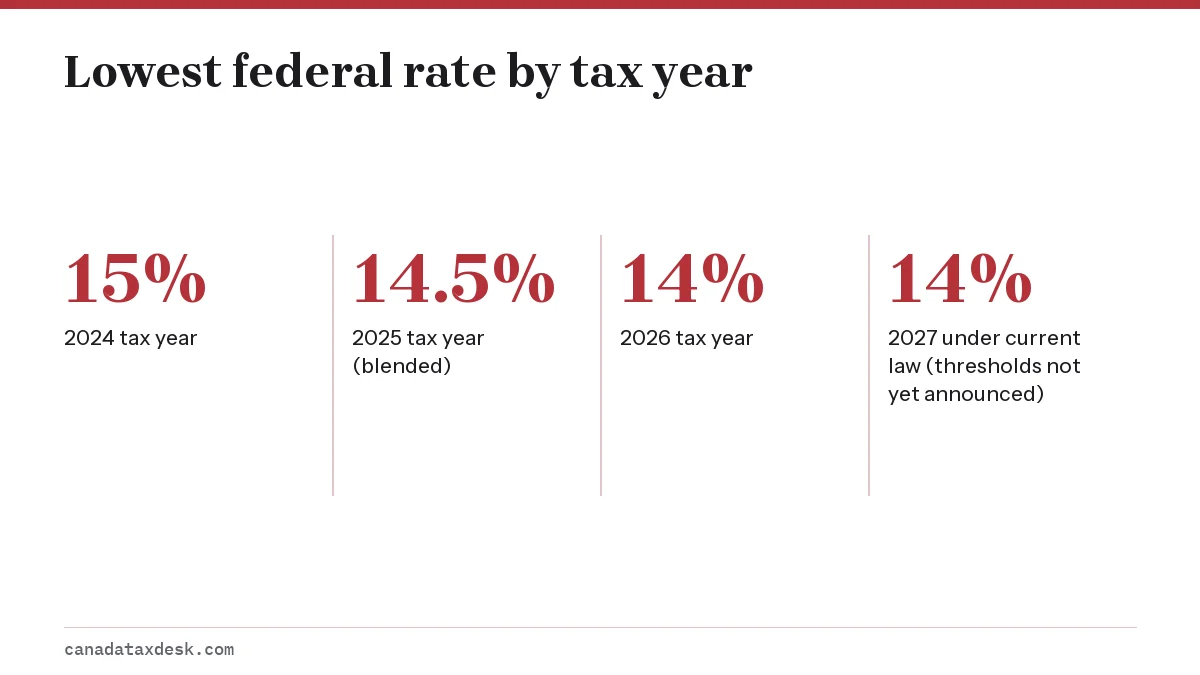
The 14% tax rate in Canada is the lowest federal income tax rate, charged on the first $58,523 of taxable income for 2026. It replaced the old 15% rate on July 1, 2025, so the 2025 return used a blended 14.5% and 2026 is the first full year at 14%. Finance Canada estimates the cut saves an individual up to $420 in 2026.
- 01Lowest federal rate, 2026
- 14% on the first $58,523
- 02Date the cut took effect
- July 1, 2025
- 03Rate used on 2025 returns
- 14.5% (blended)
- 04Maximum saving per person, 2026
- Up to $420 (Finance Canada)
- 05Two-income family saving, 2026
- Up to $840 (Finance Canada)
Is the lowest federal tax rate in Canada now 14%?
Yes. For the 2026 tax year the 14 tax rate in Canada applies to taxable income up to $58,523, according to the CRA's current-year rates page. Income above that threshold moves into the 20.5%, 26%, 29% and 33% bands, which did not change.
The lowest tax bracket is the first band of taxable income in the federal rate table. Everyone who pays federal tax has at least part of their income in it, which is why a one-point cut to this band reaches almost every taxpayer. Finance Canada's June 2026 report on the cut says it produces tax savings for nearly 22 million Canadians.
| Province or territory | First provincial bracket | Combined rate on those dollars |
|---|---|---|
| Alberta | 8% to $61,200 | 22% |
| British Columbia | 5.6% to $50,363 | 19.6% |
| Manitoba | 10.8% to $47,564 | 24.8% |
| New Brunswick | 9.4% to $52,333 | 23.4% |
| Newfoundland and Labrador | 8.7% to $44,678 | 22.7% |
| Northwest Territories | 5.9% to $53,003 | 19.9% |
| Nova Scotia | 8.79% to $30,995 | 22.79% |
| Nunavut | 4% to $55,801 | 18% |
| Ontario | 5.05% to $53,891 | 19.05% |
| Prince Edward Island | 9.5% to $33,928 | 23.5% |
| Saskatchewan | 10.5% to $54,532 | 24.5% |
| Yukon | 6.4% to $58,523 | 20.4% |
Quebec is not shown: Quebec residents reduce their federal tax by the 16.5% Quebec abatement and pay provincial tax to Revenu Québec at its own rates. Among the rest, Nunavut has the lowest combined starting rate at 18% and Manitoba the highest at 24.8%.
The change is written into law. Bill C-4 received Royal Assent on March 12, 2026, and set the rate at 14.5% for 2025 and 14% for 2026 and later years. For the full table of all five federal bands, see our 2026 tax brackets guide.
When did the federal tax cut to 14 percent take effect?
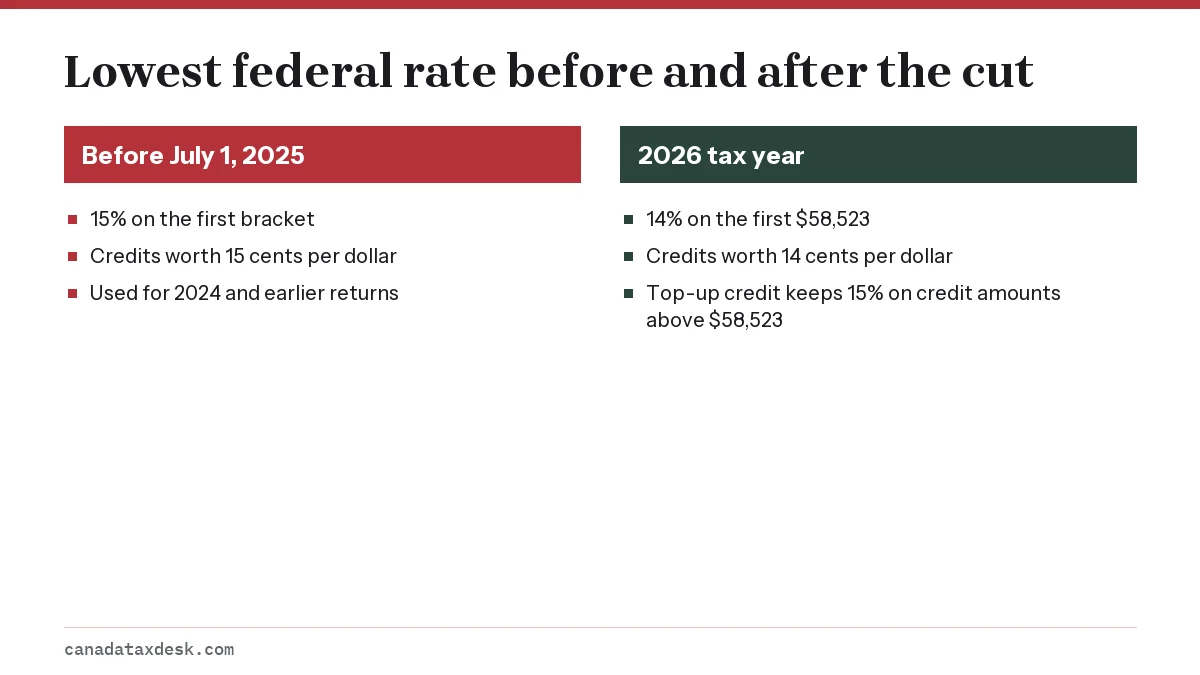
The federal tax cut to 14 percent started on July 1, 2025. From January to June 2025 the bottom rate was still 15%, so no single annual rate described 2025 accurately.
Why the 2025 return showed 14.5%
Income tax is calculated once for the whole year, not month by month. To reflect six months at 15% and six months at 14%, Parliament set a single 14.5% rate for the 2025 tax year. That is the rate you saw on the return filed in spring 2026, even though nobody was taxed at 14.5% in any particular pay period.
The 2026 return, due April 30, 2027 for most people, is the first one where the minimum tax bracket rate is a straight 14% from January to December. Our 2027 season changes page lists the other updates that apply to that return.
How much does the 14% rate save you in 2026?
The most a single person saves from the tax cut in Canada in 2026 is about $420, and a household with two earners can save up to $840, according to Finance Canada. The saving is smaller for people with lower income, because the cut only helps on income that is actually taxed.
The $420 figure comes from simple arithmetic. The rate drop is one percentage point on income up to $58,523, but the basic personal amount credit also drops by one point on $16,452. The net gain is 1% of the difference: ($58,523 minus $16,452) x 1% = $420.71.
| Taxable income | Tax cut on income | Loss on basic personal amount credit | Net saving |
|---|---|---|---|
| $16,452 or less | Up to $164.52 | Up to $164.52 | $0 |
| $30,000 | $300.00 | $164.52 | $135.48 |
| $45,000 | $450.00 | $164.52 | $285.48 |
| $58,523 or more | $585.23 | $164.52 | $420.71 |
Anyone whose income is below the basic personal amount already paid no federal tax, so the cut gives them nothing. Above $58,523 the saving stops growing, because higher bands kept their old rates.
Does the rate cut lower my non-refundable tax credits?
Yes, slightly. Most federal non-refundable credits are calculated at the lowest tax rate, so each credit dollar is now worth 14 cents instead of 15. Finance Canada says the value of these credits falls by $5.4 billion in total, while the rate cut reduces income tax by $10.6 billion, so the net effect is a tax reduction.
| Tax year | Basic personal amount | Credit rate | Credit value |
|---|---|---|---|
| 2025 | $16,129 | 14.5% | $2,338.71 |
| 2026 | $16,452 | 14% | $2,303.28 |
| 2026 if the rate had stayed at 15% | $16,452 | 15% | $2,467.80 |
The credits affected include the basic personal amount, the Canada employment amount, the credits for CPP and EI contributions, the age amount, the disability amount, tuition, and medical expenses. For most people the smaller credits are more than offset by the lower tax on income.
Worked example: a $45,000 earner in 2026
Consider an employee with $45,000 of taxable income in 2026 who claims the basic personal amount and the Canada employment amount of $1,501. All of their income sits in the lowest federal band.
- Federal tax on income: $45,000 x 14% = $6,300.00.
- Credits for the basic personal amount and Canada employment amount: ($16,452 + $1,501) x 14% = $2,513.42.
- Federal tax before CPP and EI credits: $6,300.00 minus $2,513.42 = $3,786.58.
- Under the old 15% rate the same steps give $6,750.00 minus $2,692.95 = $4,057.05.
- Difference: $270.47 less federal tax because of the 14% rate.
The actual saving is slightly lower once the credits for CPP and EI contributions are included, because those credits also shrank by one point. Provincial tax is unaffected: each province sets its own lowest rate on its Form 428, and Quebec sets its rates through Revenu Québec.
To see your own figure with provincial tax added, try our Canadian income tax calculator.
What the 14% rate means for your pay and your 2027 filing
Employers calculate federal withholding from the CRA's T4127 payroll formulas, which use 14% for 2026. If your employer applied the correct tables all year, most of the saving already arrived in your pay cheques and will not show up as a bigger refund in 2027.
- If you had two jobs or large side income, withholding may not match the final tax. Your 2026 return settles the difference.
- If you are self-employed, nothing was withheld. The lower rate reduces the balance owing on April 30, 2027 and may lower instalments for 2027.
- If you review your notice of assessment, the federal tax figure on it is calculated with the 14% rate on the first $58,523.
Under current law the rate stays at 14% for 2027. As of October 22, 2026 the 2027 bracket thresholds are not yet announced; the CRA is expected to publish them in November 2026. Our 2027 tax brackets page tracks that release.
Common questions
Is 14% the lowest tax bracket in Canada?
It is the lowest federal rate. Provinces add their own rates on top, and several provincial bottom rates are lower than 14%, such as Ontario at 5.05% and Nunavut at 4% for 2026, so the combined lowest rate depends on where you live.
What are the federal tax brackets in Canada for 2026?
There are five: 14% on the first $58,523 of taxable income, 20.5% up to $117,045, 26% up to $181,440, 29% up to $258,482 and 33% above that. Only the 14% rate changed with the cut; the other four rates are the same as before.
Why does my 2025 return say 14.5% instead of 14%?
The cut started on July 1, 2025, halfway through the year. The law set a blended 14.5% rate for the 2025 tax year to reflect six months at 15% and six months at 14%.
Do I need to do anything to get the 14% rate?
No. Tax software and the CRA apply the rate automatically when your return is assessed, and employers use it in payroll withholding. You do not file a form or make a claim.
Will the 14% rate stay the same in 2027?
Under Bill C-4 the lowest federal rate is 14% for 2026 and later years, so it stays at 14% in 2027 unless Parliament changes the law. The 2027 income threshold for the band is not yet announced.
Does the federal tax cut apply in Quebec?
Yes. Quebec residents calculate federal tax with the same 14% rate before the 16.5% Quebec abatement is applied. Quebec's own provincial rates are separate and set by Revenu Québec.
Sources
- CRA, Canadian income tax rates for individuals, current and previous years canada.ca
- CRA, Tax rates and income brackets for individuals, 2025 canada.ca
- CRA, What you need to know for the 2026 tax-filing season canada.ca
- Finance Canada, Report on the Impact of Reducing the Lowest Marginal Personal Income Tax Rate on Non-Refundable Tax Credits canada.ca
We check figures against these official pages. Rules change; confirm anything that affects a deadline or payment with the agency before you act.
Tell us what happened
Describe your situation and our editors will use it to improve this guide. If you leave your email, we may reply with a pointer to the right page or official contact. We never share your details.
Related guides
 Canada Tax Brackets 2026: Federal and Provincial Rates
The 2026 federal tax brackets in Canada are 14% on the first $58,523 of taxable income, 20.5% up to $117,045, 26% up to $181,440,…
Top-Up Tax Credit: How It Protects Your Credits in 2026
The top-up tax credit is a temporary federal non-refundable credit, claimed on line 34990, that keeps a 15% value on non-refundab…
Income Tax Calculator Canada: Estimate Your 2026 Tax
This income tax calculator for Canada estimates 2026 federal and provincial tax from your taxable income, using the CRA's 2026 br…
Canada Tax Brackets 2027: Release Timing and What to Expect
The Canada tax brackets for 2027 are not yet announced as of October 20, 2026. The CRA usually publishes the indexed federal thre…
Tax Season 2027 Canada: Tax Changes and What's New
The main tax changes for tax season 2027 in Canada apply to 2026 income: the lowest federal rate is 14% for the whole year, the f…