
BC tax brackets for 2026 and the new 5.6% lowest rate
Short answer
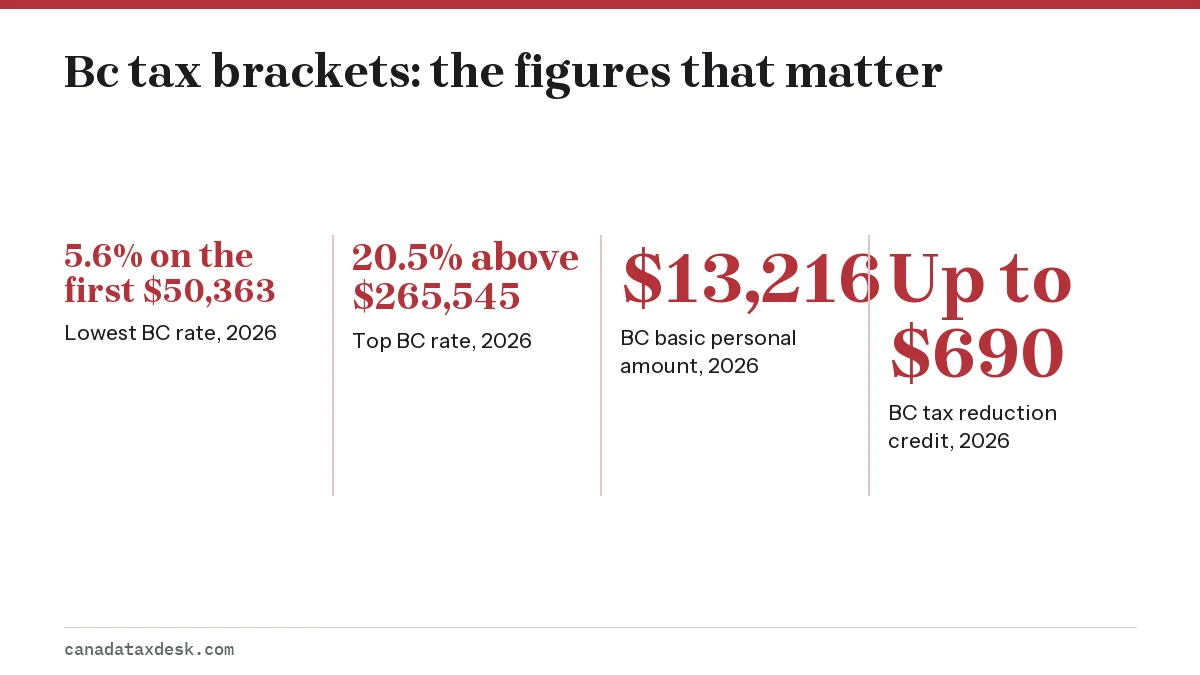
British Columbia's 2026 tax brackets run from 5.6% on the first $50,363 of taxable income to 20.5% on income above $265,545, across seven bands (CRA and Government of BC). The lowest rate rose from 5.06% under BC Budget 2026, and BC has paused indexing its brackets for 2027 to 2030.
- 01Lowest BC rate, 2026
- 5.6% on the first $50,363 (5.06% in 2025)
- 02Top BC rate, 2026
- 20.5% above $265,545
- 03BC basic personal amount, 2026
- $13,216
- 04BC tax reduction credit, 2026
- Up to $690
- 05Top combined rate
- 53.5%
- 06BC brackets for 2027 to 2030
- Indexation paused at 2026 levels
What are the BC tax brackets for 2026?
BC tax brackets for 2026 have seven rates, more than any other province except Newfoundland and Labrador. They are applied to taxable income on Form BC428, which the CRA processes with your T1 return.
| 2026 taxable income | 2026 rate | 2025 range | 2025 rate |
|---|---|---|---|
| $0 to $50,363 | 5.6% | $0 to $49,279 | 5.06% |
| $50,363.01 to $100,728 | 7.7% | $49,279.01 to $98,560 | 7.7% |
| $100,728.01 to $115,648 | 10.5% | $98,560.01 to $113,158 | 10.5% |
| $115,648.01 to $140,430 | 12.29% | $113,158.01 to $137,407 | 12.29% |
| $140,430.01 to $190,405 | 14.7% | $137,407.01 to $186,306 | 14.7% |
| $190,405.01 to $265,545 | 16.8% | $186,306.01 to $259,829 | 16.8% |
| Over $265,545 | 20.5% | Over $259,829 | 20.5% |
Every 2026 threshold rose by BC's 2.2% indexing factor. Only one rate changed: the bottom band went from 5.06% to 5.6%. The other six rates are the same as in 2025.
BC tax brackets 2022 to 2024
BC's lowest rate was 5.06% in each of these years, and every threshold was indexed. These are the CRA's figures, useful for a late return or an old notice of assessment; NETFILE still accepts returns back to 2018 until January 29, 2027.
| Rate | 2022 upper limit | 2023 upper limit | 2024 upper limit |
|---|---|---|---|
| 5.06% | $43,070 | $45,654 | $47,937 |
| 7.7% | $86,141 | $91,310 | $95,875 |
| 10.5% | $98,901 | $104,835 | $110,076 |
| 12.29% | $120,094 | $127,299 | $133,664 |
| 14.7% | $162,832 | $172,602 | $181,232 |
| 16.8% | $227,091 | $240,716 | $252,752 |
| 20.5% | No limit | No limit | No limit |
Why did BC's lowest tax rate go up for 2026?
The lowest BC rate rose because BC Budget 2026 increased it from 5.06% to 5.60% for the 2026 and later tax years. The province paired the change with a larger BC tax reduction credit, raising its maximum by $115 to $690, so that people with lower incomes are partly or fully protected.
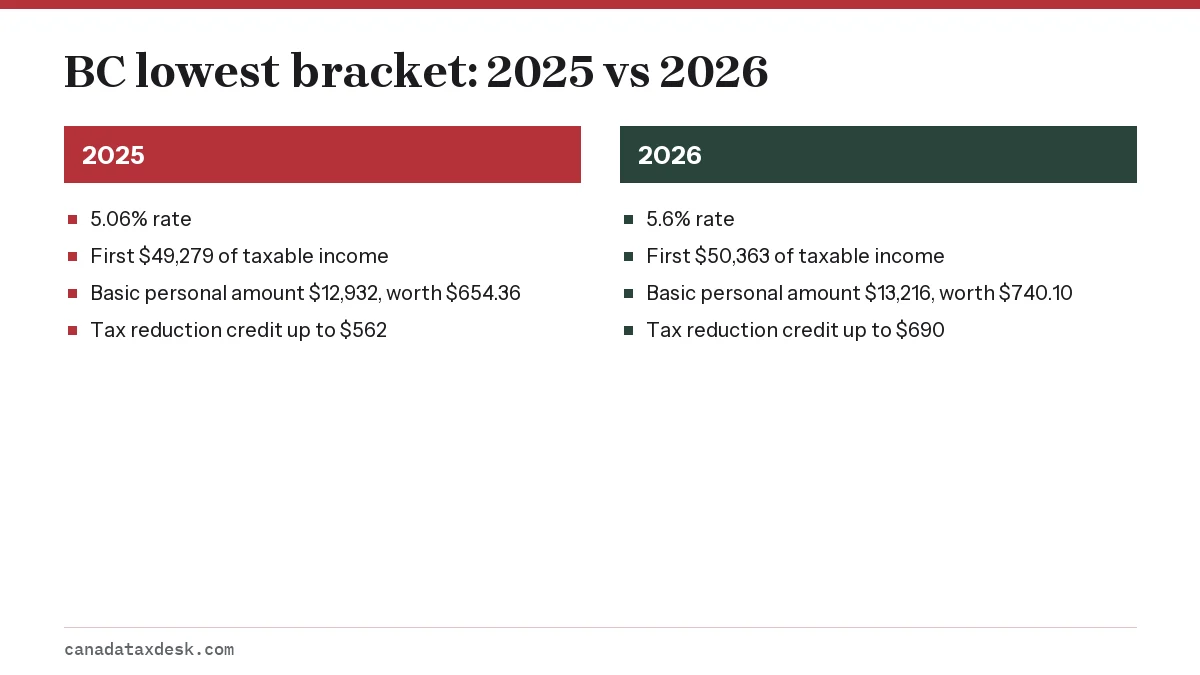
There is a second, less obvious offset. BC calculates its non-refundable credits (basic personal amount, age amount and others) at the lowest BC rate. When that rate went up to 5.6%, every credit became worth more. The BC basic personal amount credit rose from $654.36 in 2025 to $740.10 in 2026.
BC tax brackets combined with federal rates
Adding federal and BC rates band by band gives eleven combined marginal rates for 2026, from 19.6% at the bottom to 53.5% at the top. The combined bands are uneven because the federal thresholds and BC thresholds fall at different dollar amounts.
| Taxable income | Federal | BC | Combined |
|---|---|---|---|
| $0 to $50,363 | 14% | 5.6% | 19.6% |
| $50,363 to $58,523 | 14% | 7.7% | 21.7% |
| $58,523 to $100,728 | 20.5% | 7.7% | 28.2% |
| $100,728 to $115,648 | 20.5% | 10.5% | 31% |
| $115,648 to $117,045 | 20.5% | 12.29% | 32.79% |
| $117,045 to $140,430 | 26% | 12.29% | 38.29% |
| $140,430 to $181,440 | 26% | 14.7% | 40.7% |
| $181,440 to $190,405 | 29% | 14.7% | 43.7% |
| $190,405 to $258,482 | 29% | 16.8% | 45.8% |
| $258,482 to $265,545 | 33% | 16.8% | 49.8% |
| Over $265,545 | 33% | 20.5% | 53.5% |
BC has no surtax or health premium, so the 53.5% top rate is the full story for ordinary income. Ontario's top rate is similar at about 53.53%, but only because of its surtax; our Canada tax brackets guide lists the top rate in every province.
BC personal amounts and the BC tax reduction credit
The BC basic personal amount for 2026 is $13,216, up from $12,932 in 2025. At the 5.6% credit rate it cuts BC tax by $740.10. This is far below Alberta's amount and below the federal $16,452; our basic personal amount page compares all of them.
- Age amount: $5,927 if you are 65 or older on December 31, 2026 and net income is $44,119 or less, phased out at $83,633 (TD1BC 2026).
- Pension income amount: up to $1,000 of eligible pension income (TD1BC 2026).
- Spouse or common-law partner amount: $11,317, reduced when your spouse's net income is above $1,132 (Government of BC).
- Disability amount: $9,913 (Government of BC).
- BC tax reduction credit: up to $690 for 2026. It starts to shrink at net income of $25,570, falls by 3.56% of income above that, and is gone at $44,952 (2025: $562, reduced from $25,020, gone at $40,807).
The tax reduction credit is why a person at $30,000 pays less BC tax in 2026 than in 2025 even though the bottom rate went up. Above about $45,000 the credit no longer applies and the higher rate is felt in full on the first $50,363.
Worked example: BC tax in 2025 vs 2026
The table below runs the same taxable incomes through the 2025 and 2026 BC rules. It assumes the only credits are the BC basic personal amount and the BC tax reduction credit, so real returns with CPP, EI and other credits will be lower.
| Taxable income | 2025 BC tax | 2026 BC tax | Change |
|---|---|---|---|
| $30,000 | $478.93 | $407.61 | $71.32 less |
| $40,000 | $1,340.93 | $1,323.61 | $17.32 less |
| $50,000 | $1,894.67 | $2,059.90 | $165.23 more |
| $75,000 | $3,819.67 | $3,977.28 | $157.61 more |
| $150,000 | $11,997.96 | $11,977.43 | $20.53 less |
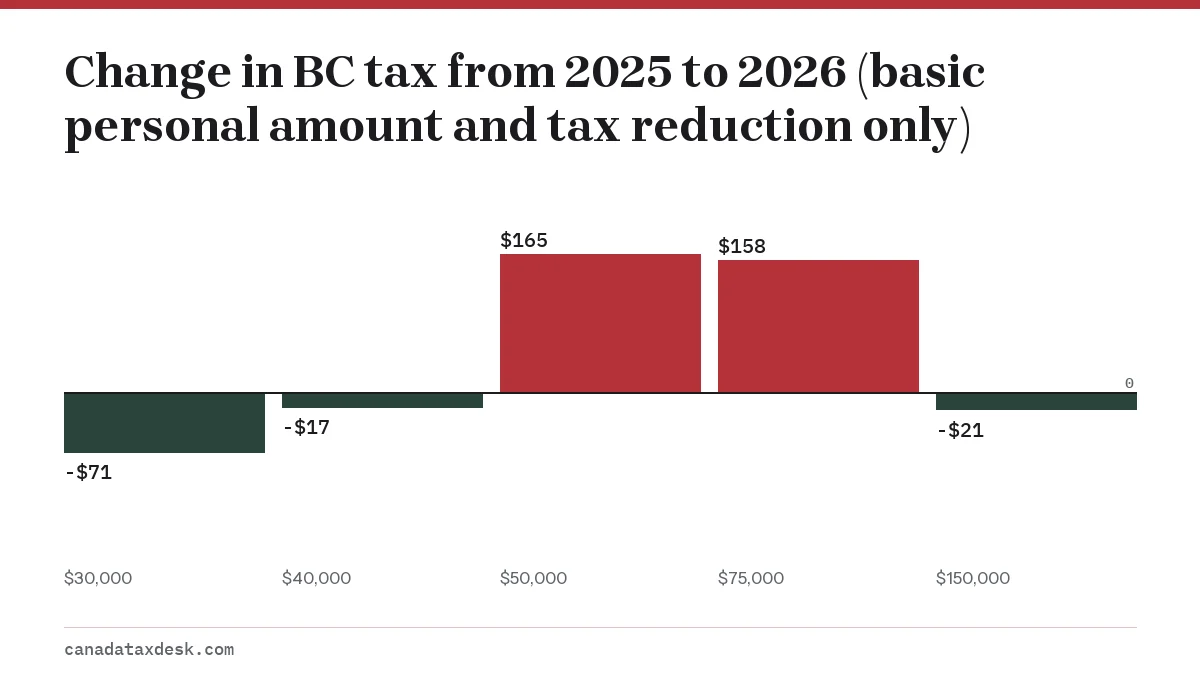
The pattern is clear: people with low incomes gain from the bigger reduction credit, middle incomes pay somewhat more, and high incomes come out about even because 2.2% indexing widened every band. The Government of BC estimated the average increase at $76 for 2026 and said more than 40% of taxpayers would save once the larger reduction credit is counted.
Here is how the $75,000 figure for 2026 is built: $50,363 at 5.6% is $2,820.33; the next $24,637 at 7.7% is $1,897.05; together $4,717.38. Subtract the $740.10 basic personal amount credit to get $3,977.28. No tax reduction credit applies at this income.
What happens to BC tax brackets in 2027?
BC Budget 2026 paused indexation of provincial brackets and non-refundable credits for the 2027 to 2030 tax years, holding them at 2026 levels. Unless the province changes that plan, the 2027 BC table will match the 2026 table above, including the $13,216 basic personal amount. Indexation is set to resume for the 2031 tax year.
Federal 2027 brackets are a separate matter: as of October 22, 2026 they are not yet announced, and the CRA is expected to release them in November 2026. Our 2027 tax brackets page will list them when they are published. If you moved to BC from another province, remember that your province of residence on December 31 decides which Form 428 you file; compare Alberta tax brackets or Quebec tax brackets if that applies to you.
Common questions
What is the lowest BC tax rate for 2026?
It is 5.6% on the first $50,363 of taxable income. BC Budget 2026 raised it from 5.06%, which was the 2025 rate.
What are the combined BC and federal tax brackets for 2026?
Combined, the 2026 federal and BC rates form eleven bands, from 19.6% on the first $50,363 of taxable income to 53.5% above $265,545. BC has no surtax, so those are the full marginal rates on ordinary income.
Why do I owe BC tax this year when I got a refund before?
Payroll withholding only switched to the 5.6% rate after July 1, 2026, so tax held back in the first half of 2026 may be too low. A small balance owing on the 2026 return is possible for middle-income earners.
How much can I earn in BC before paying provincial tax?
With only the basic personal amount and the BC tax reduction credit, BC tax stays at zero until taxable income is roughly $25,500 in 2026. CPP, EI and other credits raise that point further.
Will BC tax brackets change in 2027?
The BC government paused indexation for 2027 to 2030, so the provincial thresholds and credits are set to stay at 2026 levels. The federal 2027 brackets are not yet announced.
What is the top marginal tax rate in BC?
It is 53.5% on taxable income over $265,545 in 2026: 33% federal plus 20.5% provincial. BC has no surtax on top of that.
Sources
- CRA, Canadian income tax rates for individuals, current and previous years canada.ca
- CRA, Tax rates and income brackets for individuals, 2025 canada.ca
- Government of BC, Personal income tax rates www2.gov.bc.ca
- Government of BC, Budget 2026 tax changes www2.gov.bc.ca
- Government of BC, B.C. basic personal income tax credits www2.gov.bc.ca
- CRA, TD1BC 2026 British Columbia Personal Tax Credits Return canada.ca
- CRA, Tax rates and income brackets for individuals, all years canada.ca
We check figures against these official pages. Rules change; confirm anything that affects a deadline or payment with the agency before you act.
Tell us what happened
Describe your situation and our editors will use it to improve this guide. If you leave your email, we may reply with a pointer to the right page or official contact. We never share your details.
Related guides
 Canada Tax Brackets 2026: Federal and Provincial Rates
The 2026 federal tax brackets in Canada are 14% on the first $58,523 of taxable income, 20.5% up to $117,045, 26% up to $181,440,…
Alberta Tax Brackets 2026: New 8% Rate and Thresholds
Alberta's 2026 tax brackets are 8% on the first $61,200 of taxable income, 10% up to $154,259, 12% up to $185,111, 13% up to $246…
Quebec Tax Brackets 2026: 14% to 25.75% and Combined Rates
The 2026 Quebec tax brackets are 14% on taxable income up to $54,345, 19% up to $108,680, 24% up to $132,245 and 25.75% above tha…
Basic Personal Amount 2026: $16,452 Federal, All Provinces
The federal basic personal amount for 2026 is $16,452, reduced gradually for net income between $181,440 and $258,482 to a minimu…
Canada Tax Brackets 2027: Release Timing and What to Expect
The Canada tax brackets for 2027 are not yet announced as of October 20, 2026. The CRA usually publishes the indexed federal thre…