
Basic personal amount 2026: federal and provincial amounts, including Ontario
Short answer
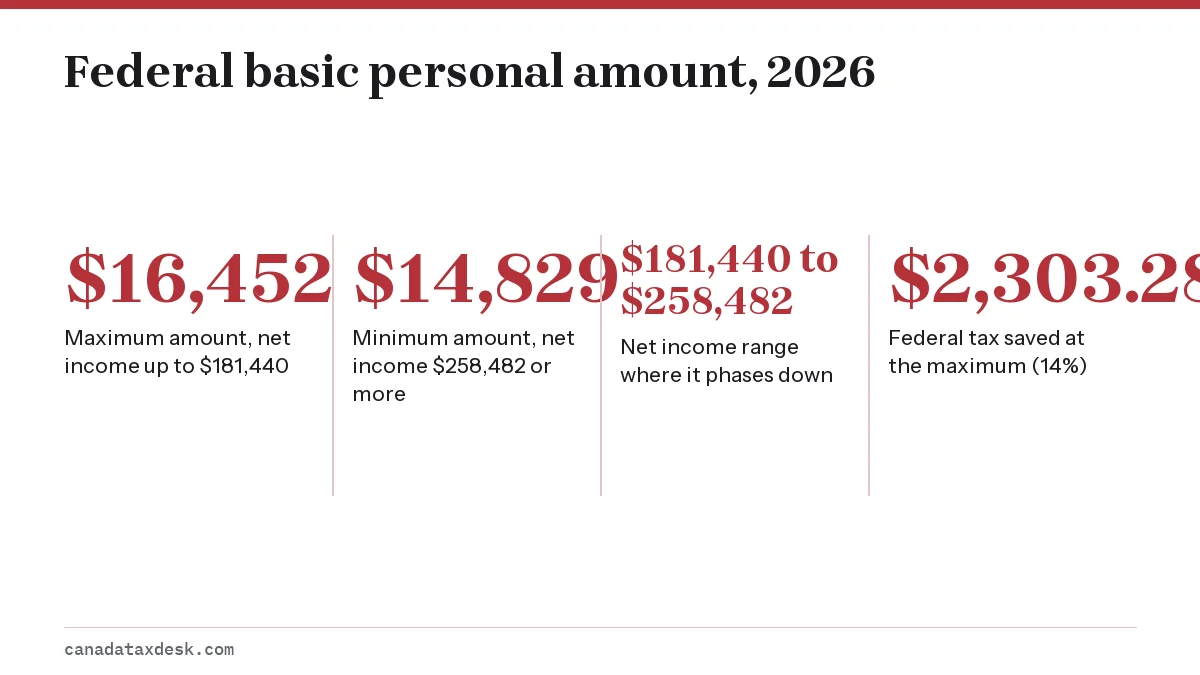
The federal basic personal amount for 2026 is $16,452, reduced gradually for net income between $181,440 and $258,482 to a minimum of $14,829 (CRA, T4127 January 2026). Each province and territory has its own 2026 amount, from $11,188 in Newfoundland and Labrador to $22,769 in Alberta, with Ontario at $12,989. The federal amount is a non-refundable credit worth 14%, or $2,303.28 at the maximum.
- 01Federal basic personal amount, 2026
- $16,452 maximum
- 02Minimum amount at high income
- $14,829 (net income $258,482 or more)
- 03Federal tax saved at the maximum
- $2,303.28 (14%)
- 04Federal amount, 2025
- $16,129 maximum, $14,538 minimum
- 05Provincial amounts, 2026
- $11,188 (NL) to $22,769 (AB); Ontario $12,989
- 062027 amount
- Not yet announced; usually published in November
What is the basic personal amount for 2026?
The basic personal amount 2026 figure is $16,452 at the federal level for anyone with net income of $181,440 or less. The basic personal amount is a non-refundable tax credit that every resident of Canada can claim, so a set slice of income carries no federal tax. It is claimed on line 30000 of the T1 return, and tax software fills it in automatically.
Non-refundable means the credit can bring your federal tax down to zero but cannot create a refund by itself. If your income is low enough that you owe nothing, the unused part of the basic personal amount is lost; it does not carry forward and cannot be transferred to a spouse.
Basic personal amount 2025 compared
For 2025 returns, the federal amount was $16,129 for net income of $177,882 or less and $14,538 for net income above $253,414 (CRA, line 30000). The 2026 figures are 2.0% higher, the federal indexing factor for 2026.
Why is my basic personal amount reduced?
Your federal basic personal amount is reduced if your net income on line 23600 is above $181,440 for 2026. The extra $1,623 above the $14,829 floor shrinks in a straight line across the $77,042 range up to $258,482, where only $14,829 remains.
| Net income (line 23600) | Basic personal amount | Federal credit at 14% |
|---|---|---|
| $181,440 or less | $16,452.00 | $2,303.28 |
| $200,000 | $16,061.01 | $2,248.54 |
| $220,000 | $15,639.68 | $2,189.55 |
| $240,000 | $15,218.35 | $2,130.57 |
| $258,482 or more | $14,829.00 | $2,076.06 |
To work out your own figure: subtract $181,440 from your net income, multiply the result by $1,623 divided by $77,042, and subtract that from $16,452. The Federal Worksheet in the tax package does the same calculation. Note that the test uses net income, not taxable income, so a larger RRSP deduction can raise your amount; see line 23600 net income for what counts.
What are the provincial basic personal amounts for 2026?
Each province and territory except Quebec sets its own basic personal amount, which goes on line 58040 of its Form 428. The 2026 amounts range from $11,188 in Newfoundland and Labrador to $22,769 in Alberta, according to the CRA's T4127 payroll guide and Form TD1ON for Ontario.
| Province or territory | 2025 amount | 2026 amount | 2026 credit value |
|---|---|---|---|
| Alberta | $22,323 | $22,769 | $1,821.52 (8%) |
| British Columbia | $12,932 | $13,216 | $740.10 (5.6%) |
| Manitoba | $15,780 | $15,780 | $1,704.24 (10.8%) |
| New Brunswick | $13,396 | $13,664 | $1,284.42 (9.4%) |
| Newfoundland and Labrador | $11,067 | $11,188 | $973.36 (8.7%) |
| Nova Scotia | $11,744 | $11,932 | $1,048.82 (8.79%) |
| Ontario | $12,747 | $12,989 | $655.94 (5.05%) |
| Prince Edward Island | $14,650 | $15,000 | $1,425.00 (9.5%) |
| Saskatchewan | $19,491 | $20,381 | $2,140.01 (10.5%) |
| Northwest Territories | $17,842 | $18,198 | $1,073.68 (5.9%) |
| Nunavut | $19,274 | $19,659 | $786.36 (4%) |
| Yukon | Same as federal | Same as federal ($16,452 maximum) | $1,052.93 (6.4%) at the maximum |
Manitoba kept its amount at $15,780 and reduces it at high incomes; for 2025 it phased out between $200,000 and $400,000 of net income. Yukon follows the federal amount, including the federal reduction. Quebec residents claim a Quebec amount on the separate Revenu Quebec return; see Quebec tax brackets.
A bigger amount does not always mean a bigger saving, because each province multiplies its amount by its own lowest rate. Nunavut's $19,659 saves $786.36, while Manitoba's smaller $15,780 saves $1,704.24. Province-specific detail is on our Alberta tax brackets page and the other provincial pages in this section.
How much can I earn before paying tax in Canada?
For 2026, a person whose only credit is the basic personal amount pays no federal income tax on the first $16,452 of taxable income. Most employees can earn more than that tax-free, because other credits are added on top.
- Canada employment amount: employees add $1,501 for 2026, which raises the federal zero-tax point to about $17,953 of employment income.
- CPP and EI credits: the base CPP contributions and EI premiums you pay also count as non-refundable credits, pushing the point a little higher again.
- Age amount: people 65 or older at year end may claim an extra amount; see our age amount for seniors page.
- Provincial tax: the provincial zero-tax point is different, because it depends on the provincial amount, from $11,188 to $22,769.
So a worker earning $17,000 in Ontario owes no federal tax but may still owe a small amount of Ontario tax, because Ontario's amount is $12,989. Ontario, like some other provinces, has further low-income reductions that can cancel that amount; the Form 428 works this out.
What is the basic personal amount worth in tax dollars?
The federal basic personal amount is worth 14% of the amount in 2026, or $2,303.28 at the $16,452 maximum. Federal non-refundable credits are multiplied by the lowest federal rate, which fell to 14% for 2026 after a blended 14.5% for 2025 and 15% before that.
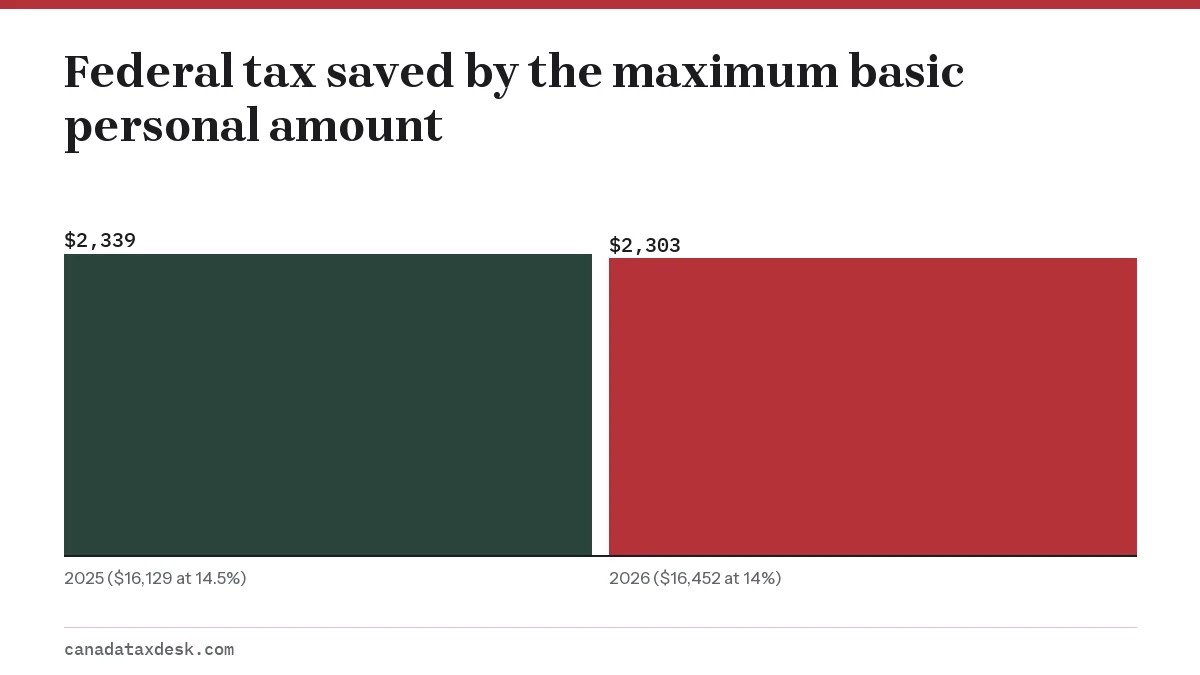
The rate cut means the credit itself is worth slightly less per dollar than before, even though the amount grew. For 2025, $16,129 at 14.5% gave $2,338.71. The lower rate still leaves most people ahead, because 14% also applies to the first $58,523 of income; see the 14% lowest tax rate for the full effect.
People with large total credits get some of the lost value back. A temporary top-up tax credit keeps a 15% rate on non-refundable credit amounts above the first bracket threshold for 2025 to 2030. The basic personal amount alone never reaches that threshold, so it only matters when your credits add up to a large total.
What will the basic personal amount be for 2027?
The 2027 basic personal amount is not yet announced as of October 2026. The CRA usually publishes indexed amounts for the next year in November, and the federal amount rises with the federal indexing factor set for 2027.
Any figure you see before November is a projection. When the CRA releases the numbers, our Canada tax brackets guide and its 2027 companion page will carry them. Your January 2027 pay stub will be the first place the new amount shows up, because employers use it on the TD1 form for payroll.
Common questions
Do I need to apply for the basic personal amount?
No. It is claimed on line 30000 of your return, and tax software or the CRA's calculation adds it for every resident filer. For payroll, you confirm it on your TD1 form for each employer.
Can I claim the basic personal amount with two jobs?
You can only claim it once per year on your return. If both employers apply it through TD1 forms, too little tax is withheld and you will likely owe at filing time, so claim it with one employer and enter zero on the other TD1.
Does the basic personal amount reduce my refund if I have no income?
No. It is non-refundable, so with no tax owing it simply goes unused. You should still file, because a return is needed for benefits such as the GST/HST credit and Canada Child Benefit.
Is the basic personal amount the same as the tax-free threshold?
Close but not identical. With only this credit, the first $16,452 of taxable income is federally tax-free for 2026, but other credits such as the Canada employment amount raise the real threshold.
What was the basic personal amount in 2025?
The 2025 federal amount was $16,129 for net income of $177,882 or less, reducing to $14,538 above $253,414. At the 2025 blended 14.5% rate, the maximum was worth $2,338.71.
What was the basic personal amount in 2022?
The 2022 federal basic personal amount was $14,398 for net income of $155,625 or less, reducing to $12,719 for net income of $221,708 or more (CRA payroll deductions tables, January 2022). Each province's 2022 amount is on line 58040 of its 2022 Form 428.
Sources
- CRA, T4127 Payroll Deductions Formulas, January 2026 canada.ca
- CRA, Line 30000 Basic personal amount canada.ca
- CRA, Canadian income tax rates for individuals, current and previous years canada.ca
- CRA, TD1ON 2026 Ontario Personal Tax Credits Return canada.ca
- CRA, What you need to know for the 2026 tax-filing season canada.ca
We check figures against these official pages. Rules change; confirm anything that affects a deadline or payment with the agency before you act.
Tell us what happened
Describe your situation and our editors will use it to improve this guide. If you leave your email, we may reply with a pointer to the right page or official contact. We never share your details.
Related guides
 Canada Tax Brackets 2026: Federal and Provincial Rates
The 2026 federal tax brackets in Canada are 14% on the first $58,523 of taxable income, 20.5% up to $117,045, 26% up to $181,440,…
Canada's 14% Tax Rate: What the Rate Cut Means for You
The 14% tax rate in Canada is the lowest federal income tax rate, charged on the first $58,523 of taxable income for 2026. It rep…
Top-Up Tax Credit: How It Protects Your Credits in 2026
The top-up tax credit is a temporary federal non-refundable credit, claimed on line 34990, that keeps a 15% value on non-refundab…
Age Amount Tax Credit 2026: Up to $9,208 at 65 and Older
The federal age amount tax credit for 2026 in Canada is up to $9,208 for anyone 65 or older on December 31, 2026. It shrinks by 1…
Alberta Tax Brackets 2026: New 8% Rate and Thresholds
Alberta's 2026 tax brackets are 8% on the first $61,200 of taxable income, 10% up to $154,259, 12% up to $185,111, 13% up to $246…
Canada Tax Brackets 2027: Release Timing and What to Expect
The Canada tax brackets for 2027 are not yet announced as of October 20, 2026. The CRA usually publishes the indexed federal thre…