
Alberta tax brackets for 2026 and the new 8% rate
Short answer
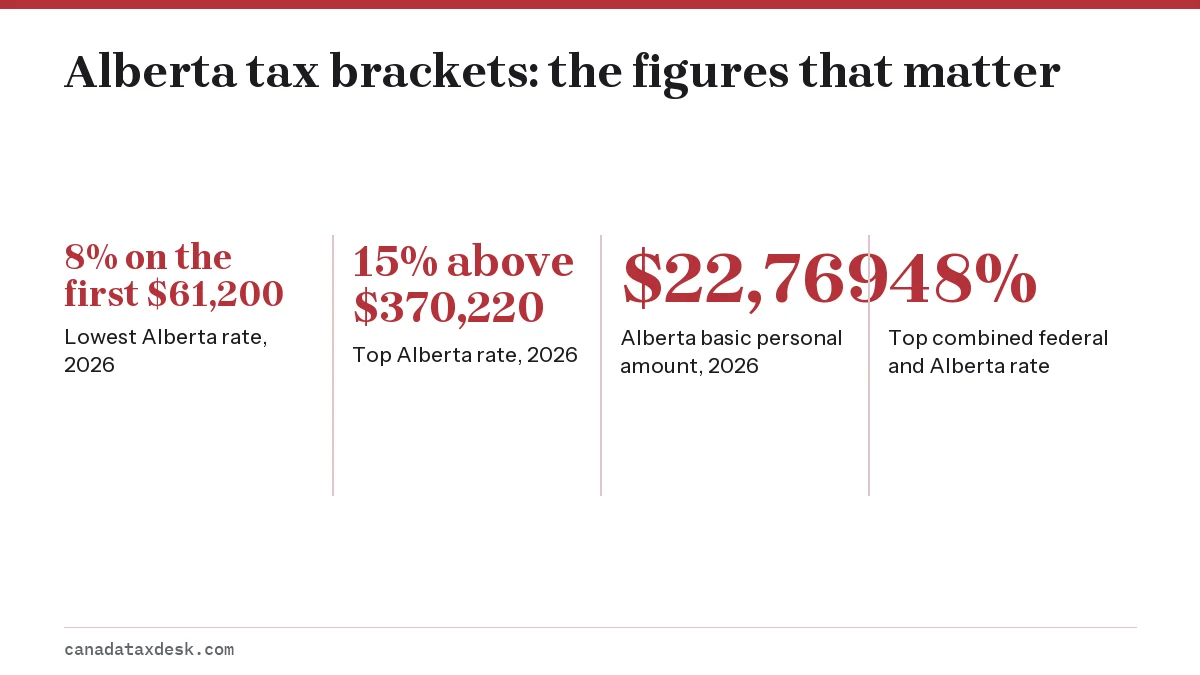
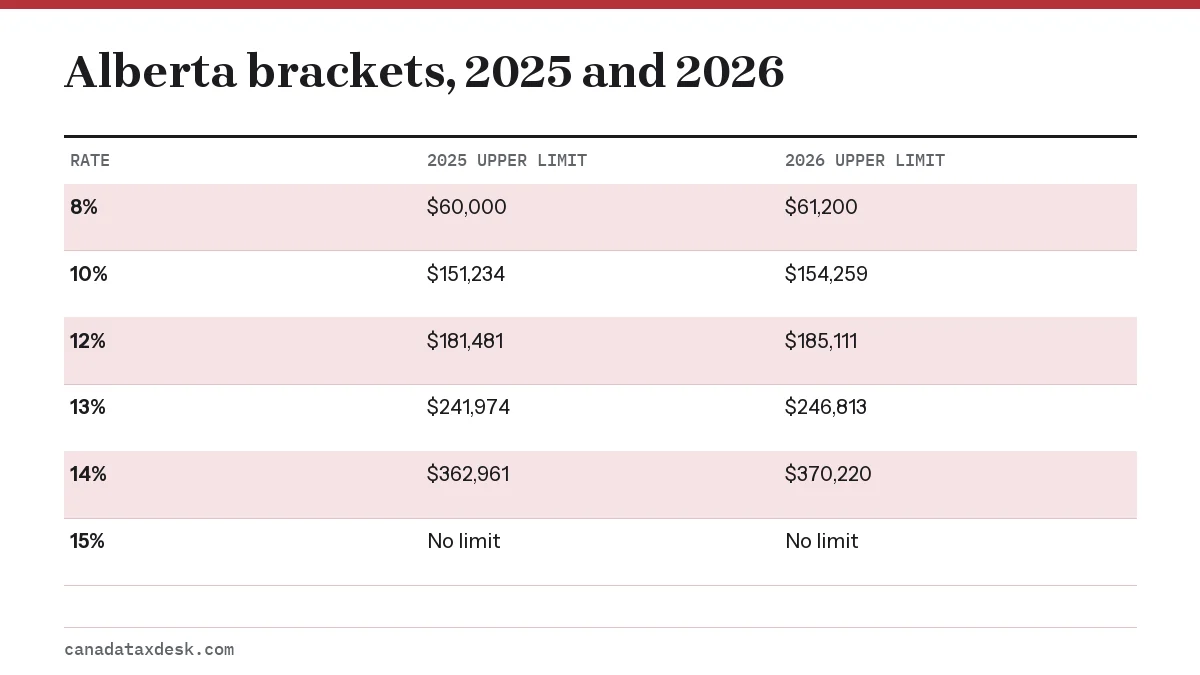
Alberta's 2026 tax brackets are 8% on the first $61,200 of taxable income, 10% up to $154,259, 12% up to $185,111, 13% up to $246,813, 14% up to $370,220 and 15% above that (CRA). Combined with federal tax, the top marginal rate in Alberta is 48%, second-lowest among the provinces after Saskatchewan (47.5%).
- 01Lowest Alberta rate, 2026
- 8% on the first $61,200
- 02Top Alberta rate, 2026
- 15% above $370,220
- 03Alberta basic personal amount, 2026
- $22,769
- 04Top combined federal and Alberta rate
- 48%
- 05Alberta indexing factor, 2026
- 2.0%
What are the Alberta tax brackets for 2026?
Alberta tax brackets for 2026 run from 8% to 15% across six bands, according to the Canada Revenue Agency (CRA). They apply to your taxable income from line 26000 of the T1 return, and the tax is worked out on Form AB428, Alberta Tax and Credits.
| Taxable income | Alberta rate |
|---|---|
| $0 to $61,200 | 8% |
| $61,200.01 to $154,259 | 10% |
| $154,259.01 to $185,111 | 12% |
| $185,111.01 to $246,813 | 13% |
| $246,813.01 to $370,220 | 14% |
| Over $370,220 | 15% |
Every threshold moved up by Alberta's 2.0% indexing factor for 2026, as listed in the CRA's T4127 Payroll Deductions Formulas. Unlike Ontario, Alberta indexes all of its thresholds, so no band is frozen in place.
A tax bracket is a slice of income taxed at one rate. Only the dollars inside each slice pay that slice's rate, so moving into the 10% band does not raise the tax on your first $61,200.
When did Alberta add the 8% bracket?
Alberta's 8% bracket applies from January 1, 2025, on the first $60,000 of taxable income for 2025 and the first $61,200 for 2026. Before 2025, Alberta's lowest rate was 10%, so the new band cut tax on the first slice of income for nearly every Alberta filer.
Some sources give July 1, 2025 as the start date. That was when payroll withholding switched to the new rate; the Government of Alberta says the bracket itself was effective January 1, 2025, so the full-year saving showed up on 2025 returns filed in spring 2026. Alberta estimates the new bracket saved individuals up to $750 in 2025.
The Alberta supplemental tax credit
Alberta non-refundable credits, such as the basic personal amount, are multiplied by the lowest provincial rate. When that rate fell to 8%, people with very large credit claims would have lost value, so Alberta added a non-refundable supplemental tax credit equal to 2% of certain credit amounts above $60,000. It is claimed on line 61545 using Worksheet AB428 (CRA, Alberta tax information for 2025). Most people will not reach it; it mainly helps those with large medical, caregiver or disability claims.
Alberta tax brackets 2025 for comparison
For 2025 returns the Alberta bands were 8% to $60,000, 10% to $151,234, 12% to $181,481, 13% to $241,974, 14% to $362,961 and 15% above. Use these figures if you are still filing or checking a 2025 return.
Alberta tax brackets 2022 to 2024
Before the 8% band, Alberta had five brackets starting at 10%. These are the CRA's figures for the three earlier years, useful if you are filing a late return or checking an old notice of assessment; NETFILE still accepts returns back to 2018 until January 29, 2027.
| Rate | 2022 upper limit | 2023 upper limit | 2024 upper limit |
|---|---|---|---|
| 10% | $134,238 | $142,292 | $148,269 |
| 12% | $161,086 | $170,751 | $177,922 |
| 13% | $214,781 | $227,668 | $237,230 |
| 14% | $322,171 | $341,502 | $355,845 |
| 15% | No limit | No limit | No limit |
Alberta tax brackets combined with federal rates
Your combined marginal rate in Alberta is the federal rate plus the Alberta rate on your next dollar of taxable income. Because the two sets of thresholds do not line up, there are ten combined bands for 2026, ranging from 22% to 48%.
| Taxable income | Federal | Alberta | Combined |
|---|---|---|---|
| $0 to $58,523 | 14% | 8% | 22% |
| $58,523 to $61,200 | 20.5% | 8% | 28.5% |
| $61,200 to $117,045 | 20.5% | 10% | 30.5% |
| $117,045 to $154,259 | 26% | 10% | 36% |
| $154,259 to $181,440 | 26% | 12% | 38% |
| $181,440 to $185,111 | 29% | 12% | 41% |
| $185,111 to $246,813 | 29% | 13% | 42% |
| $246,813 to $258,482 | 29% | 14% | 43% |
| $258,482 to $370,220 | 33% | 14% | 47% |
| Over $370,220 | 33% | 15% | 48% |
Between $181,440 and $258,482 of net income, the federal basic personal amount shrinks, which adds roughly 0.3 percentage points to the real federal rate in that range. Alberta has no provincial surtax and no health premium, so the table above is the full provincial picture. The federal bands are explained on our Canada tax brackets page.
What is the basic personal amount in Alberta for 2026?
The Alberta basic personal amount for 2026 is $22,769, up from $22,323 in 2025 (CRA, T4127 January 2026). It goes on line 58040 of Form AB428 and is credited at 8%, so it lowers Alberta tax by $1,821.52.
That makes Alberta's amount the largest provincial basic personal amount in Canada and well above the federal $16,452. In practice, a resident with only this credit pays no Alberta tax on the first $22,769 of taxable income. The same $22,323 figure was also the 2025 income cut-off for the Alberta spouse or common-law partner amount (line 58120) and amount for an eligible dependant (line 58160). Our basic personal amount page lists every province and territory side by side.
Alberta tax brackets vs Ontario: is Alberta tax lower?
Yes, at most incomes the total provincial charge is lower in Alberta than in Ontario for 2026. Ontario's lower first rate (5.05%) can win on tax alone near $50,000, but once the Ontario Health Premium is added, Alberta comes out ahead at every income in the table below, and the gap widens sharply above about $100,000 because Ontario's surtax kicks in.
| Taxable income | Alberta tax | Ontario tax, surtax and health premium | Alberta saves |
|---|---|---|---|
| $30,000 | $578.48 | $1,159.06 | $580.58 |
| $50,000 | $2,178.48 | $2,469.06 | $290.58 |
| $75,000 | $4,454.48 | $4,747.02 | $292.54 |
| $100,000 | $6,954.48 | $7,127.83 | $173.35 |
| $150,000 | $11,954.48 | $15,170.39 | $3,215.91 |
| $250,000 | $24,550.06 | $34,757.99 | $10,207.93 |
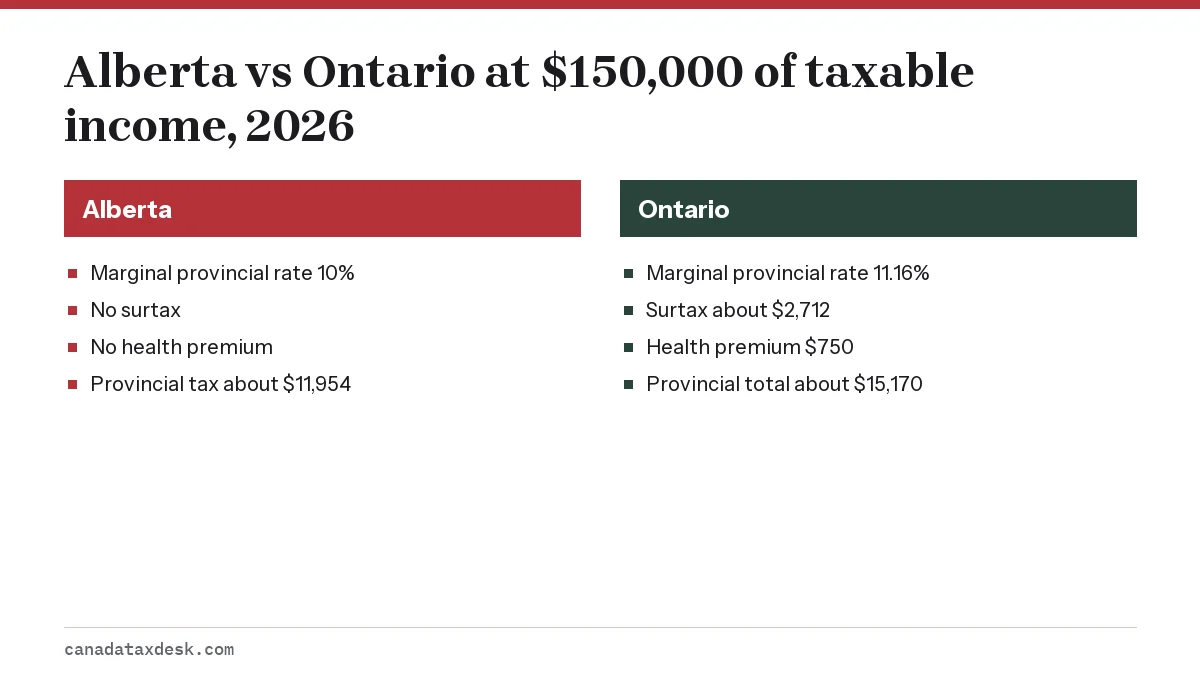
Federal tax is identical in both provinces, so these gaps are the whole difference in income tax. How we worked the $75,000 Alberta line: 8% of $61,200 is $4,896, plus 10% of the next $13,800 is $1,380, for $6,276; subtracting the $1,821.52 personal amount credit leaves $4,454.48.
Real returns include CPP, EI, pension and other credits, which lower both columns. Sales taxes also differ: Ontario charges 13% HST while Alberta has only the 5% GST. Full Ontario detail, including the surtax steps, is on our Ontario tax brackets page, and our income tax calculator guide shows how to run your own numbers.
What if you moved to or from Alberta?
You pay Alberta tax on your whole year's income if you lived in Alberta on December 31, even if you moved there in the fall. Someone who left Alberta for BC in November files Form BC428 instead and pays BC rates for the full year.
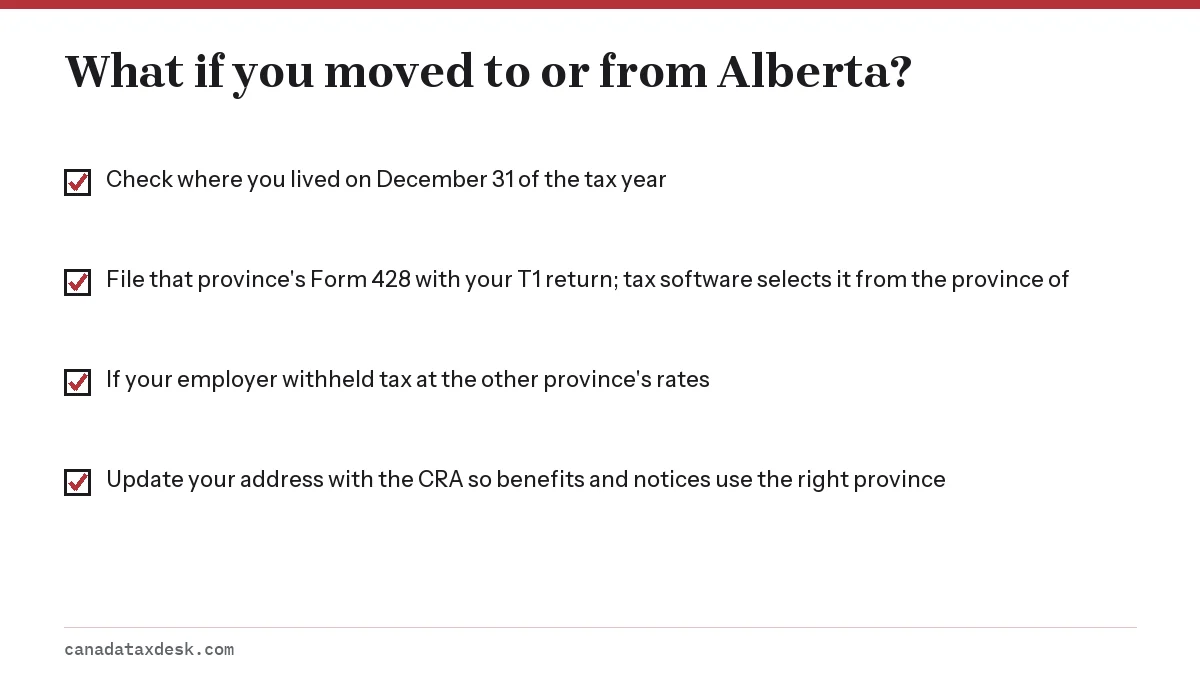
- Check where you lived on December 31 of the tax year.
- File that province's Form 428 with your T1 return; tax software selects it from the province of residence you enter.
- If your employer withheld tax at the other province's rates, expect a refund or balance owing when you file.
- Update your address with the CRA so benefits and notices use the right province.
Moving from Quebec works differently because Quebec residents file a separate provincial return; see Quebec tax brackets. West coast rates are on the BC tax brackets page.
When will the 2027 Alberta tax brackets be released?
As of October 22, 2026, the 2027 Alberta tax brackets and basic personal amount have not been announced. The CRA is expected to publish the 2027 indexed amounts in November 2026, and the Alberta thresholds will rise by whatever indexing factor Alberta sets for 2027. We will post them on our 2027 tax brackets page when they appear.
Common questions
What is the Alberta tax rate on $100,000?
At $100,000 of taxable income in 2026, your next dollar is taxed at 10% by Alberta and 20.5% federally, for a combined marginal rate of 30.5%. Alberta tax on the full $100,000, after the basic personal amount credit, is about $6,954.
Does Alberta have a flat tax?
No. Alberta has six progressive brackets, from 8% on the first $61,200 to 15% above $370,220 for 2026.
What is the highest tax bracket in Alberta?
The highest Alberta bracket for 2026 is 15% on taxable income over $370,220. Combined with the 33% top federal rate, the top marginal rate is 48%.
What is the combined tax rate in Alberta?
For 2026 the combined federal and Alberta marginal rate runs from 22% on the first $58,523 of taxable income to 48% above $370,220, across ten bands. Alberta has no surtax or health premium, so these are the full rates.
Is the Alberta 8% bracket permanent?
The CRA's payroll guide states that the 8% lowest bracket applies for 2025 and later tax years. The threshold is indexed each year, reaching $61,200 for 2026.
Why do I owe Alberta tax when my pay stub looked right?
Common causes are more than one employer each giving you the full basic personal amount, untaxed side income, or a move during the year. Check your T4 slips against your return and adjust your TD1AB form for next year.
Sources
- CRA, Canadian income tax rates for individuals, current and previous years canada.ca
- CRA, Tax rates and income brackets for individuals, 2025 canada.ca
- CRA, T4127 Payroll Deductions Formulas, January 2026 canada.ca
- Government of Alberta, Personal income tax alberta.ca
- CRA, Alberta tax information for 2025 canada.ca
- CRA, Line 30000 Basic personal amount canada.ca
- CRA, Tax rates and income brackets for individuals, all years canada.ca
We check figures against these official pages. Rules change; confirm anything that affects a deadline or payment with the agency before you act.
Tell us what happened
Describe your situation and our editors will use it to improve this guide. If you leave your email, we may reply with a pointer to the right page or official contact. We never share your details.
Related guides
 Canada Tax Brackets 2026: Federal and Provincial Rates
The 2026 federal tax brackets in Canada are 14% on the first $58,523 of taxable income, 20.5% up to $117,045, 26% up to $181,440,…
Ontario Income Tax Brackets 2026: Combined Federal Rates
Ontario's 2026 income tax brackets (CRA) are 5.05% on the first $53,891 of taxable income, 9.15% up to $107,785, 11.16% up to $15…
BC Tax Brackets 2026: British Columbia Income Tax Rates
British Columbia's 2026 tax brackets run from 5.6% on the first $50,363 of taxable income to 20.5% on income above $265,545, acro…
Quebec Tax Brackets 2026: 14% to 25.75% and Combined Rates
The 2026 Quebec tax brackets are 14% on taxable income up to $54,345, 19% up to $108,680, 24% up to $132,245 and 25.75% above tha…
Basic Personal Amount 2026: $16,452 Federal, All Provinces
The federal basic personal amount for 2026 is $16,452, reduced gradually for net income between $181,440 and $258,482 to a minimu…
Income Tax Calculator Canada: Estimate Your 2026 Tax
This income tax calculator for Canada estimates 2026 federal and provincial tax from your taxable income, using the CRA's 2026 br…