
CRA automatic filing: who may qualify and how it will work
Short answer
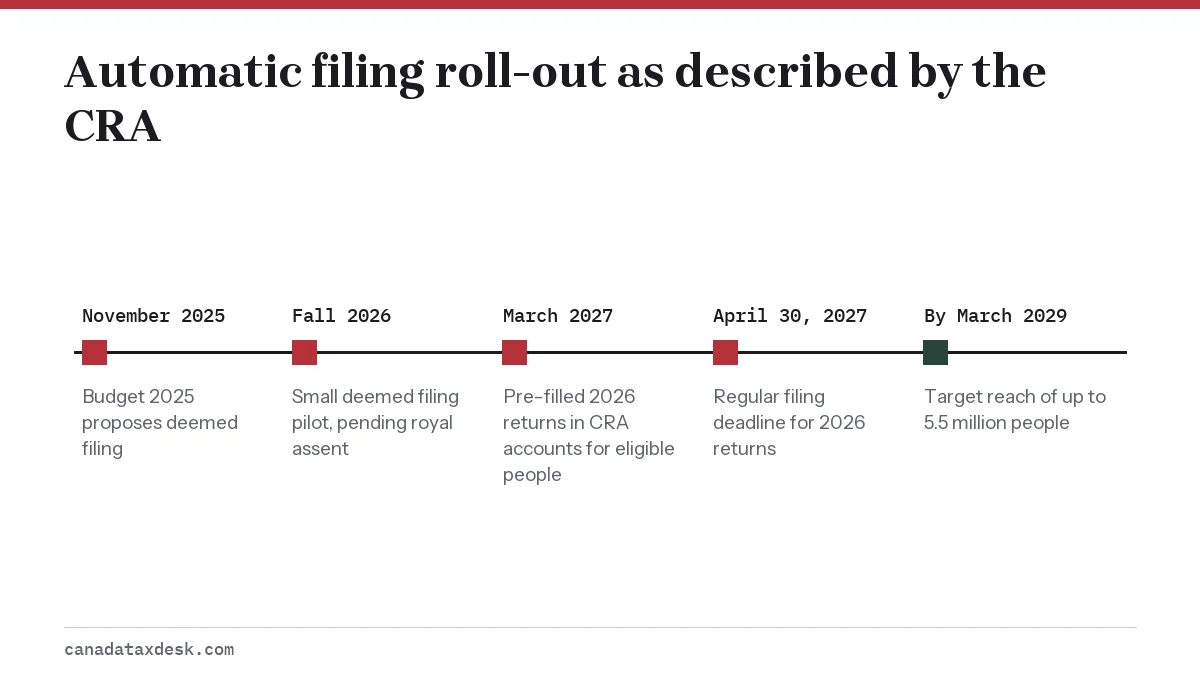
CRA automatic filing is a plan, announced in Budget 2025, for the CRA to file returns for some lower-income people who owe no tax and have not filed. The CRA describes a small deemed filing pilot from fall 2026, pending royal assent, and pre-filled returns to review in your CRA account from March 2027. You get a review window and can opt out.
- 01Announced in
- Budget 2025 (proposed Income Tax Act amendment)
- 02Deemed filing pilot
- Fall 2026, small scale, pending royal assent
- 03Pre-filled returns in CRA account
- From March 2027
- 04Review window before deemed filing
- 90 days from the CRA's notice
- 05Government reach target
- Up to 5.5 million lower-income people
What CRA automatic filing is
CRA automatic filing means the CRA files an income tax return on your behalf, using information it already holds, instead of waiting for you to file. Budget 2025 proposed changing the Income Tax Act to give the CRA discretionary authority to do this for certain individuals, generally those who do not owe tax. The CRA calls this deemed filing.
The point is benefits, not tax collection. People with low incomes who never file often miss the Canada child benefit, the Canada Groceries and Essentials Benefit and provincial payments, because those are calculated from a return. A return filed by the CRA would let those payments be worked out.
Who automatic tax filing in Canada is aimed at
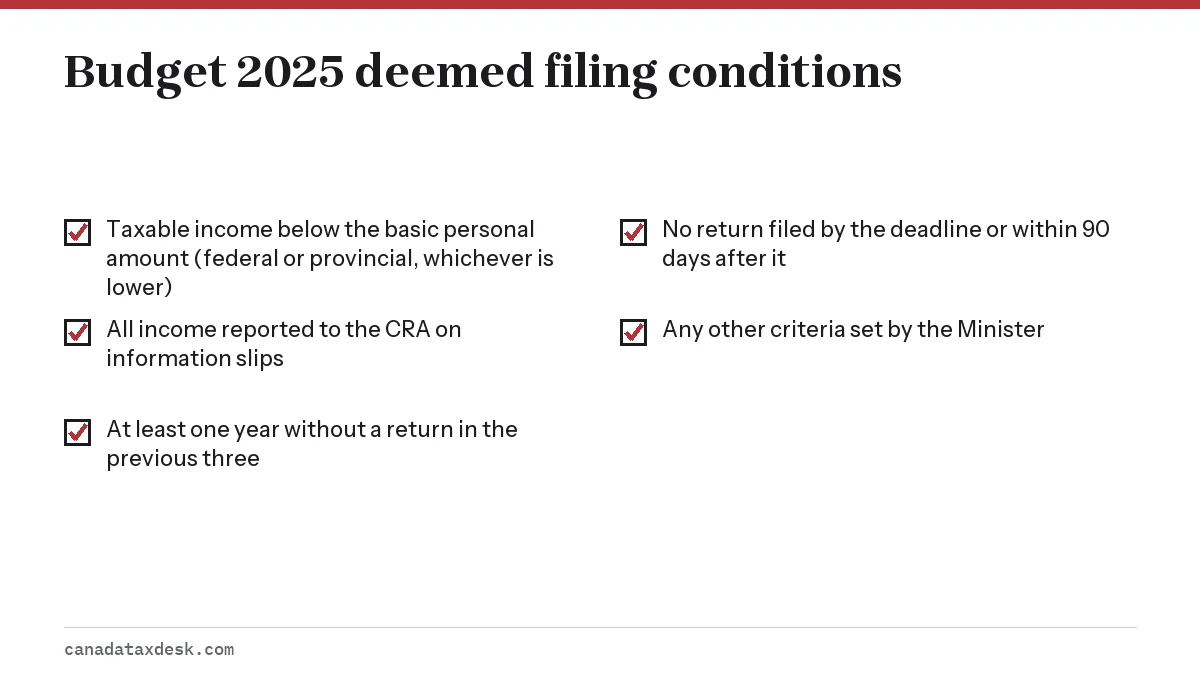
The Budget 2025 measure lists conditions a person would have to meet before the CRA could file for them. In plain terms:
- Taxable income for the year is below the federal basic personal amount or the provincial equivalent, whichever is lower (plus the age amount or disability amount where they apply).
- All of the person's income comes from sources that are reported to the CRA on information slips, such as a T4, T4A or T5007.
- The person has skipped filing a return at least once in the three previous tax years.
- The person has not filed for the year, either before the deadline or within 90 days after it.
- Any other criteria the Minister sets.
So this is not a service for anyone who wants a shortcut. Someone with self-employment income, rental income, or deductions the CRA cannot see would not fit, and anyone who already files each year is outside the deemed filing group by definition.
Read the video transcript
CRA automatic filing: who may qualify and how it will work
CRA automatic filing is a plan, announced in Budget 2025, for the CRA to file returns for some lower-income people who owe no tax and have not filed.
Announced in: Budget 2025 (proposed Income Tax Act amendment).
Deemed filing pilot: Fall 2026, small scale, pending royal assent.
Pre-filled returns in CRA account: From March 2027.
The Budget 2025 measure lists conditions a person would have to meet before the CRA could file for them.
The normal assessment, objection and appeal rules apply to a return the CRA files this way.
A second track is aimed at people who can file but find it hard.
Will the CRA file my taxes automatically? Only if you fit a narrow group: lower income, no tax owing, all income on slips the CRA receives, and a history of not filing.
What happens with your return under deemed filing
- The filing deadline passes and you have not filed.
- About 90 days after the deadline, the CRA sends a notice to your CRA account showing the tax information it has for you.
- You have 90 days from that notice to review it. If something is missing or wrong, you opt out and file your own return to claim what you are entitled to.
- If you do not respond within the 90 days, the CRA can file the return for you.
- The CRA issues a notice of assessment and then works out your benefit and credit entitlements.
The normal assessment, objection and appeal rules apply to a return the CRA files this way. If you disagree with the assessment, you can object, generally within 90 days of the date on the notice, or ask for a change afterwards the same way you would for a return you filed yourself.
Who gets a CRA pre-filled return in March 2027?
A second track is aimed at people who can file but find it hard. From March 2027, the CRA plans to offer eligible lower-income individuals a pre-filled 2026 return inside their CRA account. You review it, make changes if needed, and then either consent to the CRA filing it or decline, according to the CRA's consultation report.
The CRA's consultation report says people would get at least six weeks to review before the April 30, 2027 deadline. The CRA's infographic cites about 1 million eligible people in March 2027 and up to 5.5 million by March 2029 (the 2028 tax year); treat those as targets, not guarantees.
The CRA's easier tax filing page sets out who may be invited. You may get an invitation in your CRA account from March 2027 if you have:
- Filed a 2025 tax return by October 31, 2026.
- A lower income and a simple, non-taxable tax situation.
- A CRA account.
- Your correspondence preference in that account set to electronic mail by October 31, 2026.
So if you want to be considered, sign in to your CRA account or register for one, check your personal information and switch your correspondence preference to electronic mail before October 31, 2026. The CRA describes the service as free and based on information it already has on file; meeting these conditions does not guarantee an invitation.
How CRA automatic filing differs from SimpleFile
SimpleFile already exists. It lets eligible people with low income and simple tax situations file for free by phone, online (SimpleFile Digital) or on a short paper form. The CRA says about 3 million people were eligible in 2026. Invitations go out by mail or to the CRA account, and SimpleFile Digital can also be used without an invitation by people who meet the criteria.
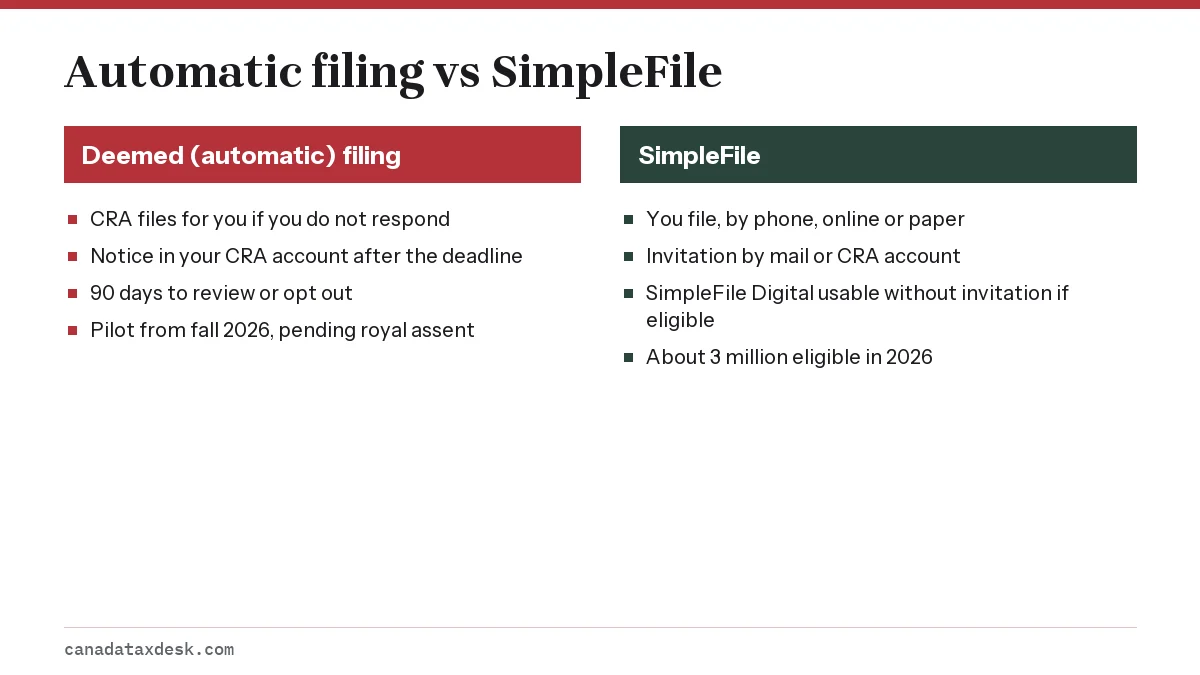
The key difference is who acts. With SimpleFile you still file, just more easily. With deemed filing the CRA files if you do nothing. The SimpleFile invitation page covers the current service in detail.
Can you opt out of automatic tax filing?
Yes. Budget 2025 states that individuals would be able to opt out, and the CRA's consultation report describes opting out as the route for anyone whose information needs changes. Opting out does not remove your filing obligation or your benefits; it means you file the return yourself.
You might prefer to file yourself if you have receipts the CRA does not see, such as medical expenses, tuition or rent-based provincial credits, or if you want to claim a disability amount not yet on file. The fastest way to stay in control is to file by the tax deadline, which keeps you outside deemed filing for that year.
What is still not announced
- Whether the enabling legislation has received royal assent in time for the fall 2026 pilot.
- How many people the pilot and the March 2027 pre-filled returns will actually reach.
- The exact income limit and other tests behind the CRA's lower-income, non-taxable screen for pre-filled returns.
- How provincial credits, and Quebec returns filed with Revenu Quebec, will be handled.
We will update this page when the CRA publishes the 2027 filing-season details, usually in February. Other changes for next season are on our what's new for tax season page, and the regular filing routes are on how to file a tax return in Canada.
Common questions
Will the CRA file my taxes automatically?
Only if you fit a narrow group: lower income, no tax owing, all income on slips the CRA receives, and a history of not filing. Even then you get a 90-day notice and can opt out.
Who qualifies for automatic tax filing in Canada?
Under Budget 2025, people whose taxable income is below the basic personal amount, whose income is all reported on slips, who have missed at least one return in the past three years and who have not filed for the year.
Is automatic filing the same as SimpleFile?
No. SimpleFile is a free, easier way for eligible people to file their own return. Automatic or deemed filing is the CRA filing a return for you if you do not respond to its notice.
When does CRA automatic filing start?
The CRA describes a small deemed filing pilot from fall 2026, pending royal assent, and pre-filled returns in CRA accounts from March 2027 for the 2026 tax year.
What do I need to do by October 31, 2026 to get a pre-filled return?
File your 2025 return, have a CRA account, and set the account's correspondence preference to electronic mail, all by October 31, 2026. Invitations from March 2027 go only to people with a lower income and a simple, non-taxable situation, so these steps make you eligible to be considered rather than guaranteeing an invitation.
Can I change a return the CRA filed for me?
Yes. The usual assessment, objection and appeal rules apply, so you can object to the assessment or request a change the same way as for any other return.
Sources
- Automatic tax filing canada.ca
- Infographic: Automatic tax filing canada.ca
- Automatic Tax Filing Consultation Report canada.ca
- Budget 2025: Tax measures, supplementary information budget.canada.ca
- SimpleFile canada.ca
- The CRA is making tax filing easier canada.ca
We check figures against these official pages. Rules change; confirm anything that affects a deadline or payment with the agency before you act.
Tell us what happened
Describe your situation and our editors will use it to improve this guide. If you leave your email, we may reply with a pointer to the right page or official contact. We never share your details.
Related guides
 How to File a Tax Return in Canada: Complete Guide
How to file a tax return in Canada: collect your slips and receipts, pick a filing method (certified software with NETFILE, a Sim…
Tax Season 2027 Canada: Tax Changes and What's New
The main tax changes for tax season 2027 in Canada apply to 2026 income: the lowest federal rate is 14% for the whole year, the f…
Tax Deadline Canada 2027: When Tax Season Starts and Ends
The tax deadline in Canada for 2026 returns is Friday, April 30, 2027, for both filing and paying. Self-employed people and their…
Late Tax Return Canada: How to File Overdue Tax Returns
A late tax return in Canada costs you a penalty only if you owe tax for that year; otherwise the main cost is delayed refunds and…