
CRA review letter: what it means and how to answer it
Short answer
A CRA review letter asks you to prove an amount you reported or claimed, usually by sending receipts or slips. It is a routine check, and the CRA states it is not an audit. Reply by the date in the letter, quote the reference number, and upload your documents through Submit documents in My Account. If you do not reply, the CRA can deny the claim and reassess.
- 01Is it an audit?
- No; the CRA says a review is not a tax audit
- 02Deadline
- The date printed in your letter
- 03Fastest way to reply
- Submit documents in My Account
- 04Upload limits
- Up to 10 files per session, 150 MB total
- 05Keep records for
- At least six years
What is a CRA review letter?
A CRA review letter is a request for proof. The CRA assesses most returns by computer first so notices go out quickly, and can check selected claims later against receipts or slips from employers and financial institutions. The letter names the tax year, the line or claim being checked, the documents it wants and a date to reply.
Returns are picked for several reasons, according to the CRA: amounts that do not match slips from employers and banks, the type of deduction or credit claimed, your past compliance history, and pure random selection. Getting a letter does not mean the CRA thinks you did something wrong.
CRA review letter vs audit
A review is narrow. It focuses on one or a few specific amounts, is handled by correspondence, and usually ends once you send the requested documents. The CRA's review page states plainly that a review does not represent a tax audit. Audits are a separate and much deeper examination with their own process.
In practice, the difference shows in the scope of what is asked. A review letter might want medical receipts totalling the $3,100 you claimed on line 33099. An audit looks at books and records across the whole return or business. If a review letter asks only for receipts for one claim, you are dealing with a review.
Types of CRA reviews
The CRA runs eight review programs for individual returns. The name of the program, or the timing of the letter, tells you whether your notice of assessment is on hold or whether a reassessment could follow.
| Program | When it happens | What it checks |
|---|---|---|
| Pre-assessment Review | Before the notice of assessment | Income, deductions and credits you claimed |
| Processing Review | After the notice of assessment | The same kinds of amounts, once assessed |
| Request Verification | Before a notice of reassessment | Whether your change request is allowable and supported |
| Matching | After the notice of assessment | Your return against information from employers, financial institutions and other third parties |
| Refund Examination | Before or after assessment | That the correct refund is issued |
| Supplementary Examination | Before or after (re)assessment | Income, losses and deductions needing detailed examination |
| Special Assessments | Before or after assessment | Trends and situations needing a deeper review |
| Identity Protection Services | Before or after assessment | High-risk accounts and suspected identity theft |
Matching and Supplementary Examination letters
A Matching letter comes after your notice of assessment: the CRA has compared your return with information from third parties such as employers and financial institutions, for example when a slip issued in your name does not match what you reported. For questions about a T1 Matching letter the CRA lists 1-866-772-2237, and 1-800-263-4747 for its Pre-Matching program. A Supplementary Examination contact letter concerns income or loss amounts, or deductions, that need a more detailed examination, and can arrive before or after a notice of assessment or reassessment. Both are still reviews: reply with the reference number and the documents listed, the same way as any other review letter.
A letter that arrives before your notice of assessment is covered in detail on our CRA pre-assessment review page, because it freezes the refund until you reply.
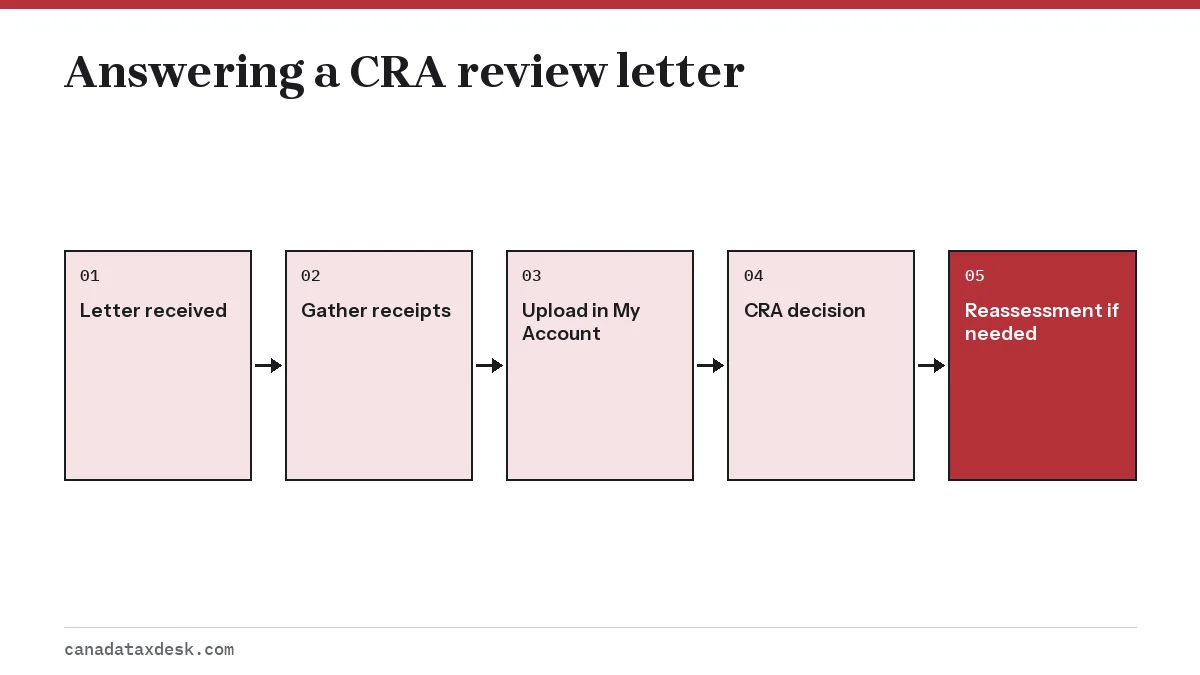
How to respond to a CRA review letter, step by step
A complete first reply is the single biggest factor in how fast a review closes. Send everything the letter lists at once rather than in pieces.
- Find the reference or case number in the upper right corner of the letter and note the reply date.
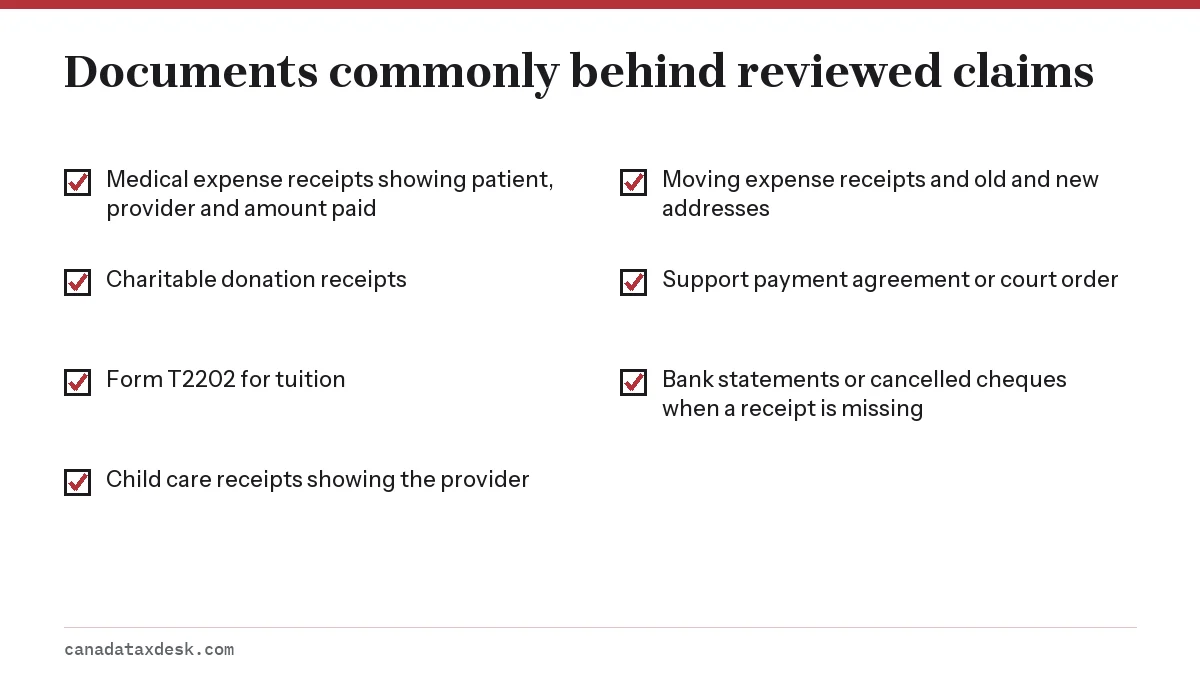
- Gather every document listed. For a missing receipt, write a short explanation and include other proof, such as a bank statement or cancelled cheque.
- Scan each document at 200 dpi or lower, as PDF or JPG where possible.
- Sign in to My Account (or Represent a Client, for an authorized representative) and select Submit documents.
- Enter the tax year and the case or reference number with no spaces, so the files reach the right program.
- Upload up to 10 files in one session, giving each file a unique name (the CRA suggests including the line number), then confirm.
- Save the confirmation number with a copy of what you sent.
Worked example: a medical expense review
Say the letter asks you to support $3,100 of medical expenses on line 33099 of your 2025 return. You have pharmacy printouts for $1,900, a dental receipt for $800, and a physiotherapy clinic that has closed, so the last $400 has no receipt. Upload the two sets of receipts, add your credit card statements showing the three physiotherapy payments, and include a one-paragraph note explaining that the clinic closed and naming the dates and amounts.
That reply gives the reviewer everything in one pass. If the CRA accepts only the $2,700 backed by receipts, the change to your credit is modest: with 2025 net income of $50,000 the 3% threshold is $1,500, so the claim drops from $1,600 to $1,200 and the federal credit falls by $58 at the 14.5% rate. Knowing the stakes helps you decide how much effort a missing receipt deserves.
Writing a reply letter to the CRA
A short cover letter helps the reviewer match your documents to the file. Put the reference number from the upper right corner of the CRA's letter at the top, then your name, the tax year and the claim being reviewed, followed by a numbered list of what you enclosed. Where a receipt is missing, explain why in a sentence or two and point to the other proof you included. Keep it factual: there is no need to argue the law at this stage.
Replying by mail
You can mail copies to the address printed in the letter instead. Put the reference number on every page and keep the originals. Mail is slower and gives you no instant confirmation, so upload online if you can.
File formats the upload accepts
The CRA's online portal accepts .pdf, .doc, .docx, .xls, .xlsx, .rtf, .txt, .jpg, .jpeg, .tif, .tiff and .xps files, up to 150 MB per submission. A representative needs level 2 authorization to upload for a client.
CRA review letter deadline and extensions
There is no single deadline for every review. The reply date is set in your letter, and that is the date that counts. If you cannot meet it, for example because a clinic needs time to reprint receipts, call the number at the bottom of your letter before the date passes and ask for more time.
If the date passes with no reply, the CRA can finish the review with what it has. For a claim it cannot verify, that usually means reducing or denying the claim and issuing a notice of reassessment. On a $3,100 medical claim, losing the credit could mean a new CRA balance owing with interest.
After you respond: processing time and outcomes
The CRA does not publish a single processing time for reviews. Its service standards for returns exclude cases where it has to contact you for more information, so the clock depends on the program, the season and how complete your reply was. Watch the progress tracker and your My Account mail rather than sending the same documents twice.
- Claim accepted: the file closes. If the review happened before assessment, your notice of assessment follows.
- Claim changed: you receive a notice of reassessment explaining the change, with any refund or balance.
- New documents later: the CRA says it accepts new submissions after a claim is changed and will look at it again.
If you disagree with the result
Start by sending any extra proof you have. If the CRA still refuses and you believe it applied the law incorrectly, you can file a formal objection, generally within 90 days of the date on the notice. The steps are on our notice of reassessment page, and the whole post-filing sequence is mapped in the after you file guide.
CRA reviews now run year-round
Review letters used to arrive in seasonal waves, mostly in the months after the filing deadline. That changed in 2026: the CRA said that effective April 2026 it would conduct post-assessment reviews of individual income tax and benefit returns on a year-round basis.
The practical effect is that a letter in October about a return filed in April is now ordinary rather than unusual. It does not mean your return was singled out, and it does not change what the letter asks for or how long you have to answer.
Step by step
Read the letter
Note the reference number, the claim being checked, the documents requested and the reply date.
Gather proof
Collect every listed receipt or slip, or write an explanation with alternative proof for anything missing.
Scan the documents
Scan at 200 dpi or lower in an accepted format such as PDF or JPG.
Upload in My Account
Use Submit documents, enter the tax year and reference number, upload up to 10 files and confirm.
Track the outcome
Save the confirmation number and watch My Account mail for the decision or a reassessment.
Common questions
Why did I get a review letter from the CRA?
The CRA selects returns when amounts do not match third-party slips, when certain deductions or credits are claimed, because of past compliance history, or at random. It is a check on specific amounts, not an accusation.
Is a CRA review the same as an audit?
No. The CRA states that a review is not a tax audit. A review asks for proof of specific amounts by correspondence, while an audit examines records in much more depth.
How long do I have to respond to a CRA review letter?
Use the reply date printed in your letter. If you need more time, call the number at the bottom of the letter before that date and ask for an extension.
What happens if I ignore a CRA review letter?
The CRA can decide the review without your documents, which usually means reducing or denying the claim and sending a notice of reassessment. Any resulting balance collects interest.
How do I send documents to the CRA for a review?
Use Submit documents in My Account, enter the tax year and the reference number from the letter with no spaces, and upload up to 10 files. You can also mail copies to the address in the letter.
Can I send documents after the CRA changed my claim?
Yes. The CRA says it accepts new submissions after a claim is adjusted and will review the claim again for a possible adjustment.
What is a matching letter from the CRA?
It is a letter from the CRA's Matching program, which compares your return after assessment with information from third parties such as employers and financial institutions. If something does not match, the letter tells you what the CRA found and what it needs from you; reply by the date in the letter. Questions about a T1 Matching letter go to 1-866-772-2237.
Is a Supplementary Examination contact letter an audit?
No. Supplementary Examination is one of the CRA's eight review programs for individual returns. It looks at income or loss amounts and deductions that need a more detailed examination, and you answer it like any review letter: send the listed documents with the reference number by the date in the letter.
Sources
- Review of your tax return by the CRA canada.ca
- Types of reviews (CRA) canada.ca
- Responding to us (CRA) canada.ca
- Submitting documents online (CRA) canada.ca
- How tax returns are selected for review (CRA) canada.ca
- EFILE news and program updates (Canada.ca) canada.ca
We check figures against these official pages. Rules change; confirm anything that affects a deadline or payment with the agency before you act.
Tell us what happened
Describe your situation and our editors will use it to improve this guide. If you leave your email, we may reply with a pointer to the right page or official contact. We never share your details.
Related guides
 After You File Your Tax Return: CRA Timeline Explained
The CRA tax return timeline starts the moment your return is received. For a return filed online, the CRA's service standard is a…