
T5 slip in Canada: interest, dividends and where they go
Short answer
A T5 slip in Canada is the Statement of Investment Income that banks, brokers and corporations issue for interest, dividends and similar income earned outside a registered account. Box 13 interest goes on line 12100. Box 25 eligible dividends and box 11 other dividends go on line 12000. You must report investment income even when no T5 arrives.
- 01Slip deadline
- Last day of February after the year
- 02Box 13 interest
- Line 12100
- 03Box 25 and box 11 dividends
- Line 12000 (box 11 also on 12010)
- 04No slip under
- $50 of investment income, but you still report it
What is a T5 slip in Canada?
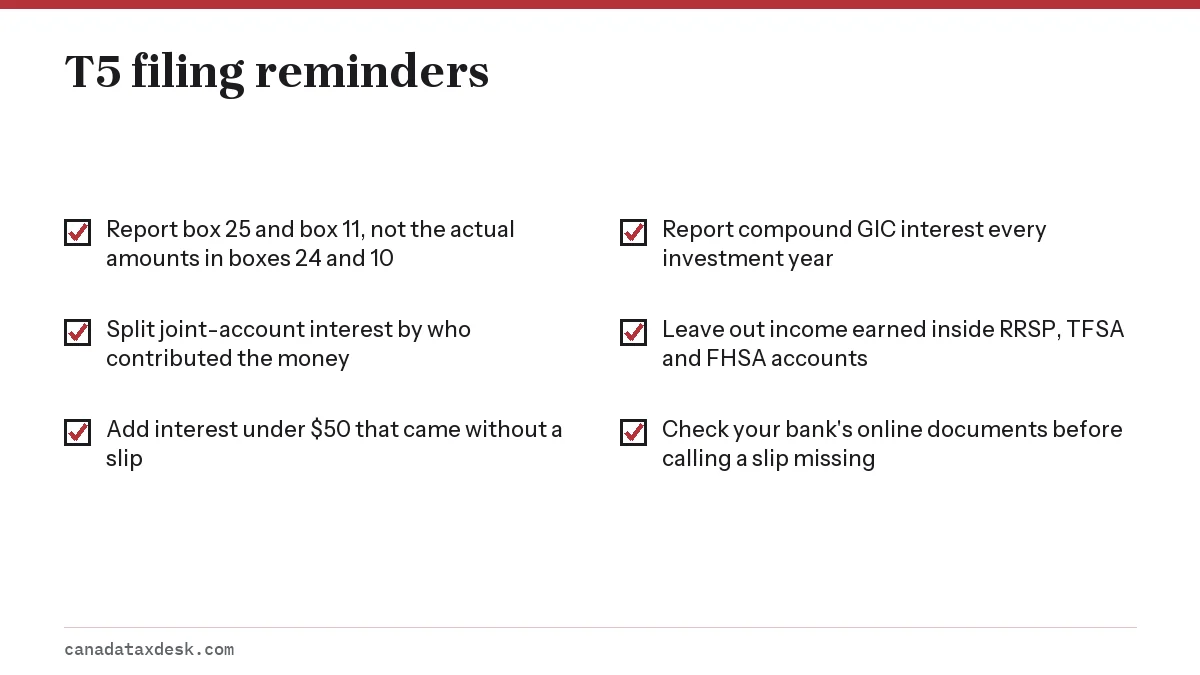
The T5 slip meaning is simple: it is the Statement of Investment Income. A Canadian bank, credit union, broker or corporation issues one when it paid or credited you interest, dividends, royalties or certain other investment income in a non-registered account during the calendar year. Money earned inside an RRSP, TFSA or FHSA does not appear on a T5.
Issuers must get T5 slips to you by the last day of February following the year, so slips for 2026 income arrive by the end of February 2027. The CRA's guidance for issuers allows T5 slips to be made available on a secure online portal, while email delivery needs your written consent, so check your bank's document centre before assuming a slip is missing.
Main T5 slip boxes
Most people only see two or three filled boxes. The table covers the boxes that carry amounts onto the return.
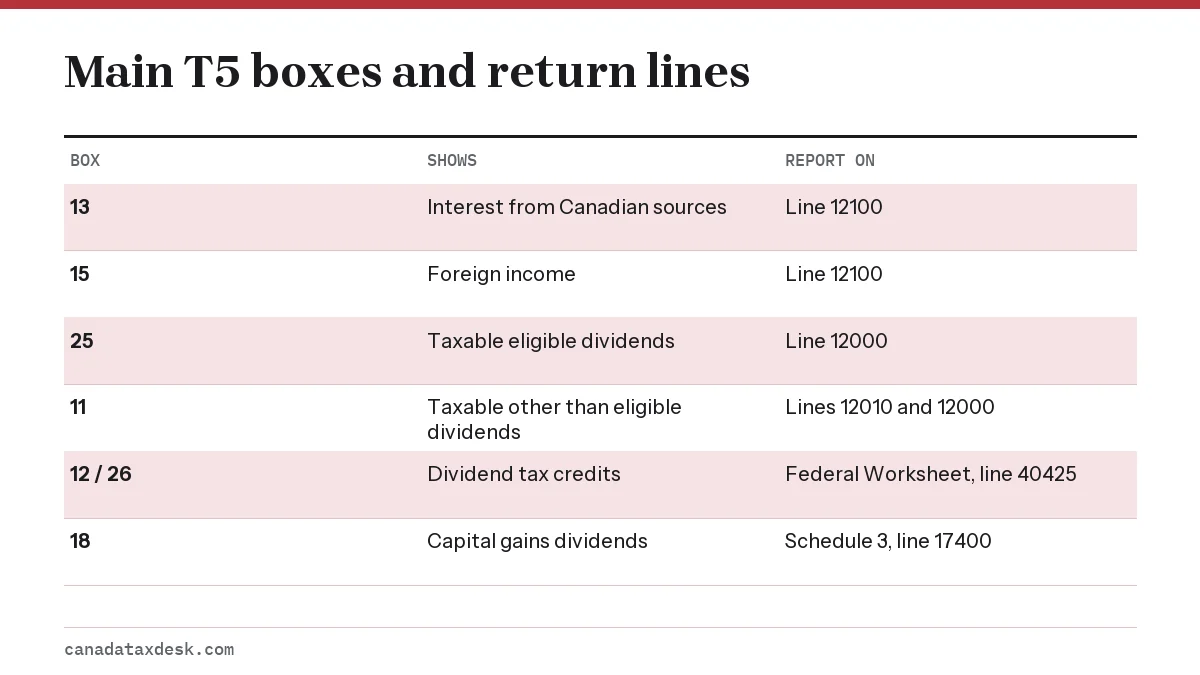
T5 slip box 13: interest from Canadian sources
Box 13 holds interest from bank accounts, GICs, term deposits and bonds. It goes on line 12100 along with box 14 (other income from Canadian sources) and box 15 (foreign income). Example: a $12,000 GIC paying 4% a year credits $480 of interest, and that $480 shows in box 13.
T5 slip box 25: the taxable amount of eligible dividends
Dividends come in two sets of three boxes. Box 24 is the actual eligible dividend you received, box 25 is the grossed-up taxable amount, and box 26 is the dividend tax credit. You report box 25, not box 24, on line 12000. The larger taxable figure looks odd, but the dividend tax credit from box 26 offsets it. Boxes 10, 11 and 12 work the same way for dividends other than eligible dividends: report box 11 on lines 12010 and 12000.
Box 18 capital gains dividends go on Schedule 3 at line 17400, not on line 12000. Box 16 foreign tax paid is used for the foreign tax credit rather than subtracted from income.
| Box | What it shows | Where it goes |
|---|---|---|
| 10 | Actual amount of dividends other than eligible dividends | Not entered as income; report box 11 instead |
| 14 | Other income from Canadian sources | Line 12100 |
| 16 | Foreign tax paid | Foreign tax credit, line 40500 |
| 17 | Royalties from Canadian sources | Line 10400 if from your own work or invention, line 13500 if you have related expenses, otherwise line 12100 |
| 19 | Accrued income: annuities | Line 11500 if you were 65 or older at year-end or received it because of your spouse's or common-law partner's death, otherwise line 12100 |
| 24 | Actual amount of eligible dividends | Not entered as income; report box 25 instead |
| 30 | Equity-linked notes interest | Line 12100 |
Joint accounts: who reports the T5
Banks usually print a joint account's T5 in both names, or in one name, based on how the account is set up. That label does not decide who pays the tax. The CRA says each person reports a share of the interest that matches how much they contributed to the account.
- Work out who put the money in. If one spouse deposited all $20,000, that spouse reports all the interest, even if the slip shows both names.
- If both contributed, split the interest in the same proportion as the deposits, for example 60/40.
- Each person enters only their share on line 12100.
- Keep deposit records so you can explain the split if the CRA sends a review letter.
Interest without a slip
Issuers do not have to send a T5 when your total investment income from them is under $50. The income is still taxable, and the CRA expects it on line 12100. Add up small amounts from your year-end statements, such as $18 on a chequing account and $27 on a savings account.
Compound GICs and other investments that pay out at maturity work differently. You report the interest earned in each full investment year, even though no cash reached you and no slip arrived. A 3-year compound GIC bought in June 2025 means reporting the first year's growth on your 2026 return.
Foreign bank interest also belongs on line 12100, converted to Canadian dollars at the Bank of Canada rate for the day it arose.
Where T5 amounts go on your return
Certified tax software has a T5 entry screen that mirrors the slip. Type each box as printed and the software routes the figures. If you file on paper, use the Federal Worksheet for line 12100 and the table above.
If a T5 is late, request a copy through your CRA account or from the issuer, as described on our missing tax slip page. For other slips arriving in the same season, see the tax slips guide, the T4E slip for EI benefits and the T2202 tuition certificate.
How to file T5 slips and the T5 Summary
If you are the one issuing T5 slips, for example a small corporation that paid dividends to its shareholder, you send the CRA an information return made up of the T5 slips and a T5 Summary that totals them. The CRA's issuer rules set these deadlines and exceptions:
- Give each recipient their T5 by the last day of February after the calendar year; 2026 slips are due by the end of February 2027. If the business or activity ends, the deadline is 30 days after it ends.
- File the slips and the T5 Summary with the CRA by the same date.
- If you file over the Internet, do not also mail paper copies to the CRA.
- You do not need a slip for a recipient whose total for the year is less than $50, and investment income paid to non-residents is not reported on a T5.
- Sending a slip by email needs the recipient's written consent.
Common questions
What is a T5 slip?
It is the Statement of Investment Income. Canadian financial institutions and corporations issue it to report interest, dividends and other investment income paid to you outside registered accounts.
Do I report interest under $50 without a T5?
Yes. The issuer can skip the slip below $50, but the interest is still taxable. Enter it on line 12100 using your account statements.
What is box 13 on a T5?
Box 13 is interest from Canadian sources, such as bank accounts, GICs and bonds. It goes on line 12100 of your return.
Why is T5 box 25 higher than the dividend I received?
Box 25 is the grossed-up taxable amount of eligible dividends. You report it on line 12000 and claim the box 26 dividend tax credit, which offsets the higher figure.
Do I need a T5 for my TFSA interest?
No. Interest and dividends earned inside a TFSA are not taxable and are not reported on a T5 or on your return.
What is box 24 on a T5?
Box 24 is the actual amount of eligible dividends you received. It is not the figure you report: line 12000 takes the grossed-up amount in box 25, and box 26 gives the matching dividend tax credit. Type box 24 into your software as printed, but do not add it to income yourself.
Sources
- T5 Statement of Investment Income: information for individuals canada.ca
- Line 12100: Interest and other investment income canada.ca
- T5 slip (information for issuers) canada.ca
- When do you have to prepare a T5 slip? canada.ca
- Distributing the T5 slips canada.ca
We check figures against these official pages. Rules change; confirm anything that affects a deadline or payment with the agency before you act.
Tell us what happened
Describe your situation and our editors will use it to improve this guide. If you leave your email, we may reply with a pointer to the right page or official contact. We never share your details.
Related guides
 Canadian Tax Slips Explained: T4, T4A, T5 and More
Tax slips in Canada are information returns that employers, payers, banks, schools and governments send to you and to the CRA. Th…
Missing Tax Slip? T4 Slip Download and Other Fixes
If a slip has not arrived, try a T4 slip download from CRA My Account first; every slip the issuer has filed is there. Otherwise,…
T2202 Tuition Slip: How Students Claim Tuition Fees
The T2202, Tuition and Enrolment Certificate, is the slip a designated Canadian college or university issues to show your eligibl…
T4E Slip: Reporting EI Benefits and EI Repayment
The T4E slip is the Statement of Employment Insurance and Other Benefits that Service Canada issues for EI paid to you during the…
T4 Slip Boxes Explained: Box 14, 22, 40, 32, 38 and 85
The T4 slip boxes you actually type into a return are few: box 14 (employment income, line 10100), box 16 or 17 (CPP or QPP, line…