
NETFILE eligibility: the years, returns and claims it accepts
Short answer
NETFILE eligibility depends on three things: the tax year, the type of return and what is on it. In the 2026 season NETFILE accepts original returns for 2018 to 2025. It refuses deceased and bankruptcy returns, deemed residents and a short list of unusual income and claims. If you are excluded, file on paper or ask an EFILE preparer.
- 01Original return years (2026 season)
- 2018 to 2025
- 02Years for the 2027 season
- Not yet announced (2019 to 2026 expected)
- 03Deceased person's return
- Not accepted by NETFILE
- 04Returns for others
- Up to 20 per computer or CRA account per year, with Represent a Client
NETFILE eligibility in one minute
Most residents of Canada with ordinary employment, pension, investment or self-employment income meet NETFILE eligibility. The service is built around a living person, resident in a province or territory, filing an original return for a recent year from certified software. Anything that falls outside that picture, such as a death, a bankruptcy or a return for an older year, is likely to be refused.
Your certified software normally flags an exclusion before you try to transmit. If it does not, and the CRA rejects the file, the reason usually appears in a message during transmission. See NETFILE rejected return for that situation.
NETFILE eligible tax years
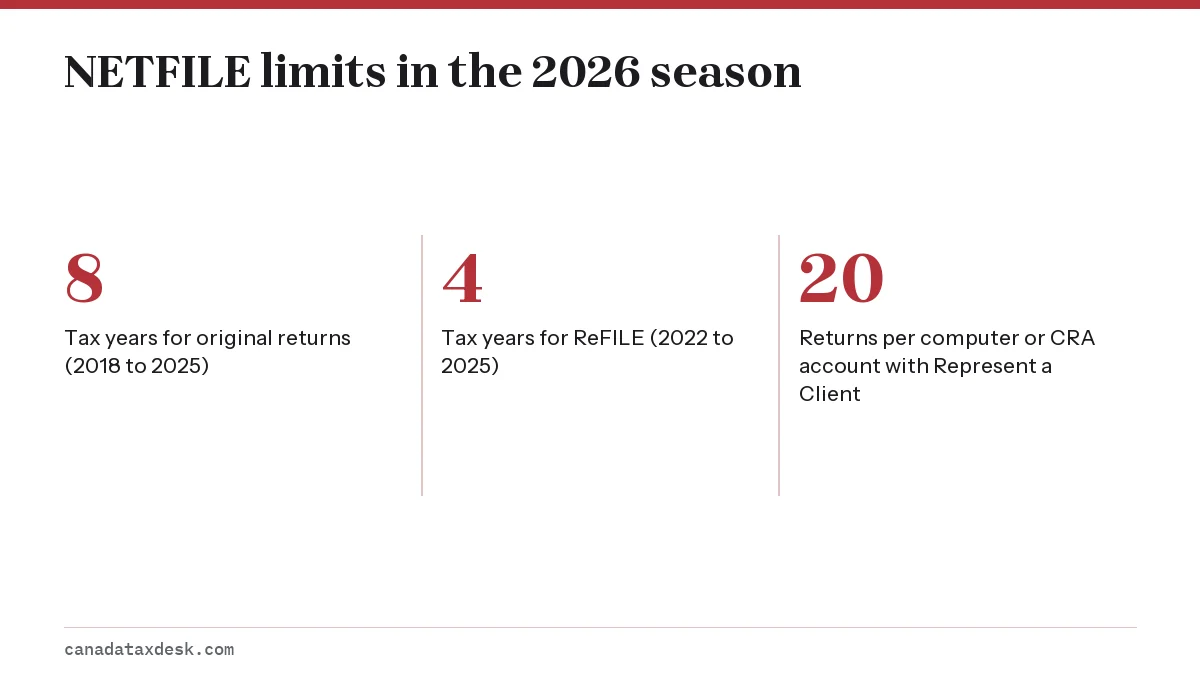
During the 2026 season, which runs from February 23, 2026 until January 29, 2027, NETFILE accepts original returns for tax years 2018, 2019, 2020, 2021, 2022, 2023, 2024 and 2025. That is 8 years. Amended returns go through ReFILE, which covers a shorter span of 4 years.
| Return | 2026 season | 2027 season |
|---|---|---|
| Original return, NETFILE | 2018 to 2025 | Not yet announced; 2019 to 2026 expected |
| Amended return, ReFILE | 2022 to 2025 | Not yet announced; 2023 to 2026 expected |
| Original return before the window | Paper only | Paper only |
The window has shifted one year forward each season. If you still owe a 2018 return, file it before January 29, 2027: once the 2027 season opens, 2018 is expected to fall out of range and would then need a paper return.
Can I use NETFILE for previous years?
Yes, for any year inside the window. You need certified software for that particular year, since products are certified year by year. Many vendors keep prior-year editions available for this reason. Returns for years before the window must be printed and mailed; our late tax return guide explains the penalties that may already apply and how to limit them.
For a year you have already filed, NETFILE is the wrong tool. Sending a second original return does not replace the first. Use ReFILE or Change my return to amend it instead.
Returns NETFILE cannot accept
The CRA's NETFILE page lists several kinds of return that are excluded regardless of the year.
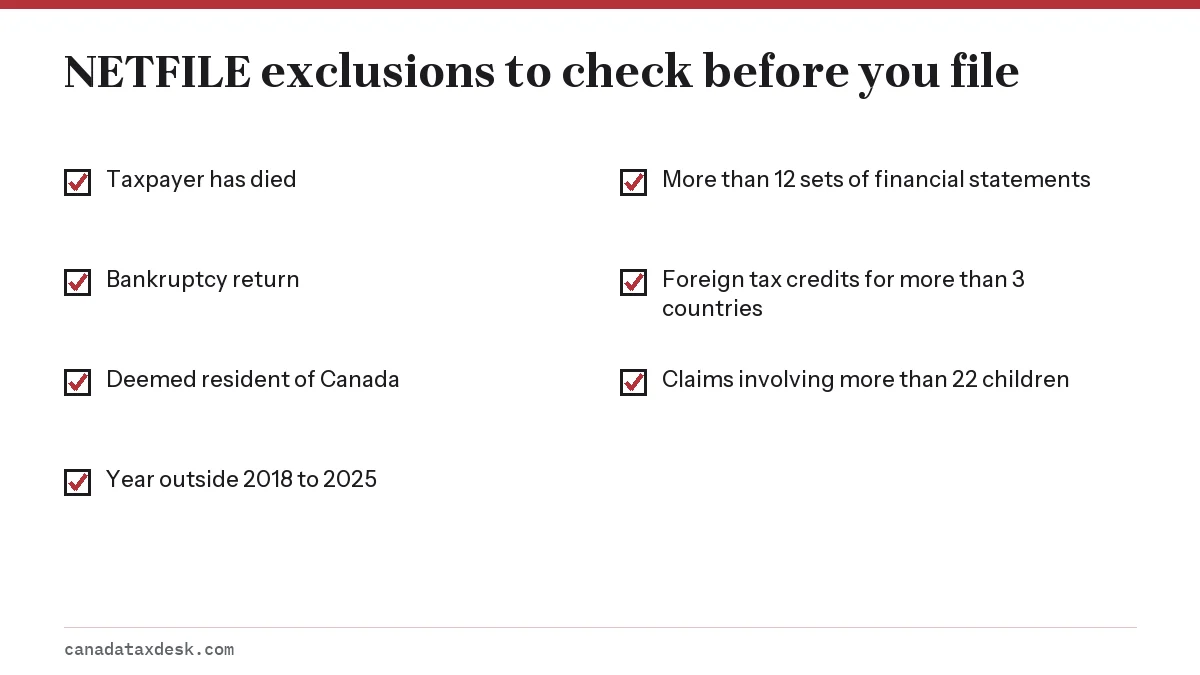
- A return for a deceased person
- A bankruptcy return
- A return for a deemed resident, meaning someone who does not pay provincial or territorial tax
- A return from someone whose social insurance number starts with 0, unless they are a newcomer to Canada
- A return for a year outside the eligible range
Can I NETFILE for a deceased person?
No. NETFILE refuses every return for a deceased taxpayer. The legal representative can mail a paper final return, or hire a preparer registered for CRA EFILE. The EFILE exclusion list only covers taxpayers who died before the current tax year, so a final return for someone who died during the year being filed may still go electronically through a preparer.
How to file a tax return for a non-resident of Canada
Non-residents have few electronic options: the CRA's EFILE exclusions cover non-residents for 2018 to 2025 unless the return is filed under section 116. Most non-residents who must file complete the CRA's income tax package for non-residents and deemed residents and mail it. The CRA asks filers outside Canada to wait 16 weeks before contacting it about a refund.
Income and claims that block NETFILE
A return can also be refused because of what is on it. These exclusions are rare, but if one applies, no certified product can send your return through NETFILE.
- Canadian-source income from Lloyd's of London
- Employment income from a prescribed international organization
- Pension income that accrued before 1972
- Certain RDSP income
- Electing to defer tax on spin-off shares distributed by a foreign corporation
- More than 12 sets of financial statements
- Foreign tax credits for more than 3 countries
- A deduction for scientific research and experimental development expenses
- Claims involving more than 22 children
Three rental properties and two businesses make five statements, well under the limit of 12, so most self-employed filers never reach these limits.
What other NETFILE restrictions apply?
The CRA's NETFILE page lists more exclusions that rarely apply but block the transmission when they do. Certified software checks for them before you send.
| Restriction | What triggers it |
|---|---|
| Foreign tax credit | Claiming less than the maximum federal foreign tax credit, or a federal business or non-business foreign tax credit for more than 3 countries |
| Provincial credits | An Alberta stock savings plan tax credit (Form T89), a Saskatchewan royalty tax rebate (Form T82), a Nova Scotia research and development tax credit recapture, or a Newfoundland and Labrador research and development tax credit (Form T1129) |
| Environmental trust credit | An Ontario, Saskatchewan, British Columbia or Yukon qualifying environmental trust tax credit, also called a mining reclamation trust tax credit |
| RDSP income | RDSP income in field 12500 when you are not eligible for the disability tax credit for yourself for the current tax year and the 2 preceding tax years |
| Foreign pension contributions | A deduction in field 20700 that combines amounts from at least 2 of Forms RC269, RC267 and RC268 |
| Farming with AgriStability or AgriInvest | Partnership farming income on a T5013 slip or from a partnership with a corporate partner, tax-exempt self-employed income reported by a registered Indian under the Indian Act, more than 10 livestock or crop inventory valuation entries, or more than 8 purchased inputs, deferred income or accounts payable entries, on page 7 of Form T1273 |
If one of these applies, the last section of this page shows how to file instead.
Filing for other people
You can prepare and NETFILE returns for family members from one computer. If you are registered for Represent a Client, the CRA lets you file up to 20 returns per computer or CRA account for each tax year. A household of six (two adults, a student and three teens with summer jobs) fits comfortably.
Above that volume, or when you charge a fee, the preparer route applies. Anyone paid to prepare more than 5 T1 returns in a calendar year must file them electronically.
What to do if you are not eligible
- Confirm the reason. Read the message from your software or the CRA; a wrong year or data problem is fixable, a true exclusion is not.
- Check whether a preparer can EFILE it. Some returns NETFILE refuses, such as a current-year final return, are within EFILE.
- Otherwise print and mail it. See our guide to a paper tax return for where to send it and what to attach.
- Keep the deadline. A paper return is still due April 30, 2027 for 2026 income (June 15, 2027 if you are self-employed, with payment still due April 30).
Common questions
Who is not eligible for NETFILE?
Deceased and bankrupt taxpayers, deemed residents, people whose social insurance number starts with 0 unless they are newcomers, and returns for years outside the accepted range. Returns carrying a few rare items, such as Lloyd's of London income or foreign tax credits for more than 3 countries, are also excluded.
Can I NETFILE a 2017 return?
No. In the 2026 season the earliest year NETFILE accepts is 2018, so a 2017 return must be mailed on paper.
Can I NETFILE my first ever tax return?
Yes, if you meet the other rules. A newcomer whose social insurance number starts with 0 is specifically allowed. You simply will not have an access code, because you have never received a notice of assessment.
Can I NETFILE for my parents?
Yes, as long as the returns are otherwise eligible. With Represent a Client registration you can file up to 20 returns per computer or CRA account for each tax year.
Why does my software say my return is not eligible for NETFILE?
It has detected an item on the CRA exclusion list, such as a bankruptcy, a deceased taxpayer or an unsupported year. Review the exclusion list; if one applies, file on paper or through an EFILE preparer.
What are the NETFILE restrictions?
They fall into three groups: the tax year (2018 to 2025 in the current season), the type of return (no deceased, bankruptcy or deemed-resident returns, and a SIN starting with 0 only for newcomers), and what the return reports or claims, from Lloyd's of London income to some provincial credits and AgriStability or AgriInvest farming cases. Certified software checks the list before you send.
Can I NETFILE a 2021 return?
Yes. Until January 29, 2027, NETFILE accepts original returns for 2018 to 2025, so a 2021 return can still be sent with software certified for 2021. To amend a 2021 return that was already assessed, use Change my return or Form T1-ADJ, since ReFILE covers only 2022 to 2025 this season.
Sources
- NETFILE: tax software for filing personal taxes (CRA) canada.ca
- NETFILE and ReFILE eligibility (CRA) canada.ca
- EFILE: file returns and exclusions (CRA) canada.ca
- Income tax package for non-residents and deemed residents (CRA) canada.ca
- Refunds (CRA) canada.ca
- Canada Carbon Rebate for individuals: proposed October 30, 2026 deadline (Canada.ca) canada.ca
We check figures against these official pages. Rules change; confirm anything that affects a deadline or payment with the agency before you act.
Tell us what happened
Describe your situation and our editors will use it to improve this guide. If you leave your email, we may reply with a pointer to the right page or official contact. We never share your details.
Related guides
 NETFILE Canada: How to File Your Tax Return Online
NETFILE Canada is the CRA service that receives a personal T1 return sent straight from certified tax software. For the current s…
Late Tax Return Canada: How to File Overdue Tax Returns
A late tax return in Canada costs you a penalty only if you owe tax for that year; otherwise the main cost is delayed refunds and…
ReFILE CRA: How to Amend Your Return with Tax Software
ReFILE is the CRA service that lets you send changes to an already assessed T1 return straight from certified tax software. In th…
NETFILE Quebec: Filing Your Quebec and Federal Returns
NETFILE Quebec is really two transmissions. A Quebec resident sends a federal T1 to the CRA through NETFILE and a separate provin…
CRA EFILE: Registration, Login and 2027 Renewal
CRA EFILE is the electronic filing service for people and firms who prepare tax returns for others. Preparers apply online, pass…